


C.O.M. Furniture Sourcing: How to Customize Dining Chairs Without High MOQs
- Wolfgang Adler

- 12 minutes ago
- 7 min read
Customizing dining chairs through C.O.M. Furniture Sourcing without high MOQs is achieved by leveraging modular dining chair manufacturing, which pairs standardized, pre-tested metal frames or seat shells with customized upholstery. This decouples textile customization from core structural manufacturing, enabling B2B buyers to achieve custom dining chairs low MOQ while maintaining strict structural consistency and reducing inventory risks.
What is C.O.M. (Customer's Own Material) Sourcing in B2B Furniture?
In European commercial and retail markets, design exclusivity and textile variety are critical for setting brand collections apart. Customer's Own Material furniture, commonly known as C.O.M., allows furniture wholesalers, retail chains, and contract buyers to specify their own fabrics or leathers for upholstered seating instead of relying on a manufacturer's standard options. Under the C.O.M. model, a buyer purchases or supplies high-performance textiles—often sourced from European premium mills—and ships them to the manufacturing facility in China for final assembly.
This custom approach bridges the gap between high-end local interior designs and large-scale industrial manufacturing. For a product manager or purchasing director in Germany or the Netherlands, C.O.M. offers unmatched aesthetic flexibility. However, it requires a manufacturing partner with deep expertise in material handling, precise fabric cutting, and a thorough understanding of textile performance, including abrasion resistance, colour fastness, and breathability. While traditional customization demands massive volume commitments, modern strategic sourcing partners utilize advanced modular designs to enable small-batch flexibility without sacrificing product consistency.
By leveraging this method, B2B buyers can introduce premium upholstery textures, specific corporate brand colours, or localized flame-retardant contract fabrics directly into their product offerings. This helps businesses stand out in highly competitive retail and commercial markets without investing in entirely new product designs from scratch.
Why Do Custom Fabric Dining Chairs Typically Require Such High MOQs?
The standard production line of an upholstered dining chair is designed for high-volume repetition. When a B2B buyer requests custom fabric, it breaks the conventional manufacturing rhythm and creates several operational bottlenecks that traditionally justify high Minimum Order Quantities (MOQs):
Material Waste in Cutting: Fabrics are delivered in rolls. Industrial cutting machines are optimized for nesting patterns across multiple chair components to minimize scrap. Cutting a small batch of 10 or 20 chairs creates significant textile waste and increases the unit cost.
Setup and Tooling Costs: Every structural variation in wooden boards or metal frames requires re-tooling. For instance, setting up automatic welding robotic arms for metal frames or adjusting punching machines for batch punching of wooden boards is only cost-effective when spread over hundreds of units.
Internal Board Production Constraints: Installing four-legged nails on wooden boards with specialized nailing machines requires batch setup. Running separate small setups for custom upholstered chairs increases labor costs exponentially.
Testing and Certification Risks: Under European B2B safety regulations, any change in material composition must still comply with rigorous standards such as the EN12520 strength and durability tests. Testing single custom samples is economically unfeasible for factories if the total order volume is too low.
These operational realities mean that traditional furniture manufacturers must protect their production margins by setting high order thresholds, often forcing buyers to purchase unwanted inventory just to secure a customized look.
How Can Modular Dining Chair Manufacturing Solve the High MOQ Dilemma?
To bypass these traditional limitations, forward-thinking B2B supply chain partners have developed innovative modular systems. An excellent example of this is modular dining chair manufacturing, which decouples fabric customization from frame production.
The principle of modular dining chair manufacturing is highly logical: by standardising the internal structural components (the metal frames, seat shells, and mechanical fasteners) while keeping only the external upholstery customisable, manufacturers can eliminate the need for large-batch fabric runs.
Under this system, the factory maintains a stock of standard, pre-tested seat shells and metal bases. Since these metal frames are welded in high volumes using automatic robotic arms and finished with durable powder coating, their individual cost remains extremely competitive. When a European buyer places an order for custom dining chairs low MOQ, the factory only needs to upholster the pre-manufactured modular shells using the specified C.O.M. fabric.
This approach delivers massive commercial benefits:
Zero Inventory Risk on Frames: Buyers do not have to purchase full-container loads of a single custom chair model to cover frame manufacturing costs.
Easy Container Consolidation: Buyers can mix different upholstered styles (using different fabrics) on the same standardized base frames to easily optimize container loading.
'Test First, Ship Second' Assurance: Because the modular core is standardized, structural testing is completed long before the custom upholstery is applied, ensuring complete reliability.

What Logistics and Supply Chain Challenges Exist in Transcontinental C.O.M. Sourcing?
Implementing Customer's Own Material furniture sourcing requires managing a transcontinental supply chain for fabrics. European buyers must coordinate the transport of premium textiles from European mills to the assembly facility in China. The primary challenges in this workflow include:
Import Tariffs and Customs Clearance: When shipping fabric into China for manufacturing and subsequent re-export, buyers must utilize custom bonded warehouse structures or specific processing trade channels to avoid double taxation.
Lead Time Coordination: The average transit time for ocean freight from Rotterdam to Shenzhen is approximately 35 to 45 days. If the fabric delivery is delayed, it halts the entire dining chair production line. To mitigate this, many purchasing managers coordinate sample development via air courier while shipping the main fabric rolls well in advance.
Material Inspection on Arrival: Unlike standard factory fabrics, European C.O.M. textiles must be inspected immediately upon arrival at the Chinese factory. Professional quality control teams check every incoming roll for batch consistency, dye lot variations, and physical defects before they reach the automated cutting machines.
Furthermore, clear communication regarding fabric yield is essential. Sourcing teams must calculate the exact linear meters required per chair, factoring in fabric direction, pattern matching, and waste margins, to ensure that neither insufficient nor excessive fabric is shipped.
How Do We Maintain Safety, Testing, and Compliance Standards in Custom Production?
Customization must never compromise on compliance, safety, and durability, especially for high-frequency contract use in hotels and restaurants across Germany, Switzerland, or Ireland.
To guarantee this, the fabric itself must meet international safety guidelines. Leading B2B manufacturers ensure that all standard and custom fabrics are OEKO-TEX STANDARD 100 certified. This label guarantees that every thread and component is tested for harmful substances, making the materials formaldehyde-free, human-friendly, and fully aligned with the strict European Green Policy and sustainable development guidelines. In addition, recycled plastic bottle options are available to match European eco-compliance standards.
Furthermore, advanced fabric technologies, like specialized functional fabrics, solve the durability issue. These high-performance textiles utilize molecular-level hydrophobic nano-coatings combined with micro-ventilation channels. This provides:
Waterproof & Stain Resistance: Spills sit on the surface instead of absorbing, which is critical for dining rooms and busy hospitality projects.
Abrasion Resistance & Breathability: The fabric remains highly breathable and resists scratches, making it pet-friendly and extremely durable without losing its soft, premium touch.
Simultaneously, the manufacturing facility itself must adhere to global ethical standards. B2B buyers should choose partners with factories certified under the BSCI (Business Social Compliance Initiative). A BSCI-certified factory prioritizes worker safety, providing protective overalls, metal cut-resistant gloves for fabric cutters, and gas masks for workers handling formaldehyde-free, eco-friendly glues.

What Sourcing Checklist and Strategy Should Sourcing Managers Use for Low-MOQ Customisation?
To ensure a successful partnership and minimize international purchasing friction, B2B buyers can follow this practical evaluation matrix when selecting a Chinese manufacturing partner for C.O.M. projects:
Sourcing Dimension | Traditional Customization | Modular C.O.M. Sourcing | Buyer\'s Action / Verification |
|---|---|---|---|
:--- | :--- | :--- | :--- |
Minimum Order Quantity | Typically 100-200 units per fabric/colour | 20-50 units per fabric (using standard frames) | Check if the supplier offers modular seat shell and base combinations. |
Lead Time | 60-70 days (due to custom frame development) | 30-45 days (utilizing pre-manufactured bases) | Confirm raw frame inventory levels and standard frame lead times. |
Material Safety | Unverified local fabrics, potential chemical residues | OEKO-TEX Standard 100 certified, formaldehyde-free | Request valid OEKO-TEX test certificates from the factory. |
Production Technology | Manual fabric cutting, inconsistent manual welding | Automated cutting, robotic welding arms, automated board punching | Ask for a video walkthrough of the automated machinery and QC line. |
Structural Testing | Separate batch testing required for each design | Standardized core frames pre-certified to EN12520 standards | Request EN12520 mechanical durability test reports for the core frame. |
Logistics Risk | High packaging volume, higher risk of damage | Knock-Down (KD) structures, optimized flat packaging | Verify container loading optimization and structural stability of packaging. |
Using Knock-Down (KD) structures is particularly valuable. Flat packaging significantly reduces the shipping volume (CBM) of dining chairs, allowing more units to fit into a single container. This protects the products during long transit and lowers overall shipping costs per chair, which directly enhances retail margins.
How Can ASKT Support Wholesalers and Retailers with Low-MOQ Custom Dining Chairs?
As an established B2B supply chain partner with over 20 years of manufacturing experience, ASKT focuses on solving the real procurement challenges of European buyers. Operating with a deep understanding of European dining trends, ASKT bridges the gap between massive manufacturing efficiency and boutique customization.
ASKT’s design philosophy is grounded in reality. The engineering team focuses on ergonomic comfort and structural longevity, ensuring that every chair fits seamlessly into modern European homes and commercial projects. From swivel mechanisms with auto-return functions to integrated pocket spring seating, ASKT combines functional performance with elegant aesthetics.
To simplify the complex transcontinental communication process, ASKT utilizes advanced digital integration and structured design parameters. This ensures category managers can easily clarify technical specifications (such as seat height, backrest angles, swivel mechanisms, auto-return functions, pocket spring integration, or fabric finishes) before production begins. This eliminates transnational communication gaps, reduces sampling cycles, and ensures complete manufacturing consistency from the very first run.
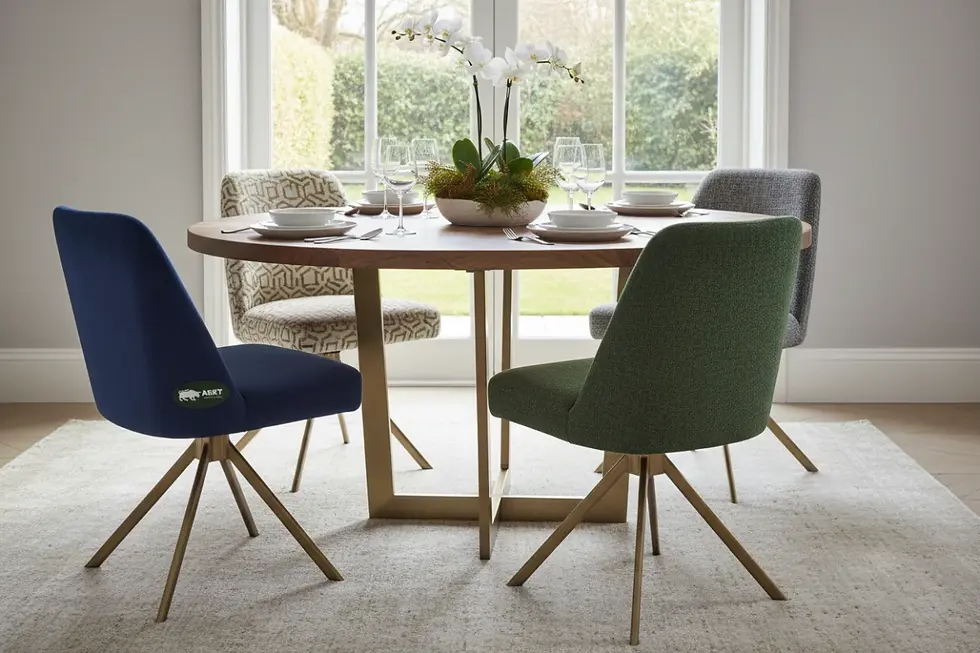
Whether you are evaluating dining chair or dining table suppliers for the European market, ASKT can support you with product development, quality testing, and stable export experience. For European wholesalers, retailers and project buyers looking for reliable dining furniture supply from China, ASKT can help turn product ideas into commercially stable collections through professional B2B furniture customization.
FAQ
What is the typical MOQ for C.O.M. dining chairs using a modular manufacturing system?
By utilizing a modular manufacturing system, the minimum order quantity (MOQ) can be reduced to as low as 20 to 50 units per fabric color, provided that standard, pre-stocked frame bases and seat shells are used.
How can buyers avoid double taxation when shipping European fabrics to China?
Buyers can utilize specific processing trade arrangements or customs bonded warehouses in China. Under these structures, imported fabrics are classified as raw materials for re-export, exempting them from standard domestic import tariffs.
How are custom dining chairs tested to ensure safety and structural durability?
The underlying modular metal frames are pre-tested and certified to meet the European EN12520 structural integrity and safety standard. This guarantees strength and durability regardless of the custom upholstery fabric applied.
What is the primary benefit of Knock-Down (KD) structures for custom dining chairs?
KD structures allow chairs to be flat-packed, which significantly reduces the packaging volume (CBM). This optimization maximizes container loading efficiency, lowers ocean freight costs per unit, and reduces the risk of transit damage.


Comments