


Intermediaries Catch: Why OEM Furniture Manufacturing Protects Design Integrity & Quality Control
- Media ASKT

- 6 days ago
- 6 min read

Introduction
For furniture brands, wholesalers, and retailers, one of the biggest sourcing risks isn't always poor craftsmanship or delayed deliveries. More often, it's the loss of design integrity and inconsistent quality caused by too many intermediaries between the buyer and the factory.
When a project passes through multiple trading companies, sourcing agents, or subcontractors, important details can easily be lost. Product specifications change, materials are substituted without clear communication, and quality standards become inconsistent from one production batch to another.
This is why many experienced European furniture buyers increasingly prefer working directly with an OEM (Original Equipment Manufacturer) furniture manufacturer. OEM manufacturing offers greater control over product development, quality assurance, intellectual property protection, and long-term supply stability.
Having worked with European furniture buyers for many years, I've learned that successful sourcing is rarely about finding the lowest quotation. It's about protecting the original product concept from the first technical drawing to the final container shipment. Every additional middleman introduces another opportunity for misunderstandings, compromises, or unexpected costs.
This article explains how OEM furniture manufacturing protects both design integrity and quality control, why intermediary-heavy supply chains create hidden risks, and what professional buyers should evaluate before selecting a manufacturing partner.
What Is OEM Furniture Manufacturing?
OEM furniture manufacturing refers to a production model where a factory manufactures products according to the buyer's own design, specifications, branding, and technical requirements.
Unlike standard catalogue purchasing, OEM manufacturing allows buyers to control:
Product dimensions
Materials
Upholstery fabrics
Metal or wooden frame construction
Surface finishes
Packaging design
Quality standards
Branding and labelling
The manufacturer becomes a production partner rather than simply a product supplier.
For furniture retailers and wholesalers building differentiated collections, OEM manufacturing helps create products that competitors cannot easily duplicate.
Why Too Many Intermediaries Increase Sourcing Risks
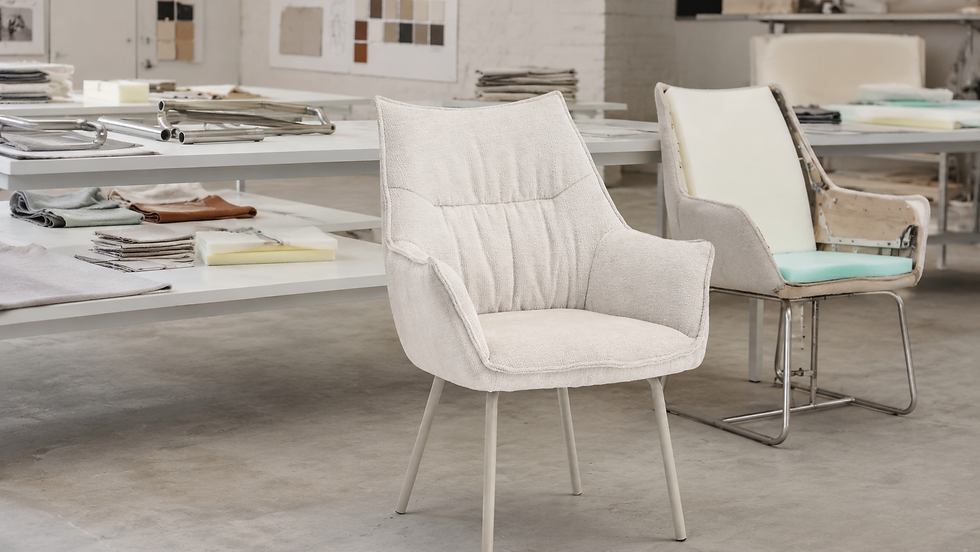
Every intermediary creates another communication layer between the buyer and the production floor.
Imagine explaining a custom dining chair design. The buyer communicates with a sourcing company. The sourcing company talks to a trading company. The trading company contacts another supplier, who finally reaches the factory.
By the time the production team receives the instructions, critical information may already have changed.
Typical problems include:
Fabric substitutions
Incorrect foam density
Modified frame construction
Packaging differences
Colour inconsistencies
Missing design details
Delayed engineering feedback
None of these issues are necessarily intentional. They are often the natural result of fragmented communication.
The longer the communication chain becomes, the more difficult it is to identify who is responsible when problems occur.
Design Integrity Depends on Direct Manufacturing Communication
Design integrity means that the finished furniture accurately reflects the original design intent.
For modern dining furniture, this includes much more than appearance.
Design integrity also covers:
Material Selection
A dining chair may look identical while using entirely different internal materials.
For example:
Lower-density foam may reduce seating comfort.
A thinner steel tube may reduce structural strength.
Different plywood grades may affect durability.
Alternative fabrics may wear more quickly.
Without direct communication between buyer and manufacturer, these substitutions can happen unintentionally.
Engineering Details
Experienced OEM manufacturers review product designs before production.
They evaluate:
Structural stability
Weight distribution
Welding locations
Screw positioning
Assembly efficiency
Packaging protection
These engineering improvements help preserve the original design while improving manufacturability.
Prototype Verification
Professional OEM projects normally include prototype development before mass production.
This allows buyers to verify:
Comfort
Dimensions
Appearance
Colour accuracy
Material performance
Assembly methods
Early verification reduces expensive production mistakes later.
Why Quality Control Is Stronger in OEM Manufacturing

Quality control is not simply the final inspection before shipment.
Effective quality management begins long before production starts.
A professional OEM manufacturer typically controls quality through every production stage.
Raw Material Inspection
Quality begins with incoming materials.
Manufacturers inspect:
Steel tubes
Fabric batches
Foam density
Wood panels
Hardware
Powder coating materials
Detecting problems early prevents defects from entering production.
Production Process Control
Quality inspections continue during manufacturing.
Typical inspection points include:
Frame welding accuracy
Surface finishing
Upholstery workmanship
Stitching consistency
Component fitting
Dimensional accuracy
Instead of discovering problems at the end, factories identify and correct them during production.
Final Product Inspection
Finished products are usually checked for:
Stability
Functionality
Cosmetic appearance
Packaging condition
Quantity accuracy
Shipping readiness
This systematic process creates more consistent production batches over time.
OEM vs Intermediary-Based Sourcing
Factor | OEM Manufacturer | Multiple Intermediaries |
Design communication | Direct with factory | Multiple communication layers |
Engineering feedback | Immediate | Often delayed |
Quality control | Factory-controlled | Varies between suppliers |
Design confidentiality | Easier to manage | Higher exposure risk |
Product consistency | Higher | More variable |
Technical problem solving | Faster | Slower |
Production transparency | Greater | Limited |
Long-term product improvement | Continuous | Less coordinated |
Protecting Intellectual Property During Furniture Manufacturing
For many furniture brands, protecting original designs is as important as controlling production quality.
When several intermediaries participate in a project, more companies gain access to:
CAD drawings
Product specifications
Material lists
Packaging artwork
Cost structures
Supplier information
Every additional participant increases the possibility of design leakage.
Professional OEM manufacturers typically establish clearer development workflows, making it easier to manage confidentiality agreements and project ownership throughout the manufacturing process.
While no manufacturing model completely eliminates intellectual property risk, reducing unnecessary communication channels helps maintain stronger design protection.
Consistent Quality Requires Long-Term Manufacturing Relationships

Furniture manufacturing is rarely perfect during the first production run.
Successful OEM partnerships improve over time.
Each production cycle provides opportunities to refine:
Packaging efficiency
Production methods
Material selection
Assembly instructions
Quality checkpoints
Cost optimisation
I often compare OEM manufacturing to building a skilled project team rather than placing a one-time purchase order. The longer both sides work together, the better they understand each other's expectations, and the fewer surprises occur.
That continuity is difficult to achieve when suppliers change frequently or when several intermediaries separate buyers from the factory.
Questions Buyers Should Ask Before Choosing an OEM Manufacturer
Before selecting a manufacturing partner, buyers should evaluate more than pricing.
Useful questions include:
Does the factory manufacture products directly?
Can engineers discuss technical drawings with buyers?
How are material changes approved?
What quality inspections occur during production?
How are prototypes managed?
How are customer designs protected?
Can production processes be explained transparently?
How are quality issues traced and corrected?
The answers often reveal far more than a quotation sheet.
How ASKT Supports OEM Furniture Manufacturing
For European furniture buyers, selecting an OEM partner is about reducing uncertainty as much as reducing cost.
ASKT has focused on manufacturing dining chairs and dining tables for the European B2B market, supporting wholesalers, retailers, and contract furniture buyers with customised product development, structured quality control, and transparent production processes. The company also invests in automated production equipment, systematic quality inspections, sustainable packaging solutions, and material testing to improve product consistency and manufacturing efficiency. Its upholstery fabrics are tested for abrasion resistance, colour fastness, breathability, and include OEKO-TEX® STANDARD 100 certified options, while manufacturing processes incorporate automated cutting, robotic welding, and worker safety systems to support stable production quality.
Rather than relying on multiple sourcing layers, ASKT works directly with customers during product development, helping maintain design accuracy from prototype approval through mass production. This direct collaboration supports clearer communication, better engineering feedback, and greater consistency across production batches. ASKT's long-term focus on the European market, including Germany and the wider DACH region, has also led to investments in market research, design exclusivity, and transparent sourcing practices that strengthen relationships with professional furniture buyers.
FAQ
What is the main advantage of OEM furniture manufacturing?
OEM manufacturing gives buyers direct control over product specifications, manufacturing quality, and product development while reducing communication errors.
Does OEM manufacturing always cost less?
Not necessarily. The primary benefit is greater consistency, quality control, and design protection rather than simply achieving the lowest purchase price.
Why do intermediaries sometimes create quality problems?
Each intermediary introduces another communication layer. Technical details can be misunderstood, delayed, or unintentionally modified before reaching the factory.
How does OEM manufacturing protect original furniture designs?
Direct cooperation with manufacturers limits unnecessary information sharing, improves confidentiality management, and reduces opportunities for design leakage.
Is OEM manufacturing suitable for small furniture brands?
Yes. Many OEM manufacturers support customised projects for growing brands, provided production volumes meet agreed minimum order quantities.
What should buyers inspect during OEM production?
Professional buyers should review prototype approval, raw material quality, production inspections, packaging standards, and final product consistency before shipment.
Conclusion

OEM furniture manufacturing is not simply a production model—it is a strategy for protecting product quality, preserving original designs, and building reliable supply chains.
While intermediaries can provide value in certain sourcing situations, excessive communication layers often increase the risk of misunderstandings, inconsistent production, and weaker quality control. Direct collaboration with an experienced OEM manufacturer enables buyers to maintain closer oversight of engineering decisions, material selection, quality assurance, and intellectual property throughout the manufacturing process.
For furniture brands aiming to develop distinctive collections and establish long-term sourcing stability, choosing the right OEM partner is often one of the most important decisions they can make.
If you are evaluating dining chair or dining table manufacturers for the European market, ASKT can support your OEM projects with product development, quality-focused manufacturing, customisation, and extensive export experience serving professional B2B furniture buyers.


Comments