


What Are No-Sag Springs? The Secret Behind Durable Dining Chairs

No-sag springs, also known as serpentine or zig-zag springs, are heavy-duty, S-shaped tempered steel wires stretched across a dining chair frame. They provide a resilient, long-lasting foundation that prevents upholstered dining chairs from sinking over time, ensuring compliance with commercial durability standards and maintaining structural integrity under high-frequency use.
What Are No-Sag Springs in Upholstered Dining Chairs?
In the B2B furniture market, particularly when sourcing contemporary indoor furniture for demanding European commercial and retail spaces, the underlying construction of a chair is far more critical than its surface aesthetics. Among the various internal support systems available today, no-sag springs—alternatively referred to as serpentine, zig-zag, or sinusoidal springs—are considered the industry standard for premium, durable seating. But what exactly are they, and how do they function within upholstered dining chairs?
No-sag springs are manufactured from high-carbon, heavy-gauge steel wires that are bent into a continuous series of S-shaped curves. When integrated into a dining chair’s seat frame, these springs are stretched horizontally or vertically across the open chassis. They are anchored firmly at each end using specialized heavy-duty metal clips, anchor plates, or brackets. The distinctive S-pattern allows the steel to compress vertically when weight is applied and immediately spring back to its original shape once the pressure is released.
For a professional dining chair manufacturer, the performance and longevity of these springs depend on three critical physical and metallurgical characteristics:
Wire Gauge (Thickness): The thickness of the steel wire is measured in gauges, typically ranging from 8 to 11 gauge for seating applications. A lower gauge number indicates a thicker, stiffer wire. For example, 9-gauge steel provides an incredibly robust, firm support base that is ideal for heavy-use commercial furniture, while an 11-gauge wire offers slightly more flexibility and a softer feel.
Loop Density and Pitch: The height and spacing of the S-curves (known as the pitch) dictate how dense the spring network is. Tighter loops and closer spacing increase the overall load-bearing surface area. This prevents the high-density polyurethane cushioning foam from pocketing or slipping between the metal gaps, which would otherwise lead to localized depressions and uneven seat wear over time.
The Tempering Process: After the carbon steel wire is bent into its serpentine shape, it must undergo a specialized thermal tempering process. Heat-treating the steel relieves the internal mechanical stresses induced during the bending phase. This process locks in the "elastic memory" of the metal, ensuring that the springs can survive hundreds of thousands of compression cycles without sagging, warping, or snapping.
By creating an arched, pre-tensioned barrier over the seat frame, no-sag springs serve as the fundamental structural deck. This deck not only supports the cushioning layer but also acts as the primary shock absorber for the entire chair, transforming a simple piece of furniture into an engineered, high-performance product.

Why Does Seat Base Construction Matter for EN12520 Durability Standards?
For European furniture wholesalers, retail chains, and contract buyers operating in highly competitive and regulated markets like Germany, the United Kingdom, and the Netherlands, compliance with safety and performance standards is an absolute commercial necessity. The benchmark standard governing the strength, durability, and safety of domestic and light commercial seating is EN12520. Sourcing chairs that fail to meet these parameters exposes an importer to severe financial risks, high return rates, and damage to their brand reputation.
To pass an official EN12520 evaluation, a chair must undergo a rigorous, mechanical dining chair load bearing test. Inside a certified testing laboratory, automated pneumatic actuators subject the seat base and backrest to thousands of repetitive force cycles. A standard durability test typically applies a downward force of up to 110 kg (or more, depending on the specific contract grade) directly onto the center of the seat cushion for 25,000 to over 100,000 cycles.
If a dining chair's inner seat construction is poorly engineered—for example, relying solely on cheap, low-tension elastic webbing or thin plywood panels—it will inevitably fail this test. Under continuous cyclic loading:
Elastic Webbing: Will stretch permanently, lose its tension, and cause the seat to sag to the point where the user can feel the hard frame underneath.
Solid Plywood Boards: While initially rigid, plywood offers zero mechanical shock absorption. The kinetic energy from sitting is transferred entirely to the foam padding (which degrades and flattens rapidly) and the frame joints. This localized stress leads to joint failure, cracking wood, or loose screws.
No-Sag Springs: Act as a dynamic suspension system. Made from high-carbon tempered steel, they absorb the downward impact energy and distribute it evenly across the entire frame. This minimizes localized stress on critical joints like dowels, corner blocks, and fasteners, allowing the overall structure to easily withstand the repetitive forces of the dining chair load bearing test.
Let us look at a direct comparison of common seat base construction methods to understand how they stack up against B2B durability requirements:
Performance Metric | No-Sag Spring Base | Elastic Webbing Base | Pocket Spring Base | Solid Plywood Base |
|---|---|---|---|---|
:--- | :--- | :--- | :--- | :--- |
Primary Material | High-carbon tempered steel | Polypropylene & rubber fibers | Individually pocketed steel coils | Engineered multi-ply hardwood |
Durability & Fatigue Life | Extremely High (5–10+ years) | Low to Moderate (1–3 years) | High (5–8 years) | High structure (but damages foam) |
Load Distribution | Outstanding (even distribution) | Moderate (stretches under point load) | Exceptional (point-by-point conformity) | Poor (zero flexibility, high joint stress) |
Seat Profile Depth | Slim to Medium (perfect for KD design) | Slim (but prone to rapid deformation) | Deep/Thick (bulky aesthetic) | Slim (but extremely firm/uncomfortable) |
EN12520 Compliance | Excellent (ideal for commercial use) | Difficult for high-use contract environments | High (requires strong surrounding frame) | Moderate (frame joints fail under cyclic shock) |
Recommended B2B Use | Premium domestic & heavy contract chairs | Promotional, low-cost residential chairs | High-end residential & lounge dining | Low-cost, basic institutional seating |
Understanding these trade-offs allows professional buyers to select the appropriate seating construction based on their target market's specific budget, aesthetic requirements, and performance expectations.
How Do No-Sag Springs Compare to Pocket Spring Seating Comfort in Commercial Furniture Sourcing?
When designing or sourcing a new product line, product managers often find themselves weighing different comfort technologies. Two of the most prominent premium suspension systems in modern upholstered dining chairs are no-sag springs and pocket spring seating comfort. While both offer a superior experience compared to simple foam-on-board construction, they serve different design aesthetics, comfort preferences, and cost structures.
No-sag springs provide a cohesive, buoyant, and slightly firmer support system. Because the S-shaped wires span horizontally across the frame, they create a uniform, unified platform. When a user sits down, the entire spring deck deflects slightly, providing excellent support that keeps the body in an ergonomically correct, upright posture. This upright, stable support is highly desirable for dining chairs, where individuals spend extended periods eating, writing, or conversing around a dining table.
Furthermore, from an engineering and logistics perspective, no-sag springs are highly efficient. Because they are mounted flat across the top of the frame, they require very little vertical depth. This thin-profile capability allows a dining chair manufacturer to design sleek, minimalist, contemporary European-style chairs. Crucially, a slimmer seat profile makes it much easier to engineer Knock-Down (KD) structures. Flat-packing KD chairs greatly optimizes container loading, significantly lowering shipping costs per unit and maximizing warehouse space utilization for wholesalers and e-commerce retailers.
On the other hand, pocket spring seating comfort relies on dozens of small, individual coil springs, each encased in its own non-woven fabric pocket. Because these coils compress independently of one another, they offer unparalleled contouring and localized pressure relief, closely mimicking the luxurious feel of a high-end mattress. However, pocket spring systems have distinct B2B trade-offs:
Thicker Profiles: To accommodate vertical pocket coils, the seat cushion must be significantly thicker, often resulting in a bulkier, heavier aesthetic that may not suit minimalist contemporary designs.
Manufacturing Cost: Pocket spring units are more complex and labor-intensive to manufacture, assemble, and integrate, which elevates the wholesale cost.
KD Limitations: Due to the physical bulk of vertical coils, flat-packing and shipping optimization are more challenging compared to flat no-sag spring designs.
For B2B buyers, a highly effective strategy is to align the suspension system with the target demographic. For high-volume contract projects, offices, and restaurants, the longevity, slim profile, and structural integrity of no-sag springs make them the optimal choice. For luxury, premium residential dining collections where long-lasting, deep comfort is the primary selling point, pocket spring seating comfort can justify its premium price tag. In some advanced designs, a hybrid approach is used—positioning a thin layer of pocket springs over a heavy-duty no-sag spring foundation—to capture the benefits of both durability and contouring comfort.

What Are the Key Quality Control Steps a Dining Chair Manufacturer Performs for Spring Assembly?
Sourcing premium upholstered dining chairs from a manufacturer in China requires a deep understanding of their quality control (QC) and assembly procedures. The theoretical benefits of no-sag springs will quickly disappear if the installation on the assembly line is done poorly. A reliable dining chair manufacturer must implement rigorous quality assurance checks at every stage of the manufacturing process to eliminate sourcing risks and guarantee structural consistency.
For wooden-framed chairs, the attachment of the spring anchor clips to the wood rails is a common point of failure. In lower-end factories, workers might manually staple these clips using standard pneumatic hand staplers. Under the intense, repetitive tension of daily use, those basic staples can slowly pull out of the wood, causing the entire spring system to collapse. To prevent this, professional manufacturers utilize specialized pneumatic machinery to install heavy-duty four-legged nails into the wooden frame. These multi-pronged metal fasteners bite deep into the timber with immense mechanical grip, ensuring that the anchor clips holding the no-sag springs remain permanently and securely locked in place, even under high-load conditions.
For metal-framed upholstered dining chairs, welding precision is the ultimate determinant of structural safety. Manual arc welding is highly prone to human error, which can lead to weak weld penetration, inconsistent joints, and structural cracking during the dining chair load bearing test. To mitigate these risks, advanced manufacturing facilities have transitioned to automated welding robotic arms. Robotic welding ensures:
Invariable Consistency: Every single weld joint is executed with the exact same angle, depth, and temperature.
Zero Slag Inclusion: Perfect structural integrity at every connection point between the spring mounting bar and the main frame chassis.
High Throughput: Flawless replication across large-scale production runs, ensuring that the 1,000th chair off the assembly line is just as strong as the first.
Beyond structural assembly, a manufacturer's commitment to social compliance and worker safety is a major indicator of their operational quality. Leading B2B factories that strictly follow Business Social Compliance Initiative (BSCI) guidelines provide clean, safe environments for their workers. This includes supplying cut-resistant metal gloves for workers handling fabric cutting, protective overalls, and professional ventilation/gas masks in the adhesive spraying cabins.
Furthermore, complying with strict European chemical safety standards (such as REACH) is critical. High-quality manufacturers exclusively use certified eco-friendly, formaldehyde-free glues and high-resilience foam to protect the health of the workers on the line and ensure the final products meet the emission standards expected by European consumers.
How Can European Furniture Importers Evaluate Dining Chair Suppliers for Structural Reliability?
Building a stable, resilient B2B supply chain for contemporary indoor furniture requires more than just finding a supplier with the lowest FOB price. European wholesalers, retail chains, and e-commerce brands need a manufacturing partner who understands compliance, logistics optimization, and long-term product consistency. When evaluating potential dining chair suppliers, purchasing managers should look for specific industrial capabilities that reduce sourcing risks and improve commercial margins.
A vital factor to assess is the supplier's commitment to independent quality testing and material certification. A world-class supplier should maintain an in-house testing laboratory equipped with specialized machines, including:
Cyclic Seat/Backrest Durability Testers: To continuously run the dining chair load bearing test in-house before sending final designs to external certification bodies (such as TÜV or SGS).
Fabric Abrasion Testers: Running Martindale friction tests to verify that the upholstered fabrics meet high durability standards (e.g., 30,000+ rubs for residential use, 50,000+ rubs for commercial use).
Packaging Drop Testers: To ensure that the export packaging can protect the product during long-distance shipping and final-mile courier delivery.
Furthermore, professional buyers must look for smart product engineering solutions that optimize inventory management and reduce freight costs. A prime example is the KINEXA modular system developed by ASKT. This system is engineered specifically to address common B2B challenges such as high Minimum Order Quantities (MOQs), complex container loading, and inventory risks. By standardizing a set of highly durable metal and wooden bases and combining them with various upholstered seat shells, the KINEXA system allows buyers to mix and match styles within a single shipping container. This approach drastically lowers the warehousing footprint, reduces financial risks, and provides European retail chains with the agility to respond quickly to changing market trends.
Additionally, the supplier’s approach to packaging is a strong indicator of their supply chain maturity. Traditional packaging often relies on massive amounts of single-use plastics and bulky styrofoam blocks, which are difficult to recycle and increase shipping volume. Advanced suppliers prioritize sustainable packaging solutions. By using optimized flat-pack designs (KD structures) wrapped in thick cardboard and protected with high-density, recyclable honeycomb paper, they achieve two goals simultaneously:
Lower Shipping Costs: Maximizing the density of the container loading so that more chairs fit into a single 40ft HQ container, reducing the per-unit freight cost.
ESG Compliance: Supporting European importers in meeting their corporate social responsibility and environmental, social, and governance (ESG) targets by reducing plastic waste.
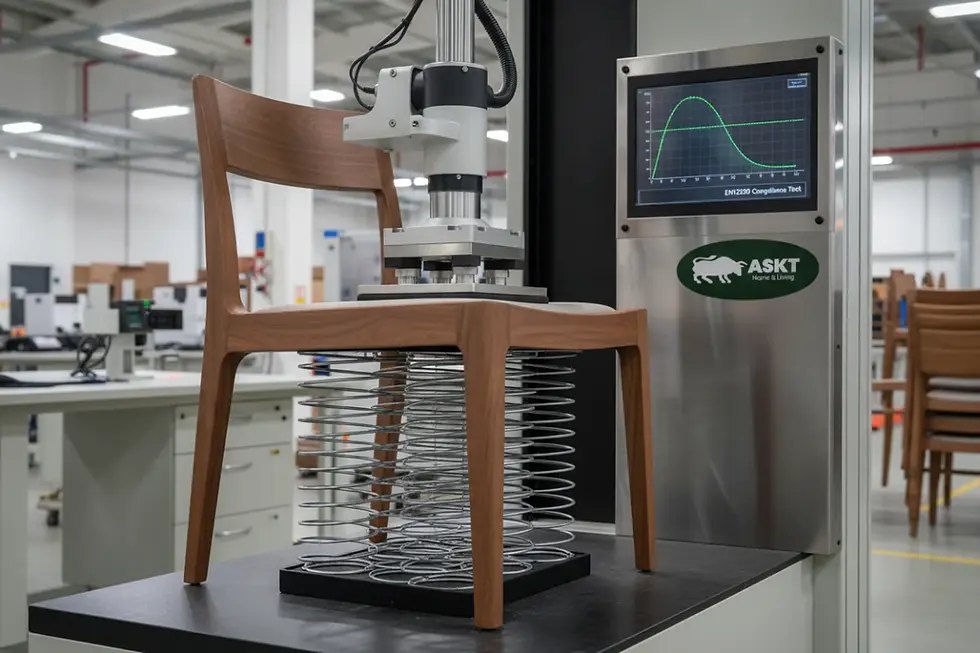
Sourcing upholstered dining chairs equipped with high-carbon tempered no-sag springs is a strategic decision that directly translates to fewer customer complaints, zero structural failures, and elevated brand reputation. By understanding the underlying engineering—from pneumatic four-legged nail fastening to rigorous cyclic load-bearing tests—B2B buyers can confidently navigate the supply chain and select products built for long-term commercial success.
If you are evaluating dining chair or dining table suppliers for the European market, ASKT can support you with product development, customization, quality testing and stable export experience. To discuss your sourcing requirements or to request a sample, connect with our team today at ASKT B2B Dining Furniture Sourcing and Customisation.
FAQ
What is the lifespan of no-sag springs compared to standard elastic webbing?
No-sag springs made from high-carbon tempered steel typically last between 5 to 10+ years in commercial environments without losing their shape or support. Standard elastic webbing, while comfortable initially, tends to stretch permanently and sag within 1 to 3 years of high-frequency use, leading to premature product replacement.
How does seat base construction affect the shipping volume and container loading of dining chairs?
Chairs utilizing no-sag springs can be designed with a much flatter, sleeker seat profile compared to bulky pocket spring systems. This thin-profile design makes it far easier to engineer Knock-Down (KD) structures, allowing the chairs to be packed tightly in flat cartons. This optimization significantly increases the number of units that can fit in a shipping container, dramatically lowering B2B shipping costs.
Do no-sag springs squeak over time, and how can a manufacturer prevent this?
Squeaking occurs when metal springs rub directly against the wood frame or metal clips. Professional manufacturers prevent this by lining the metal anchor clips with a specialized plastic or nylon sleeve. This friction-reducing barrier ensures silent, smooth operation throughout the lifetime of the dining chair.


Comments