


Why Expanding Dining Chair Product Assortment Won’t Fix Declining Store Traffic?
- Media ASKT

- Apr 30
- 4 min read
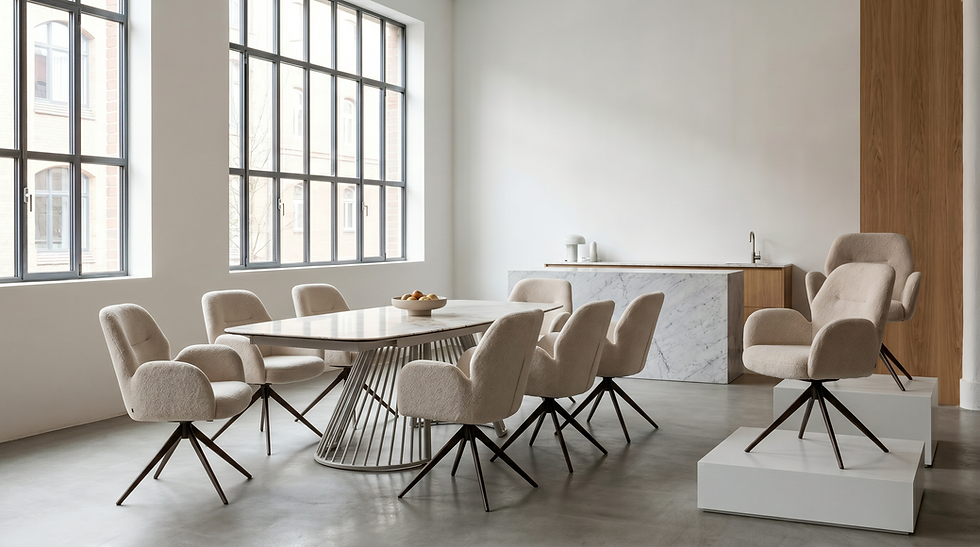
The German furniture retail environment is currently navigating a period of intense structural change. Stationary trade (Stationärer Handel) is under immense pressure as foot traffic declines and pricing competition from digital-first players intensifies. Many procurement leaders respond to these challenges by expanding their Sortiment, hoping that a wider variety of dining chairs will capture a broader audience. However, this strategy often backfires, leading to increased Lagerdruck (warehouse pressure) and diluted margins without addressing the core issue of customer frequency.
In this strategic analysis, we examine why the 'more is better' approach to product assortment is a fundamental judgment error in the current market and provide a framework for SKU efficiency that prioritizes Marge and Lieferzuverlässigkeit.
The Illusion of Choice: Why More SKUs Don't Mean More Customers
Many German retailers believe that if a customer cannot find a specific chair in the showroom, the solution is to add ten more variations to the floor. This logic ignores the psychological reality of 'overchoice.' In a declining market, the goal is not to offer everything, but to offer the right thing. Expanding the Sortimentsbreite (assortment breadth) without a corresponding increase in demand lead to several critical business risks.
First, excessive variety fragments your marketing budget. Instead of promoting a 'Hero Product' that drives Abverkauf (sell-through), resources are spread thin across dozens of underperforming SKUs. Second, it complicates the sales process. When sales staff are overwhelmed by technical specifications for fifty different dining chairs, their ability to close a deal effectively diminishes.
Common Mistakes: The Hidden Costs of Assortment Expansion

When a retail chain or a medium-sized furniture house expands its dining chair selection too rapidly, it often overlooks the hidden operational costs. These mistakes directly impact the cash flow and long-term stability of the business.
Increased Lagerdruck and Capital Lock-up: Every new SKU requires a minimum stock level. In the German market, where warehouse space is expensive, carrying slow-moving items (Penner-Artikel) kills liquidity.
High Reklamationsquote (Complaint Rate): Managing 50 different suppliers or 200 different chair models increases the risk of quality variance. A high rate of Reklamation destroys the net margin after the sale is completed.
Neglecting Lieferzuverlässigkeit: By spreading orders across too many manufacturers, retailers lose their 'Key Account' status. When supply chains tighten, these retailers are the first to suffer from delivery delays, leading to cancelled customer orders.
ASKT Furniture has observed that successful German partners focus on a curated selection. With over 15 years of manufacturing experience and ISO 9001 certification, we emphasize that quality and consistency outperform sheer volume every time.
The SKU Efficiency Framework: A Decision Logic for Procurement
To move away from the 'Assortment Trap,' Einkaufsleiter should adopt a data-driven framework. Instead of asking 'What else can we add?', ask 'What is the performance density of this SKU?'
The 80/20 Rule in Dining Chairs
Typically, 20% of your dining chair models will generate 80% of your Marge. The remaining 80% of the assortment often contributes more to operational headaches than to profit. A professional Sortiment-Analyse should be conducted quarterly to prune items that do not meet minimum Abverkauf thresholds.
Supplier Reliability as a Margin Protector
Price is only one component of the total cost. A cheap chair that arrives 30 days late or with structural defects costs more in the long run. ASKT Furniture mitigates this by offering a stable 45-day delivery window and a flexible MOQ of 200 units, allowing retailers to test curated assortments without over-committing capital.
Comparison: Assortment Depth vs. Assortment Breadth
Metric | Assortment Breadth (Wide) | Assortment Depth (Focused) |
Inventory Risk | High (Multiple SKUs) | Low (Higher volume per SKU) |
Marketing Focus | Fragmented | Concentrated on Hero Products |
Supplier Leverage | Low | High (Stronger partnerships) |
Logistics Cost | High (Multiple shipments) | Optimized (Full containers) |
Profit Margin | Diluted by overhead | Maximized via efficiency |
Actionable Recommendations for 2026
Audit Your Current Floor: Identify the bottom 15% of your dining chairs based on sales per square meter and plan their exit strategy.
Prioritize Multi-Functional Designs: In the German market, dining chairs that work for both home offices and dining rooms are seeing higher Abverkauf.
Demand Transparency: Only work with manufacturers who provide clear ISO 9001 documentation and can guarantee lead times. Uncertainty is the enemy of retail planning.
Checklist: Evaluating a New Dining Chair SKU
Before adding a new model to your catalog, ensure it passes these five criteria:
Margin Target: Does the expected gross margin exceed the category average by at least 5%?
Quality Assurance: Does the manufacturer have 10+ years of experience and verified certifications?
Logistics Fit: Can the supplier guarantee a 45-day delivery to avoid stockouts?
Market Differentiation: Does this chair solve a specific customer pain point that existing SKUs do not?
Risk Mitigation: Is the MOQ flexible enough (e.g., 200 units) to allow for a trial phase?
FAQ Section
Q: How do I handle customers who ask for variety we don't have on the floor? A: Use 'Digital Shelf' solutions. Keep the physical floor focused on high-touch, high-margin items and use digital catalogs for niche variations. This reduces Lagerdruck while maintaining perceived variety.
Q: Why is a 45-day delivery time critical for German retailers? A: With the volatility of the German consumer market, long lead times (90+ days) lead to high cancellation rates if the customer finds a faster alternative. A 45-day window, like the one provided by ASKT Furniture, aligns with seasonal planning cycles.
Q: Is a 200-unit MOQ too high for a test? A: For a professional retail chain, 200 units represents a manageable risk across multiple branches. It is the 'sweet spot' where manufacturing efficiency meets retail flexibility.
Conclusion

Expanding your dining chair assortment is a reactive measure that rarely solves the problem of declining store traffic. Instead, it creates a cycle of high costs and low efficiency. By focusing on SKU density, supplier reliability, and rigorous quality standards, Einkaufsleiter can protect their Marge even in a challenging stationary trade environment. ASKT Furniture remains committed to supporting these strategic goals through our 15 years of manufacturing excellence and dedicated B2B service.
Do you want me to send you a practical evaluation checklist or decision framework for your next procurement cycle?


Comments