


Why the Same Dining Chair Does Not Sell Equally Well in North and South Germany


In the current German furniture retail landscape, where stationary trade faces a significant 7.4% revenue dip, optimizing the 'Sortiment' is no longer optional—it is a survival strategy. Procurement managers are under immense pressure to reduce 'Lagerdruck' and improve 'Cashflow' while navigating a market characterized by 'Selective Consumption.'
The High Cost of the 'One Germany' Assumption
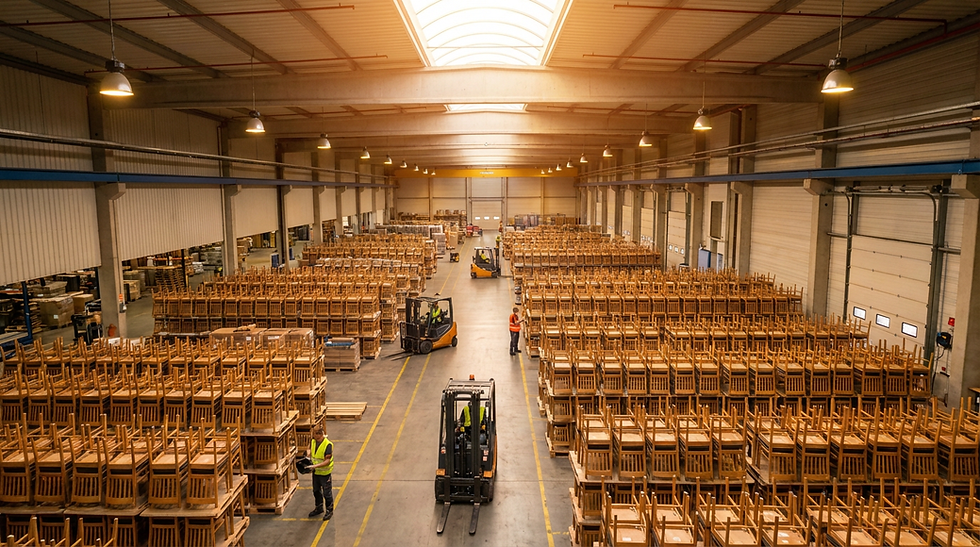
Many retail chains operate under the assumption that a popular SKU in Hamburg will perform equally well in Munich. However, the 'Nord-Süd-Gefälle' (North-South divide) remains a critical factor in the B2B and B2C furniture sectors. For an Einkaufsleiter, ignoring these cultural nuances leads to 'Ladenhüter' (slow-moving stock), which ties up capital and
forces aggressive discounting, ultimately destroying your 'Marge' (margin).
The Problem: Regional Style Divergence and the 'Ladenhüter' Risk
The fundamental problem lies in the aesthetic DNA of the regions. Northern Germany, influenced by Scandinavian proximity and Hanseatic sobriety, favors 'Scandi' minimalism—clean lines, light woods like Ash, and functional fabrics. In contrast, Southern Germany (Bavaria and Baden-Württemberg) maintains a preference for 'Modern Landhaus' and solid wood luxury. A dining chair with a heavy, dark walnut finish and velvet upholstery might achieve a high 'Abverkauf' (sell-through) in a Munich showroom but remain untouched in a Berlin loft-style outlet.
Common Mistakes in Regional Assortment Planning
Overestimating Aesthetic Uniformity: Assuming that national design trends override regional traditions.
Ignoring Materiality: Failing to recognize that Northern buyers prefer cooler metal accents while Southern buyers prioritize the tactile warmth of solid wood.
Price-Point Misalignment: Not accounting for the higher purchasing power in the South, which allows for a more premium 'Preislage' (price range) compared to the price-sensitive Northern markets.
Decision Framework: The Regional Assortment Matrix

To mitigate the 'Risks' of poor procurement decisions, ASKT Furniture recommends a structured evaluation of every SKU based on the following regional benchmarks:
1. Aesthetic Profile Alignment
Before adding a dining chair to your 'Sortiment', categorize it: Is it 'Minimalist/Industrial' (North) or 'Organic/Traditional' (South)? ASKT Furniture’s 15 years of manufacturing experience shows that chairs with tapered legs and light oak finishes have a 30% higher sell-through in Northern metropolitan areas.
2. Durability and Certification
For commercial spaces, quality is non-negotiable. ASKT Furniture ensures all products meet ISO 9001 standards. In the South, where 'Wertigkeit' (perceived value) is a primary driver, highlighting these certifications can justify a higher 'Marge'.
3. Logistical Flexibility
Large inventories lead to 'Lagerdruck'. By leveraging ASKT’s flexible MOQ of 200 units and a stable 45-day lead time, Einkaufsleiter can test regional market responses without overcommitting 'Cashflow'.
Checklist: 7 Steps for Regionalizing Your 2026 Dining Chair Procurement Plan

Analyze Regional Sales Data: Review 'Abverkauf' data per SKU specifically by postal code.
Audit Current Lagerdruck: Identify which models are underperforming in specific regional warehouses.
Evaluate Reklamation Reasons: Determine if 'Reklamation' (complaints) are due to quality or aesthetic dissatisfaction.
Test with Low MOQs: Use ASKT’s 200-unit MOQ to pilot a 'South-only' or 'North-only' collection.
Verify ISO 9001 Compliance: Ensure the manufacturer can support long-term contract durability.
Align Delivery Cycles: Use 45-day lead times to synchronize with regional seasonal peaks (e.g., outdoor dining season starts earlier in the South).
Adjust Marge Targets: Set different margin expectations based on regional 'Preislage' tolerance.
Comparison Table: North vs. South Germany Seating Preferences
Attribute | North Germany (Hamburg/Berlin) | South Germany (Munich/Stuttgart) |
Preferred Style | Scandinavian Minimalism / Industrial | Modern Landhaus / Solid Wood Luxury |
Wood Species | Ash, Light Oak, Painted Finishes | Walnut, Dark Oak, Natural Grains |
Upholstery | Coarse Linen, Gray/Blue Tones | Velvet, Leather, Warm Earth Tones |
Price Point | Mid-range (Efficiency focus) | Premium (Quality/Status focus) |
Key Decision Factor | Functionality & Space-saving | Craftsmanship & Durability |
FAQ: Managing Regional Inventory and Reklamation
Q: How does regional taste affect 'Reklamation' rates?
A: Interestingly, high 'Reklamation' in the South is often linked to 'Materialhaptik' (tactile feel). If a chair feels 'too light' or 'flimsy', even if it is structurally sound, Southern buyers perceive it as low quality. ASKT’s solid wood solutions address this specific regional concern.
Q: Can a 45-day lead time really improve my Cashflow?
A: Yes. By reducing the time between order and 'Abverkauf', you minimize the capital locked in transit and storage, allowing for more frequent 'Sortiment' updates.
Conclusion: Margin Optimization through Cultural Intelligence

Success in the German furniture retail market requires more than just a good price; it requires 'Cultural Intelligence.' By recognizing the 'Nord-Süd-Gefälle' and utilizing flexible manufacturing partners like ASKT Furniture, Einkaufsleiter can eliminate 'Ladenhüter' and protect their 'Marge'. Our commitment to ISO 9001 quality and 45-day delivery ensures that your regional strategy is backed by 'Lieferzuverlässigkeit' (delivery reliability).
Do you want me to send you a practical evaluation checklist or decision framework for your next regional assortment review?


Comments