


How to Build a Private-Label Dining Chair Collection with a Chinese OEM Factory
- Wolfgang Adler

- 10 hours ago
- 7 min read
To build a successful private-label dining chair collection with a Chinese OEM factory, European retailers must transition from sourcing random individual designs to implementing a modular shell-and-base matrix. By utilizing a modular dining chair system, retailers can combine standardized frame bases with highly customizable upholstered seat shells to drastically reduce inventory capital, minimize Minimum Order Quantities (MOQs), and optimize container loading while ensuring strict compliance with European structural standards.
What is the strategic blueprint to build a private-label dining chair collection with a Chinese OEM factory?
As the CEO of ASKT, a dedicated private label furniture manufacturer, I have spent over two decades helping European retail chains, buying groups, and B2B wholesalers navigate the complexities of contemporary furniture supply chains. A common mistake in the B2B sector is treating a dining chair collection as a random assortment of aesthetically pleasing products. To establish a commercially viable product line, retailers must approach product development through systematic collection matrix planning.
Rather than launching ten completely distinct, fully welded chair designs—which spikes tooling costs, complicates quality control, and inflates your MOQs—successful brands establish a structured design ecosystem. The goal of furniture OEM ODM customization should be to align your private-label designs with the actual living habits and interior configurations of your target markets, such as Germany, the Netherlands, or the United Kingdom.
Our design and development process is based on empirical, market-focused research. For example, our structural planning is informed by a comprehensive survey analyzing over 1,000 German households and their real-world dining environments. When designing a private-label collection, we systematically evaluate these parameters:
Dining Table Compatibility: Matching chair seat heights and armrest clearances with standard European dining table heights (typically 75–78 cm) to prevent structural interference.
Flooring and Glide Optimization: Customizing the bottom glides—such as felt, plastic, or teflon—to ensure optimal sliding performance and scratch prevention on parquet, ceramic tile, or carpeted surfaces.
Spatial Dynamics: Analyzing walking clearances and movement patterns around the dining table to optimize the overall footprint and weight of the chairs.
By anchoring your product development in objective regional data rather than subjective design trends, you can launch a private-label collection that resolves real consumer pain points, resulting in higher sales velocity and significantly lower return rates.
How can B2B buyers mitigate inventory risks and lower MOQs using a modular dining chair system?
One of the most persistent challenges in international furniture sourcing is balancing product variety with high inventory costs. If your retail brand wants to offer several colour options, fabric variants, and metal frame leg styles, ordering traditional, non-interchangeable chairs will quickly lead to bloated warehouses and tied-up capital. This is because standard factories demand separate minimum order quantities for every single finished stock-keeping unit (SKU).
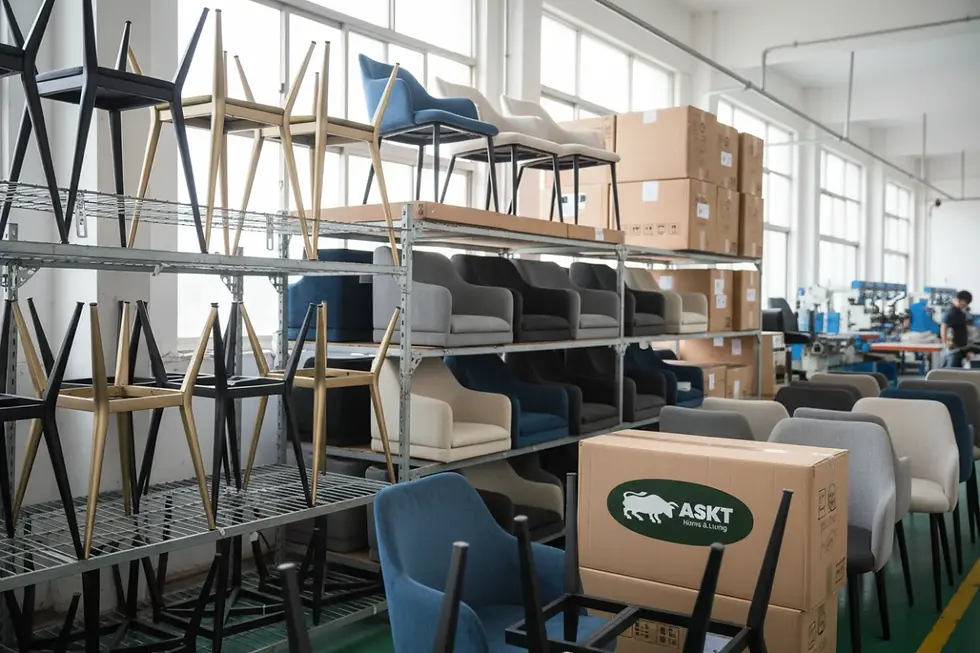
This is where a modular dining chair system completely reshapes B2B logistics. By decoupling the upholstered seating shell from the lower frame base, we implement a smart manufacturing logic: standardizing the core structural elements while keeping the visible outer elements highly customizable.
Through our KINEXA modular system (which was highlighted in the February 2026 issue of Möbelmarkt), we manufacture a highly engineered collection of seat shells that fit seamlessly onto interchangeable metal and wooden base structures. This modular approach provides several distinct commercial advantages for B2B buyers:
Strategic MOQ Reduction: Instead of ordering 100 units of a highly specific chair configuration, you can order a large, cost-effective run of standardized bases (such as 400 black powder-coated steel legs) and pair them with various fabric covers and shell designs in smaller production batches.
Efficient Inventory Control: Retailers can hold component parts in storage, assembling the final chair configurations dynamically as retail orders arrive. This prevents slow-moving color options from turning into dead stock.
Container Loading Optimization: Fully assembled chairs are incredibly inefficient to ship, as they waste valuable container space. By engineering modular components with Knock-Down (KD) structures, we maximize container loading efficiency, allowing you to fit up to four times more units per container compared to fully welded structures. This directly reduces your per-unit ocean freight cost.
Comparison: Traditional Assembly vs. KINEXA Modular Sourcing Matrix
Sourcing Metric | Traditional Fixed Sourcing | KINEXA Modular Sourcing | Commercial Value for Retailers |
|---|---|---|---|
:--- | :--- | :--- | :--- |
Container Loading Efficiency | Low (assembled units take up empty air) | Extremely High (KD flat-pack components) | Lowers ocean freight cost per seat by up to 75% |
Sourcing MOQ per SKU | High (typically 100+ units per specific color/base) | Low (bases pooled; shells varied in small batches) | Enables wider product variety with minimal capital exposure |
Assembly Requirements | No assembly needed at retail (high damage risk) | Simple bolt-on KD assembly (highly protected) | Reduces transit damage and local warehousing costs |
Product Lifetime Flexibility | Non-interchangeable; damage to base ruins entire chair | Damaged base or worn shell easily swapped individually | Protects retail margins and contract warranty claims |
Which fabric and upholstery specifications are essential for European retail compliance?
The upholstery fabric is the most critical touchpoint of any dining chair. It defines the perceived luxury of the product in a retail showroom and dictates how well the chair survives the daily wear and tear of residential or commercial environments. In my years acting as a strategic bridge for B2B procurement, I have seen many retailers suffer severe brand damage because they sourced fabrics that quickly pilled, sagged, or stained.
To eliminate this risk, our materials engineering department developed ASKT-Tex (featured in the March 2025 issue of Möbelmarkt). This functional fabric technology uses a molecular-level hydrophobic nano-coating combined with integrated micro-ventilation channels to deliver premium tactile comfort alongside commercial-grade durability. Our B2B textile specifications are strictly managed across four core pillars:
Water and Stain Resistance: The nano-coating creates high surface tension, causing liquids like water, coffee, and oil to bead up on the surface. This allows end consumers to wipe spills away easily with a dry cloth before they penetrate the cushioning.
Pet-Friendly Durability: The textile weave is tightly engineered to prevent cat and dog claws from catching, scratching, or tearing the fabric fibers.
High Abrasion Resistance: All fabrics undergo rigorous Martindale abrasion testing, reaching up to 100,000+ rubs for commercial contract environments, preventing thinning, fraying, and pilling.
Colour Fastness and Breathability: Our materials undergo strict testing for color fastness under UV light and friction exposure, ensuring the fabric retains its deep, sophisticated look even when placed next to large windows.

From a safety and compliance perspective, we maintain an absolute zero-tolerance policy. All upholstery fabrics are OEKO-TEX® STANDARD 100 certified. This guarantees they are completely formaldehyde-free and baby-friendly. Furthermore, in alignment with the European Green Policy, we offer premium fabrics woven from yarns made of recycled plastic bottles, giving our B2B partners a credible sustainability narrative to support their corporate ESG objectives.
What manufacturing technologies guarantee structural consistency and B2B compliance?
For DACH (Germany, Austria, Switzerland) and wider European markets, structural safety is a critical requirement. When you partner with a B2B dining chair supplier China, you must ensure the products are engineered to pass EN12520 (the European standard for strength, durability, and safety of domestic seating). At ASKT, we integrate these structural standards directly into the computer-aided design (CAD) phase, conducting finite element analysis (FEA) to eliminate potential stress points before tooling begins.
To ensure flawless structural consistency across thousands of production runs, our Chinese manufacturing facility relies on advanced automated machinery rather than variable manual labor:
Automated Fabric Batch Cutters: Ensure fabric panels are sliced with sub-millimeter precision, preventing loose upholstery, misalignment, or uneven seams.
Automatic CNC Board Punching: Ensures all wooden support panels are drilled uniformly, keeping internal screw mounts perfectly aligned for stable, repeat assembly.
Automated Wood Board Nailing Machines: Specialized equipment installs four-legged nails into the wooden boards with consistent force, securing internal structural integrity.
Automatic Robotic Welding Arms: Eliminate the human variability of manual welding. These robotic arms apply clean, deep-penetration welds to our metal frames, ensuring uniform strength and preventing joint failure.
Industrial Powder Coating Lines: Apply a perfectly uniform coating thickness to metal frames, protecting against moisture ingress and rust.
We also prioritize worker welfare and factory compliance. Our facilities have successfully passed the BSCI (Business Social Compliance Initiative) human rights certification. We provide all factory workers with comprehensive safety gear—including protective overalls, metal cut-resistant gloves for fabric cutters, and gas masks for workers handling glues. Additionally, all glues used in our production lines are environmentally friendly and formaldehyde-free. Every worker undergoes detailed operational training before joining the production line to ensure total consistency and safety.
How can retailers streamline communication and sample development with a private label furniture manufacturer?
Establishing a new private-label collection requires seamless communication during the critical sample development phase. Historically, B2B buyers and offshore factories wasted months passing technical sheets and sketches back and forth, only to receive a physical sample that missed the original design intent.
To eliminate this friction, we developed the Sunbin KI conversational AI platform (featured in the February 2026 issue of Möbelmarkt). This digital tool acts as an interactive product manager, asking structured "reverse questions" to clarify your specifications before we begin manufacturing. It ensures that critical variables like seat height, cushion density, swivel mechanism resistance, and packaging protection are fully aligned from the very first brief.

Our OEM/ODM sample development process is divided into four transparent phases:
CAD and 3D Modeling Alignment: We translate your design concepts into highly detailed production drawings, selecting matching components from our modular library to optimize tooling costs.
Prototype Manufacturing: We construct physical mockups to test ergonomics, seat comfort (utilizing high-density foam or pocket spring seating inserts), and structural balance.
Physical Testing and Verification: The sample undergoes rigorous mechanical testing in our internal laboratories, and we provide B2B buyers with transparent inspection reports and high-resolution video reviews.
Design Exclusivity Agreement: To build a trust-based, long-term commercial partnership, we sign regional market protection agreements. This guarantees that your customized private-label designs remain completely exclusive to your brand within your designated European territories.
By combining digital transparency with professional engineering, we turn an unpredictable sourcing process into a reliable, streamlined pipeline.
If you are evaluating dining chair or dining table suppliers for the European market, ASKT can support you with product development, customization, quality testing, and stable export experience. To begin planning your customized product matrix with our engineering team, Request Collection Matrix.
FAQ
What is the typical B2B lead time for a private-label dining chair sample?
For standard customizations using our modular library, sample development takes approximately 10 to 14 working days. Completely custom designs requiring proprietary tooling may take 25 to 30 days to complete, including full CAD alignment and structural testing.
How does ASKT ensure batch-to-batch consistency for large retail orders?
We utilize automated machinery, including batch fabric cutters, CNC board punching, automatic nailing machines, and robotic welding arms. This high-precision automation eliminates human error and guarantees identical tolerances across all production runs.
Are your products compliant with European environmental regulations?
Yes. All our upholstery fabrics hold OEKO-TEX® STANDARD 100 certifications, ensuring they are formaldehyde-free. We also use environmentally friendly glues and offer sustainable fabric options made from recycled plastic bottles.


Comments