


How to Compare a Chair’s Stated Weight Capacity With Its Frame Construction


A dining chair advertised with a 150 kg weight capacity may appear stronger than one rated for 120 kg. But does that number actually prove better durability?
Not necessarily.
For furniture retailers, wholesalers, and contract furniture buyers, a chair's weight capacity should always be evaluated alongside its frame construction, joint strength, and structural testing.
A stated weight capacity describes a claimed load limit, while frame construction determines how effectively the chair supports that load over time.
Understanding this difference helps buyers avoid misleading specifications, reduce quality complaints, and select more reliable dining chairs for European markets.
1. Why Doesn't a Higher Weight Capacity Always Mean a Stronger Chair?
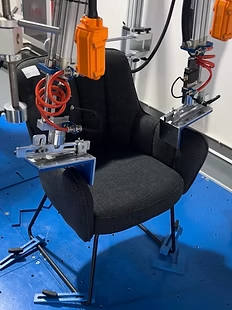
A chair's weight capacity is often presented as a single number: 120 kg, 140 kg, or 150 kg.
However, these figures are difficult to compare without knowing how they were established.
For example, a chair may withstand a high load during a short static test but develop loose joints or frame deformation after repeated everyday use.
The difference comes down to two types of loading:
Static loading: Measures how the chair performs when a specified force is applied.
Dynamic or repeated loading: Evaluates how the structure responds to repeated sitting, movement, and changing forces.
A chair that passes a static strength test is not automatically proven durable under years of repeated use.
For B2B buyers, the important question is not simply "How much weight can this chair hold?" but "What evidence supports that capacity under the intended conditions of use?"
2. How Does Frame Construction Affect Weight Capacity?
A chair's load-bearing performance depends on how force travels from the seat through the frame and legs to the floor.
Even strong materials cannot compensate for poorly designed connections or insufficient structural support.
Metal Frame Construction
Steel frames are widely used in modern dining chairs because they offer design flexibility and structural strength.
However, two visually identical chairs can perform differently depending on:
Steel tube diameter and wall thickness.
Frame geometry and supporting crossbars.
Welding quality and connection design.
Position and reinforcement of load-bearing points.
A thicker steel tube does not automatically guarantee a stronger chair. The complete frame geometry and quality of its connections must also be considered.
Wooden Frame Construction
For solid wood dining chairs, structural performance depends on wood species, component dimensions, grain direction, and joinery.
Mortise-and-tenon joints, reinforced connections, and properly designed seat rails can improve structural reliability.
Poorly fitted joints or insufficient reinforcement may cause movement and looseness after repeated use, even when the wood itself is strong.
Seat Support and Connection Points
The seat platform also plays an important role.
Plywood panels, metal support structures, and spring-supported seats distribute loads differently.
If the seat support is poorly designed, stress may concentrate around mounting points, potentially causing deformation or premature failure.
The weakest structural connection can become the limiting factor in a chair's overall load capacity.
3. Chair Weight Capacity vs. Frame Construction: What Should Buyers Compare?
Evaluation Factor | What to Check | Why It Matters |
Stated weight capacity | Rated load and supporting test evidence | Verifies whether the claim is documented |
Frame material | Steel grade, wood species, material specifications | Influences strength and stiffness |
Frame dimensions | Tube thickness, leg sections, supporting structure | Affects load distribution |
Joint construction | Welds, bolts, reinforced wooden joints | Helps prevent loosening and structural failure |
Seat support | Plywood, metal support, suspension system | Determines how loads reach the frame |
Static load testing | Applied force and test result | Evaluates structural strength |
Durability testing | Repeated loading and acceptance criteria | Evaluates resistance to wear and fatigue |
Production consistency | Frame alignment, assembly and inspection | Helps maintain quality across bulk orders |
Buyer takeaway: A documented 140 kg capacity supported by appropriate structural testing may provide greater purchasing confidence than an unsupported 150 kg claim.
4. What Testing Should European Furniture Buyers Request?

For European furniture buyers, structural testing provides a more reliable basis for evaluating dining chair quality than marketing specifications alone.
Two relevant standards are:
EN 12520 — Domestic Seating
This European standard addresses safety, strength, and durability requirements for seating intended for domestic use.
EN 16139 — Non-Domestic Seating
This standard covers safety, strength, and durability requirements for non-domestic seating, including many commercial furniture applications.
These standards specify testing requirements and procedures rather than assigning a universal maximum user-weight rating to every chair.
Buyers should request test reports that identify the tested model, applied loads, testing procedures, and results.
At ASKT Furniture, structural quality evaluation includes seat and back static load tests, seat impact tests, leg strength checks, and repeated seat-and-back durability testing.
Our manufacturing process also emphasizes metal-frame accuracy, welding consistency, and quality inspection during production.
5. What Should Buyers Check Before Placing a Bulk Order?
A single approved sample cannot guarantee consistent quality across hundreds of dining chairs.
Before confirming mass production, furniture buyers should verify five essential points:
Frame specifications: Request the material grade, tube dimensions, wall thickness, and relevant structural drawings.
Joint strength: Examine welded connections, mounting brackets, and reinforced load-bearing areas.
Testing evidence: Verify that test reports match the actual chair model and intended application.
Sample stability: Check for excessive movement, deformation, or abnormal sounds under normal use.
Batch consistency: Confirm that production inspections follow the approved specifications and sample.
For metal dining chairs, even small variations in tube bending or welding can affect frame geometry and stability.
ASKT uses controlled metal-processing and welding procedures, together with production inspections, to help maintain structural consistency across furniture orders.
For furniture retailers and wholesalers, these controls are particularly valuable when sourcing products for repeat orders or large retail programmes.
6. How Should Buyers Choose the Right Dining Chair for Their Market?

The appropriate chair construction depends on its intended application.
Residential dining chairs should balance comfort, appearance, structural safety, and durability under everyday household use.
Restaurant and hospitality chairs require particular attention to repeated loading, joint stability, and resistance to intensive daily use.
Furniture retail collections should combine documented product specifications with consistent manufacturing quality to help reduce warranty claims and customer complaints.
A higher weight-capacity figure can be useful, but only when it is supported by suitable construction and verifiable testing.
For European furniture buyers, the best purchasing decision is based on the relationship between weight capacity, frame design, and proven durability—not the largest number printed on a product specification sheet.
At ASKT Furniture, we develop dining chairs with attention to metal-frame engineering, structural testing, and consistent production quality for European furniture retailers, wholesalers, and project buyers.
Looking for Dining Chairs With Reliable Frame Construction?


Comments