


Multifunctional Dining Chairs: Swivel, Lounge Comfort and European Retail Assortment Strategy

If you work in European furniture retail or wholesale, you have probably noticed how quickly the dining chair category is changing. Not long ago, a dining chair was a fairly simple product: four legs, a seat, a back, and a clear role at the dinner table. Today, consumers are looking for chairs that do more. They want to sit comfortably for long meals, turn easily to talk to people beside them, work from the table from time to time, and still have a chair that looks right in a modern home. This shift is exactly why multifunctional dining chairs swivel lounge comfort European retail has become such an important topic for assortment planners and product managers across the continent.
As someone who has worked with European furniture buyers for many years, I have learned that the most interesting products are also the easiest ones to get wrong. A chair marketed as swivel and lounge-comfort can sound very attractive on a product sheet, but if the mechanism feels loose, the seat loses shape after six months, or the fabric stains easily, it becomes a costly problem for everyone involved: the retailer, the end customer, and the supplier. In this article, I want to walk through what multifunctional dining chairs really mean for the European market, how to evaluate their quality, and how to build a retail assortment that is both commercially attractive and operationally reliable.
Why multifunctional dining chairs matter for European retail assortments
The European home furniture market has been moving in a clear direction for several years: living spaces are becoming more flexible. Open-plan kitchens, combined dining and living areas, and smaller apartments mean that one piece of furniture often has to serve more than one purpose. A dining chair is no longer only used for dinner. It is used for breakfast, home office work, children's homework, weekend long lunches, and even as an extra seat in the living room when guests come over.
This is where the appeal of multifunctional dining chairs comes in. By combining swivel movement with a more cushioned, lounge-style seat, a single chair can work across more of these everyday moments. For retailers, that means broader customer appeal, fewer SKUs to manage for the same customer need, and a stronger position in the mid-to-upper price segment where design and comfort both matter.
However, the category also brings new challenges. When a product has more functions, there are more components that can fail. A swivel mechanism adds moving parts. A deeper, softer seat can look inviting but lose shape over time. A chair that is comfortable for lounging may be too low or too wide for standard dining tables. These are not small details; they directly affect return rates, customer reviews, and the long-term reputation of a retail brand.
For that reason, building a strong lounge comfort dining chair retail assortment is not just about picking good-looking products. It is about understanding which features genuinely add value, which ones are marketing language, and how to match the product to the real daily use patterns of European households.

A look under the upholstery: internal structure details help buyers evaluate genuine engineering behind dining chair comfort claims.
Swivel function: real mechanical value vs marketing labels
Swivel is one of those features that sounds simple until you start comparing products in detail. Some swivel dining chairs rotate smoothly and quietly, return gently to centre, and feel stable after years of use. Others feel wobbly from day one, squeak after a few months, or stop rotating evenly once the mechanism wears in. For buyers, this makes swivel dining chairs for European home use a category where you have to look well beyond the product description.
Let us start with what a swivel mechanism actually consists of. In most dining chair designs, the swivel function is built around a bearing plate mounted between the seat frame and the base. The quality of that plate, the type of bearing, the thickness of the metal, and the way it is fixed to the frame all determine how the chair will perform over time. Cheaper mechanisms often use thinner steel, simpler bearing structures, and fewer fixing points, which saves cost at the factory but leads to a shorter product life in the home.
A common marketing claim is “360-degree swivel”. Almost any swivel chair can rotate a full circle, so that phrase on its own tells you almost nothing about quality. What matters more is how it rotates. Does it move smoothly without side-to-side play? Does it stay stable when someone leans back or shifts their weight? Does it make any noise when new, and how will it perform after thousands of rotations?
Some chairs also include an auto-return function, which means the seat gently returns to a forward-facing position when the user stands up. This is a useful feature for dining use, especially in homes with children or in contract settings, but the quality of the return mechanism varies a lot. A good auto-return system should be quiet, gradual, and reliable after repeated use. A poor one can snap back too quickly, feel harsh, or fail to return at all once the internal mechanism loses tension.
When evaluating dining chair functional features vs marketing claims, my advice is always the same: ask for mechanical specifications, not just descriptions. You should want to know the type of swivel bearing, the thickness of the steel plate, the number of fixing points, and any cycle testing data the supplier can provide. You should also sit in the chair yourself, ideally a sample that has been used for some time, because a brand-new chair can feel very different from one that has had a few months of regular use.
Lounge-style comfort in a dining chair: what actually defines it
If swivel is about movement, lounge comfort is about how the chair feels when you are sitting still. The word “lounge” is used very freely in furniture marketing, so it is important to define what we actually mean when we talk about a lounge-style dining chair.
In practical terms, a lounge comfort dining chair usually has a deeper seat, more generously padded backrest, and often a more enveloping shape than a traditional dining chair. The idea is that you can sit in it for longer periods without feeling the need to get up and move. That is a genuine benefit for people who host long dinners, work from the dining table, or simply like to sit and read after a meal.
The problem is that comfort is subjective, and marketing language can make almost any chair sound comfortable. “Cloud-like”, “plush”, “luxury”, and “ergonomic” are all words you will see on product pages, but they do not tell you anything about the structure inside the seat. For professional buyers, comfort has to be evaluated in a much more concrete way.
First, look at the seat construction. A lounge-style chair with only basic foam filling will soften and lose shape relatively quickly, especially if it is used every day. Higher-quality designs often use a combination of different foam densities, sometimes with a pocket spring system inside the seat to provide support while still feeling soft. Pocket spring seating has the advantage of distributing weight more evenly and recovering its shape better over time, which makes it popular in the mid-to-high-end European market.
Second, consider the backrest. A true lounge-comfort dining chair usually offers more upper-back support than a standard model, and the angle of the backrest is slightly more relaxed. That is comfortable for sitting long periods, but it also has a practical trade-off: a more reclined backrest can make the chair wider or deeper, which affects how many chairs fit around a table and how they are placed around a room. For retail buyers, that means you have to check not only the comfort but also the practical fit with standard dining table heights and room sizes.
Third, look at the fabric. Lounge comfort is not only about padding; it is also about how the material feels against the skin, how well it breathes, and how it holds up to everyday use. A fabric can feel very soft in the showroom but pill, fade, or stain easily in real home use. For the European market, especially in family homes, easy-clean and durable fabrics are at least as important as softness.

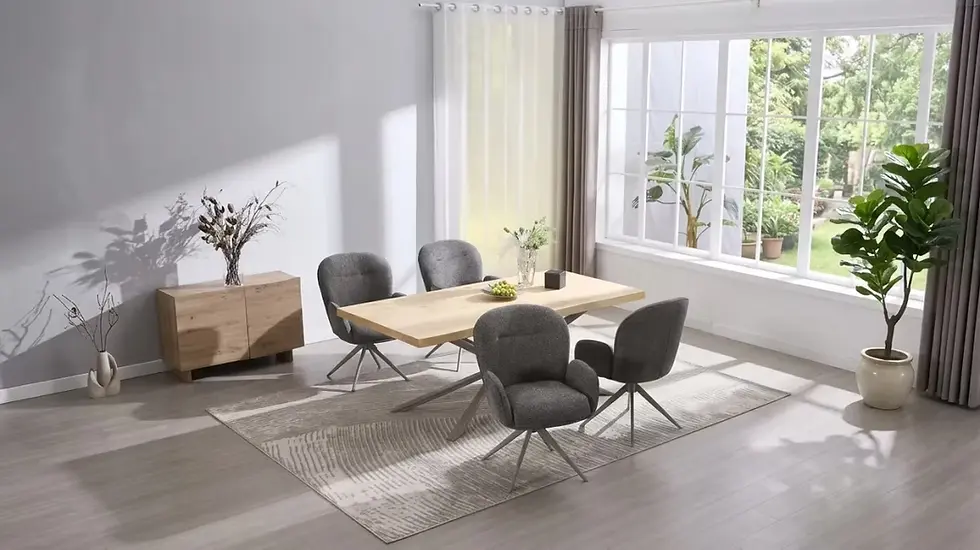
Curated lounge comfort dining chair assortments in European retail are supported by wide fabric customization options to match diverse home styles.
Core use scenarios that drive consumer purchase decisions
To position multifunctional dining chairs well in a retail assortment, it helps to understand why consumers actually buy them. From what we see across European markets, there are a few consistent use scenarios that come up again and again.
The first is the open-plan dining and living space. In many modern European homes, the dining area flows directly into the living room, so the chairs are visually present most of the time. Consumers want chairs that look right in both settings: formal enough for the dining table, but comfortable enough to pull over to the sofa area when friends come over. A swivel function makes this easier because people can turn to join different conversations without moving the whole chair.
The second scenario is home working. Even though many people have returned to office work, a large number still work from home for part of the week. A dining chair that is comfortable enough to sit in for a few hours of work, and that swivels easily between the table and the rest of the room, is a very practical solution for smaller apartments where a separate home office is not possible.
The third scenario is family use. Families with children often prefer swivel chairs because they are easier to get in and out of, especially for younger children or people with limited mobility. Lounge-style padding also makes the chair more forgiving during long meals, homework sessions, or weekend family activities around the table.
The fourth scenario is entertaining. For people who regularly host dinner parties, a swivel dining chair allows guests to turn towards each other, the kitchen, or the living area without dragging the chair across the floor. The added comfort means guests can stay seated longer, which is exactly what many hosts want.
For a retailer, understanding these scenarios is useful because it shapes how you present the product. Instead of simply describing a chair as “multifunctional”, you can explain which real daily problems it solves. That makes the product easier to sell and reduces the risk of customers buying it for the wrong reasons.
How to evaluate quality and durability for retail assortments
When it comes to multifunctional dining chair quality evaluation, there are several areas that deserve close attention. A chair can look great in a catalogue and feel comfortable in a showroom, but retail success depends on how it performs after months or years of real use.
Let us break down the most important evaluation points.
Frame quality The frame is the foundation of any chair, and it becomes even more important when a swivel mechanism is added because the mechanism puts additional stress on the structure. Metal frames should be checked for welding quality, tube thickness, powder coating finish and corrosion resistance. Wooden frames should be evaluated for timber type, joinery method, and moisture content appropriate for European indoor conditions.
Swivel mechanism performance As discussed earlier, the swivel mechanism should be judged on more than just the fact that it rotates. Important factors include smoothness of rotation, lateral stability, noise level, auto-return behaviour if applicable, and the overall thickness and quality of the bearing plate. For retail assortments expected to last several years in home use, the mechanism should be able to handle many thousands of rotation cycles without loosening or developing play.
Seat and back comfort consistency One of the biggest risks in upholstered furniture is batch-to-batch inconsistency. A chair that feels perfect in a sample might feel firmer or softer in the next production run if the foam density or upholstery tension is not carefully controlled. For retailers, consistency matters because customers expect the product they receive to match the one they tried in the store. Good suppliers control foam density, pocket spring configuration, and upholstery tension across every production batch.
Fabric performance Fabric is the part of the chair that the customer touches and sees every day, and it is also one of the most common reasons for returns or complaints. For the European market, key performance indicators include abrasion resistance, colour fastness to light and rubbing, breathability, and stain resistance. Many buyers also look for OEKO-TEX® STANDARD 100 certification as a basic assurance of safety, and an increasing number are interested in sustainable fabrics such as those made from recycled plastic bottles.
Stability and safety A swivel chair must be stable in all positions. It should not tip easily when a user leans back, reaches to the side, or shifts their weight quickly. The base design, centre of gravity, and overall weight of the chair all contribute to stability. For retail products sold in the European market, stability and safety requirements are not optional; they are a basic expectation that every product should meet.
To make evaluation easier, it can be helpful to compare suppliers using a structured checklist rather than relying on first impressions or marketing material. Taking the time to evaluate these details up front saves considerable cost and reputational risk later.

Structured quality inspection and lab testing separate reliable multifunctional dining chair engineering from pure marketing claims for European retail buyers.
Positioning multifunctional chairs in mid-to-high-end retail
Multifunctional dining chairs generally sit best in the mid-to-high-end price segment of the retail market. The reason is simple: combining swivel function with lounge comfort and good quality materials costs more to produce than a basic four-legged dining chair. Trying to sell these chairs at the very lowest price point almost always means compromising on mechanism quality, frame strength, or upholstery durability, which leads to problems further down the line.
For retailers, the opportunity lies in positioning the chair as a smart multi-use purchase rather than a luxury extra. Instead of marketing it as a premium dining chair, you can present it as a flexible seating solution that works across the dining area, home office and living space. That message resonates strongly with European consumers who are increasingly aware of how they use their homes and want furniture that adapts to their lifestyle.
It is also important to be clear about what the chair is not. A lounge-style dining chair is not the same as a lounge armchair, and a swivel dining chair is not the same as an office chair. Being honest about the intended use helps customers make the right choice and reduces the number of returns. It also builds trust, which is one of the most valuable assets a retail brand can have.
Another point worth considering is design exclusivity. In a crowded retail market, having a product that is not available everywhere else makes it much easier to build a premium position and protect margins. Many European retailers work with manufacturers on customised versions of existing designs, with unique fabrics, colours or frame finishes, so that customers cannot simply compare the exact same product across ten different websites.
At the end of the day, the success of a multifunctional dining chair assortment depends heavily on the supplier behind it. A good supplier does not just deliver chairs; they help you understand the trade-offs, control quality across production batches, and solve problems before they reach your customers. If you are currently evaluating swivel dining chairs for European home use or expanding your dining chair assortment, the most important thing is to take the time to look beyond the marketing and understand what is actually inside the product. The chairs that sell well and keep customers happy are not always the ones that look best in a photoshoot; they are the ones that are built well, tested properly, and backed by a supplier who stands behind the product.
If you would like to discuss how multifunctional dining chairs could fit into your retail or wholesale collection, explore our functional dining chair concepts and sourcing support.
FAQ
What qualifies a dining chair as multifunctional for the European market?
A multifunctional dining chair for European retail typically combines at least two usable functions beyond basic seating, most commonly a 360-degree swivel mechanism and lounge-level upholstered comfort. Some models also include auto-return swivel or KD (knock-down) structure for easier logistics. For retail buyers, the term should always be backed by verifiable mechanical and material specifications rather than marketing language alone.
How do you compare dining chair functional features vs marketing claims?
The simplest approach is to separate mechanical and material facts from descriptive language. A swivel mechanism should be judged by its bearing type, plate construction, fixing points and auto-return behaviour. Comfort should be evaluated by seat structure, suspension type and fabric performance, not by words like 'luxurious' or 'cloud-like'. Professional buyers typically request test reports and component specifications rather than relying on product descriptions.
Are swivel dining chairs for European home use suitable for contract environments too?
Many swivel dining chair designs can work in hospitality and contract settings, but only if they are built to higher durability standards. Contract use requires more robust swivel mechanisms, higher abrasion-resistant fabrics and stronger frames. Retail assortments aimed at both residential and light contract use should clearly distinguish the two specification levels to avoid after-sales issues.
What should European retail buyers prioritise in a lounge comfort dining chair assortment?
European retail buyers should prioritise three areas: first, consistent comfort across production batches so every customer receives the same seat feel; second, practical fabric performance including abrasion resistance, colour fastness and easy-clean properties suitable for family homes; third, supply reliability including MOQ flexibility, container optimisation and stable lead times. Design exclusivity is also increasingly important for retailers seeking differentiation.


Comments