


What the German Furniture Market in 2026 Tells Us About Better Buying Decisions


The German furniture market remains under pressure.
According to the Association of the German Furniture Industry (VDM), the German furniture industry generated approximately €7.7 billion in revenue during the first half of 2026, down 2.7% year on year.
The domestic market performed even more weakly, with revenue falling 4.1%.
For those of us working with living and dining furniture, the numbers deserve particular attention. Revenue from living room, dining room and bedroom furniture, together with furniture parts, fell by around 5%, while upholstered furniture declined by approximately 10%.
For the full year, the VDM currently expects German furniture industry revenue to fall by around 3%.
Those numbers matter.
But for furniture buyers, suppliers and product managers, I don't think the most useful question is:
“How difficult is the market right now?”
A better question is:
“How should this market change the way we select new products?”
That is where things become interesting.
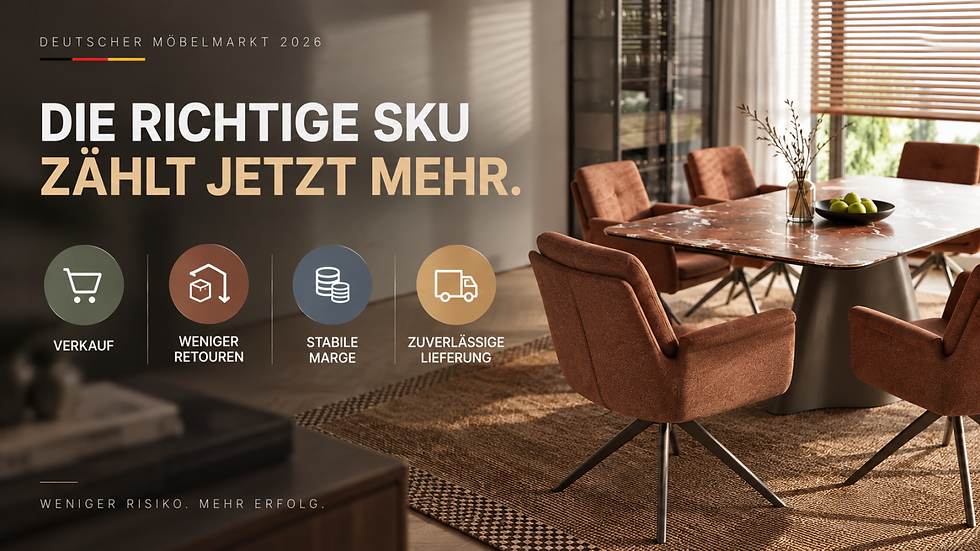
In a Difficult Market, Every SKU Has to Work Harder
When demand is strong, retailers have more room to experiment.
An unusual fabric, a new silhouette or a fashionable colour might be enough reason to add another product to the collection.
When consumers become more cautious, however, a weak SKU becomes much more expensive.
Stock turns more slowly.
Prices are easier to compare.
Promotions put pressure on margins.
And a product with a high return or complaint rate can lose its commercial appeal very quickly.
That changes the conversation between buyer and supplier.
The first question should no longer simply be:
“Is this design new?”
It should be:
“Can this product work commercially?”
In my experience, that comes down to four questions.
1. Will This SKU Actually Sell?
Design still matters. Of course it does.
But new does not automatically mean commercially successful.
I have seen dining chairs that look excellent as samples. Put them under showroom lighting and they immediately attract attention.
But a good-looking sample is only the beginning.
The proportions may not suit the target customer.
The seat may look comfortable but feel too firm after ten minutes.
A colour may photograph beautifully but prove difficult to combine with the dining tables already in a retailer's collection.
Or a fashionable design detail may make the chair distinctive while quietly reducing the number of customers willing to buy it.
This is why I believe product development should not begin with the designer alone.
It should begin with the market.
For Germany, for example, we increasingly look at questions such as:
Which upholstery fabrics are gaining relevance?
Are buyers showing more interest in swivel dining chairs than fixed-frame models?
In which applications does an auto-return swivel mechanism create genuine commercial value?
Which colours work across several interior styles rather than one narrow trend?
Can one chair platform be positioned across different price points through fabrics, stitching details or frame options?
That last question is particularly important.
A commercially intelligent collection does not necessarily need dozens of completely different chairs. Sometimes a strong seat shell, combined with carefully selected upholstery and base options, can cover several customer groups while keeping development and inventory complexity under control.
The objective should not simply be to develop more new designs.
It should be to develop more products that can actually sell.
2. Does the Product Still Make Financial Sense After Delivery?
This is where looking at a product and looking at its business case become two very different things.
A chair may be slightly cheaper to purchase.
But what happens afterwards?
If it creates more complaints, assembly problems, damage or returns, that purchasing advantage can disappear surprisingly quickly.
Imagine a small issue repeated across an order of 500 or 1,000 chairs.
A swivel mechanism begins to make noise.
A metal frame develops slight movement after repeated use.
Stitching positions vary from one production batch to another.
Or the carton does not provide enough protection during parcel delivery.
On one chair, these may look like minor problems.
Across 1,000 chairs, they are no longer minor.
They become a commercial issue.
For retailers and e-commerce furniture businesses in particular, I believe return rate should be treated as part of the real product cost.
This is why testing, quality control and packaging development should not be technical conversations that happen after the buyer has selected the product.
They belong inside the buying decision itself.
Before approving a product, a buyer should know more than how the sample looks.
They should understand how the product behaves after repeated use, assembly and transportation.
A beautiful sample tells you what the factory can make once.
It does not yet tell you what will happen to the next 1,000 pieces.
3. Does the Margin Still Work After the Product Leaves the Factory?
Furniture sourcing discussions often focus on one very visible number:
the FOB price.
It matters. But it is only one part of the equation.
The commercial result of a furniture SKU is also influenced by:
Cost Factor | Why It Matters |
Carton volume | Affects warehousing and freight efficiency |
Container utilisation | Determines how many sellable units fit into each shipment |
Packaging materials | Must balance cost, protection and sustainability |
Assembly time | Influences customer experience and after-sales issues |
Transport damage | Creates replacement, service and margin costs |
Spare parts | Affects the cost and speed of resolving problems |
Return rate | Directly affects the real profitability of the SKU |
Warranty and claims | Add cost long after the FOB invoice has been paid |
This is where buying decisions can become deceptive.
Suppose Chair A is €2 cheaper at factory level than Chair B.
Easy decision?
Not necessarily.
If Chair A requires a significantly larger carton, fewer pieces fit into the container. The apparent €2 saving can quickly be absorbed by freight.
Likewise, a fully assembled chair may look attractive from a consumer perspective, but its shipping volume may make the logistics unnecessarily expensive.
And saving a small amount on packaging is not really a saving if transport damage starts to rise.
That is why I encourage buyers to look at the total commercial economics of the SKU, rather than factory price alone.
The cheapest SKU leaving the factory is not automatically the most profitable SKU reaching the customer.
4. Can the Supplier Reproduce the Same Result 1,000 Times?
This may be the most underestimated question in furniture sourcing.
A good sample proves one thing:
the supplier can make one good product.
It does not prove that the supplier can reproduce the same result consistently in mass production.
There is a big difference.
Once two development samples become an order for 500 or 1,000 dining chairs, entirely different questions appear.
Will the upholstery colour remain consistent between batches?
Will welding points and frame dimensions stay within the required tolerances?
Will every swivel mechanism have a similar feel?
Will the stitching remain in the same position?
Can spare parts still be supplied reliably later?
And when the next order arrives six months later, will the product still match the first production run?
For professional purchasing teams, consistency can sometimes be more valuable than perfection.
Why?
Because predictability makes inventory planning easier.
It simplifies after-sales service.
It reduces uncertainty when placing repeat orders.
And it gives the retailer confidence that the product approved during development is the product that will actually arrive in the warehouse.
In a difficult market, that reliability has real financial value.
Furniture Buying Is Increasingly Becoming Risk Management
None of this means that design suddenly stops mattering in the German furniture market.
Consumers still want attractive products.
Retailers still need newness.
Showrooms still need something that catches the eye.
But the current market makes one thing increasingly clear:
Good product development cannot stop at appearance.
For a commercially successful SKU, several elements have to work together:
Design × Price × Quality × Packaging × Logistics × Reliability
If one of those elements fails badly, the entire business case becomes weaker.
This is also changing the relationship between furniture buyers and suppliers.
The most useful sourcing conversations are becoming less about:
“Show me your newest chairs.”
And more about questions such as:
“Which products have already shown commercial potential?”
“Where are the biggest return risks?”
“How can we improve container utilisation?”
“Which construction gives us the right balance between comfort, price and durability?”
“Can you maintain this quality consistently in mass production?”
Those are much more valuable questions.
Because they move the conversation from buying furniture to building a commercially reliable furniture programme.
Buyer Checklist: Questions to Ask Before Approving a New Furniture SKU
Before adding a new dining chair or dining table to a collection, I would want clear answers to these questions:
Market fit: Who is this product really designed for?
Commercial differentiation: Is there a clear reason for the retailer to add it?
Comfort: Has the product been evaluated beyond its appearance?
Construction: Will the frame, joints and mechanisms withstand repeated use?
Quality consistency: Can specifications be maintained across hundreds or thousands of units?
Packaging: Has the packaging been developed around the actual distribution channel?
Container efficiency: Is carton volume unnecessarily increasing landed cost?
Assembly: Is assembly simple and repeatable for the end customer?
Return risk: What are the most likely reasons this product could come back?
After-sales support: Are replacement components available when required?
Repeatability: Can the next production run match the approved specification?
Total cost: Does the margin still work after logistics, returns, claims and service costs are included?
The purpose of this checklist is not to make purchasing slower.
Quite the opposite.
It is to identify expensive problems before they become purchase orders.

Fewer Wrong Products May Be More Valuable Than More New Products
2026 is once again proving to be a difficult year for the German furniture industry.
But difficult markets have a way of forcing better decisions.
When every SKU has to justify its place in a collection, product selection becomes more disciplined.
More data-driven.
More focused on total cost.
And, perhaps most importantly, more focused on what happens after the purchase order is placed.
At ASKT, this is increasingly how we approach the development of dining furniture for European buyers.
A new dining chair should do more than look good in a catalogue or showroom.
It should suit its target market.
It should withstand the relevant testing and transportation requirements.
Its packaging and structure should make logistical sense.
Its quality should remain consistent in mass production.
And the retailer should have a realistic opportunity to make the product commercially successful.
Because in today's furniture market, the objective is not simply to put more SKUs into the market.
The objective is to put fewer wrong SKUs into the market.
FAQ
What should furniture buyers consider besides the FOB price?
Buyers should consider carton volume, container utilisation, packaging, assembly requirements, transport damage, spare parts, return rates and warranty claims. These factors can significantly change the real commercial cost of a furniture SKU.
Why is supplier consistency important in furniture sourcing?
A development sample only demonstrates what a supplier can produce once. For B2B buyers, the more important question is whether the same materials, dimensions, stitching, mechanisms and finish can be reproduced consistently across mass production and repeat orders.
How can furniture buyers reduce return risk?
Return risk should be considered during product development rather than after launch. Buyers should evaluate comfort, structural durability, assembly, packaging protection, mechanism performance and production consistency before approving the final specification.
Are new furniture designs always better for retailers?
Not necessarily. A new design still needs to fit the target market, price position, existing assortment and customer expectations. In a slower market, commercially versatile and repeatable products may offer more value than novelty alone.
Why does packaging matter when selecting a dining chair supplier?
Packaging affects freight efficiency, transport damage, warehousing, parcel delivery and customer experience. A small saving in packaging cost can become expensive if it results in higher damage or return rates.
Conclusion
The German furniture market in 2026 is sending buyers a useful message.
Product selection is no longer only about finding an attractive design at an acceptable factory price.
It is increasingly about commercial resilience: choosing products that can sell, survive transport and daily use, maintain consistent quality, use logistics efficiently and protect margin after they leave the factory.
For European wholesalers, retailers and product teams evaluating new dining furniture programmes, that broader view can make the difference between simply adding another SKU and building a product that deserves to stay in the collection.
If you are evaluating dining chair or dining table suppliers for the European market, ASKT can support you with product development, quality evaluation, customisation, packaging optimisation and mass-production planning — with the aim of reducing sourcing uncertainty before the order moves into volume production.
Source: Association of the German Furniture Industry (VDM), results for the German furniture industry in the first half of 2026, published 1 September 2026.


Comments