


Chairs Wholesale Guide: Grades, Composition, and How to Optimize Performance in Industry
- Sunbin Qi

- Feb 13
- 4 min read
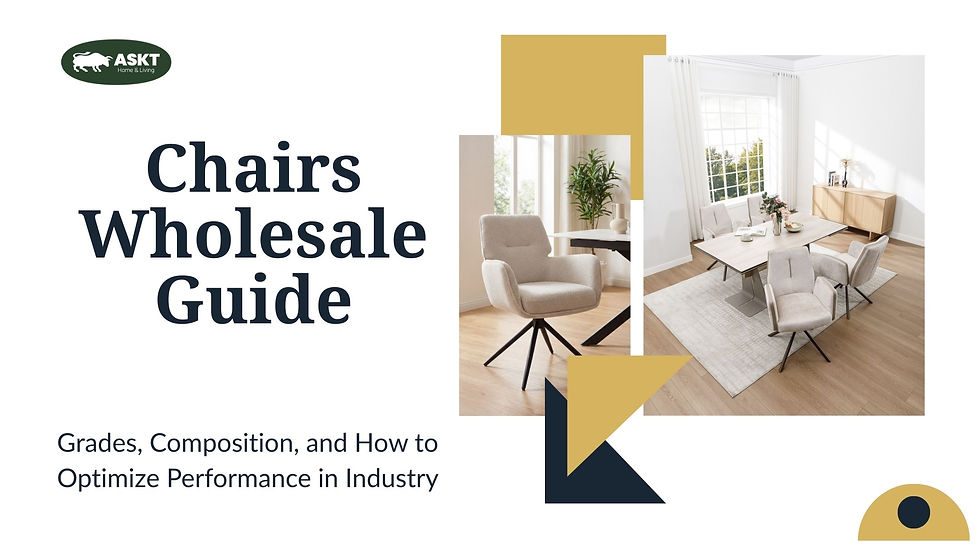
The global furniture wholesale market has shifted from simple aesthetics to a matrix of performance metrics. For B2B buyers, interior designers, and procurement officers, selecting dining and lounge seating is no longer just about the visual profile. It is about understanding the engineering behind the upholstery, the metallurgy of the frame, and the logistics of the supply chain.
This guide deconstructs the technical anatomy of wholesale chairs, defines industry grades, and outlines actionable strategies to optimize product performance for high-traffic environments.
Understanding Commercial vs. Residential Grades

The distinction between residential and commercial (contract) grade furniture is the first critical filter in wholesale sourcing. While a residential chair is engineered for intermittent use (approx. 2-3 hours daily), commercial-grade seating must withstand continuous usage (8+ hours daily) and higher static loads.
The Stability Factor and Testing Standards
For the European and North American markets, stability is non-negotiable. Professional buyers must prioritize manufacturers who adhere to specific safety directives.
EN 12520: The standard for domestic seating, focusing on strength, durability, and safety.
EN 16139: The rigorous standard for non-domestic (commercial) seating.
ANSI/BIFMA: The North American equivalent focusing on safety and performance for commercial office and institutional furnishings.
A chair that passes EN 16139 Level 1 is suitable for general contract use (offices, showrooms), while Level 2 is required for extreme use (nightclubs, transport terminals). Sourcing products with these verified test reports eliminates liability risks for retailers and distributors.
Weight Capacity and Structural Integrity
Commercial performance is defined by the frame’s ability to handle dynamic stress—the force applied when a user sits down heavily or shifts weight. Standard wholesale chairs often rate at 120kg (264lbs) static load. However, optimized industry performance requires a safety margin of up to 150kg (330lbs) or more. This is achieved not just by thickening the metal or wood, but by reinforcing the internal joinery, such as using full-weld joints in metal frames rather than spot welds, or corner-blocking in wooden structures.
Deconstructing Chair Composition
To predict the lifespan of a chair, buyers must audit its three core layers: the skeletal frame, the cushioning system, and the surface material.
Frame Materials and Engineering

The material composition of the frame dictates the chair's longevity and "hand-feel."
Steel and Iron: Powder-coated metal legs offer the highest strength-to-weight ratio. The trend in modern dining furniture is moving towards matte black or sand-blasted finishes which hide scuffs better than high-gloss chrome.
Solid Wood vs. Plywood: While solid wood legs (Oak, Beech, Rubberwood) offer a premium aesthetic, internal structures often utilize multi-layer plywood for the seat shell. This engineered wood prevents warping under humidity changes, a common issue in global shipping.
Hybrid Structures: Many high-performance "Lounge-Dining" hybrids utilize an internal metal skeleton overmolded with foam, providing the durability of a task chair with the aesthetics of a club chair.
Foam Density and Resilience
The most common failure point in wholesale seating is foam collapse. The industry standard for residential foam density is often 24-28kg/m³. However, for wholesale optimization, the baseline must be raised.
High Resilience (HR) Foam: A density of 35kg/m³ to 45kg/m³ is recommended for seat cushions. This ensures the foam rebounds instantly after use and retains its shape over years of service.
Molded Foam: Unlike cut foam (which is sliced from a block), molded foam is injected into a specific mold. This creates a consistent density skin that is impervious to crumbling, significantly extending the product lifecycle.
Upholstery Metrics
The fabric is the interface between the user and the product. Durability here is measured in "Martindale Cycles."
< 15,000 Cycles: Decorative use only.
20,000 - 40,000 Cycles: General domestic use.
> 50,000 Cycles: Commercial grade.
For dining environments, the "Hydrolysis Resistance" (resistance to humidity and sweat) and "Easy-Clean" properties are equally important. Polyester blends are currently the wholesale market leader due to their high abrasion resistance and colorfastness compared to natural fibers.
Optimizing Performance in Industry Applications

Wholesalers and retailers can optimize their portfolio performance by selecting features that solve specific end-user pain points.
The Rise of the Hybrid Lounge
Modern spatial design blends the dining room, home office, and living area. The "Dining Lounge" category—chairs that feature wider seats, armrests, and reduced seat heights—optimizes inventory by serving multiple use cases. Products with "wraparound" backrests offer the ergonomic support needed for extended working hours at a dining table, increasing their sell-through rate to remote workers.
Auto-Return Technology

In commercial settings like conference rooms and restaurants, maintaining a tidy appearance is labor-intensive. Swivel chairs equipped with Auto-Return Memory Cylinders automatically rotate back to a centered position when the user stands up. This mechanical optimization reduces the need for staff to constantly rearrange furniture, a tangible operational benefit for B2B clients.
Zero-Plastic Packaging Solutions
Performance extends to logistics. With the European Union’s stringent plastic taxes and sustainability mandates (such as the German Packaging Act), optimizing packaging is a financial imperative. Replacing Expanded Polystyrene (EPS) and plastic wraps with honeycomb paper and cardboard-engineered protection reduces import duties and appeals to eco-conscious consumers. This "Green Compliance" is a silent value-add that differentiates sophisticated wholesalers from budget importers.
Comparative Specifications for Wholesale Buyers
The following table outlines the technical divergence between standard entry-level inventory and optimized professional-grade specifications.
Component | Standard Residential Spec | Professional / Contract Spec | Performance & Optimization Benefit |
Internal Frame | Plywood (10-12mm) or Spot-welded tube | Reinforced Plywood (14mm+) or Full-weld Steel | Increases static load capacity to 150kg+; prevents squeaking and structural failure. |
Cushioning | 24-28kg/m³ Cut Foam | 40kg/m³ High Resilience or Molded Foam | Prevents seat sagging; maintains ergonomic support for 8+ hour sitting durations. |
Fabric Durability | 15,000 - 20,000 Martindale Rubs | 50,000+ Martindale Rubs | Resists visible wear in high-traffic zones; extends replacement cycles. |
Leg Attachment | Direct screw into wood | Metal-to-Metal Bolt inserts | Allows for repeated tightening without stripping threads; essential for KD (Knock-Down) stability. |
Base Mechanism | Fixed or Basic Swivel | Auto-Return Swivel (180°/360°) | Keeps venues orderly; enhances user experience in multi-functional spaces. |
Packaging | PE Foam & Plastic Tape | Honeycomb Paper & Paper Tape (Zero Plastic) | Reduces import taxes; complies with EU REACH and environmental directives. |
Conclusion

Optimizing a wholesale chair portfolio requires a departure from sourcing based solely on price per unit. By prioritizing structural composition—specifically high-density foams, welded metal frames, and high-abrasion fabrics—wholesalers can secure higher margins and lower return rates. Furthermore, integrating functional technologies like auto-return swivels and adhering to sustainable "Zero Plastic" packaging standards positions a brand as a forward-thinking leader in the global furniture market. The future of the industry belongs to those who understand that a chair is not just a seat, but a calibrated engineered product.


Comments