


Why One-Size-Fits-All Dining Chair Assortments Are a Risk for German Furniture Retailers


The German furniture retail environment (Möbelhandel) is currently navigating a period of intense structural correction. With a projected turnover decline of up to 1.6% through 2025, stationary trade (Stationärer Handel) faces unprecedented pressure from rising operational costs and thinning margins (Marge). In this climate, the traditional strategy of maintaining a massive, generic 'Sortiment' (assortment) has shifted from a competitive advantage to a significant financial liability.
The Stationary Trade Trap: Why Variety No Longer Equals Sales

Historically, German retailers believed that a wide variety of dining chairs—covering every possible price point and style—was necessary to capture the market. However, in today's economy, 'Abverkauf' (sell-through) rates for generic items are plummeting. For the 'Einkaufsleiter' (Procurement Manager), a broad but shallow assortment leads to 'Lagerdruck' (inventory pressure), where capital is locked in slow-moving items, often referred to in the industry as 'Penner-Artikel'.
When a retailer adopts a 'One-Size-Fits-All' sourcing strategy, they often sacrifice depth for breadth. This results in a lack of specialization and, more critically, a failure to meet the increasing demand for durability and customization. ASKT Furniture has observed that retailers who consolidate their SKU count while increasing the quality of their core offerings see a direct improvement in their 'Cashflow' and reduced logistical strain.
The Hidden Costs of Assortment Bloat: Capital and Reklamation
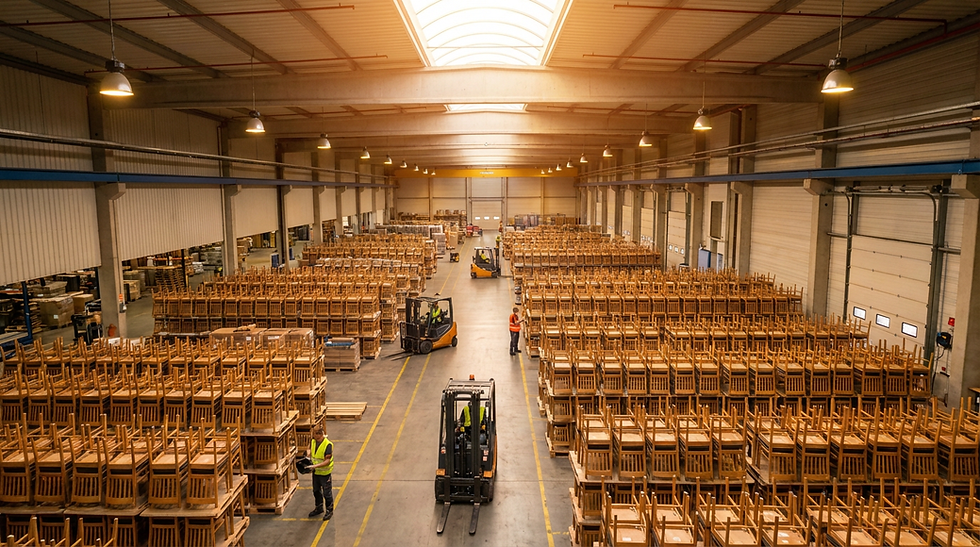
Every SKU in your warehouse carries a hidden cost. Beyond the purchase price, there is the cost of space, the risk of obsolescence, and the administrative burden of managing multiple suppliers. For German retailers, a high 'Reklamationsquote' (complaint rate) is the silent killer of 'Marge'. Generic dining chairs, often sourced from mass-market wholesalers without rigorous quality control, frequently fail in real-world residential or light-commercial use.
At ASKT Furniture, with over 15 years of manufacturing experience and ISO 9001 certification, we emphasize that quality is a risk-mitigation tool. A single 'Reklamation' can negate the profit of five successful sales when considering the costs of logistics, customer service, and replacement. Transitioning to commercial-grade chairs—designed for the rigors of the hospitality industry but styled for the home—significantly reduces these post-sale costs.
Decision Framework: Assessing SKU Efficiency in Dining Chairs
To optimize your 'Sortiment', you must move beyond simple sales volume and look at 'SKU Efficiency'. Use the following evaluation matrix to determine which products deserve a place in your 2026 collection:
Metric | Generic Sourcing Risk | Strategic Commercial Sourcing (ASKT) |
MOQ Flexibility | High (500+ pcs), leading to overstock | Flexible (200 pcs), allowing for market testing |
Quality Assurance | Variable; high 'Reklamationsquote' | ISO 9001 Certified; commercial-grade durability |
Lead Time | Unpredictable (60-90+ days) | Stable 45-day delivery for better 'Restocking' |
Customization | Limited to 'Off-the-shelf' designs | Full support for bespoke finishes and fabrics |
Margin Protection | Low; price wars with online discounters | High; unique value proposition and lower service costs |
Common Mistakes in Dining Chair Procurement
Over-ordering for Unit Price: Many 'Einkaufsleiter' are lured by a 5% discount for ordering 1,000 units, only to lose 20% in 'Marge' due to long-term storage and eventual clearance of 'Penner-Artikel'.
Ignoring the 'Commercial-Grade' Edge: Residential retailers often ignore the durability standards required by the B2B or hospitality-adjacent market, leading to higher failure rates in modern, high-use households.
Supplier Fragmentation: Managing 20 different factories for 20 different styles creates a nightmare for 'Lieferzuverlässigkeit' (delivery reliability).
Checklist: The German Retailer’s Sourcing Audit for 2026
Before finalizing your next procurement cycle, evaluate your current dining chair suppliers against these criteria:
Certification: Does the manufacturer hold ISO 9001 or equivalent quality certifications?
MOQ Agility: Can the supplier support a 200-piece MOQ to minimize 'Lagerdruck'?
Delivery Reliability: Is there a proven track record of 45-day lead times to ensure consistent 'Abverkauf'?
Technical Support: Does the supplier provide detailed material specifications (wood type, fabric Martindale rub count, metal gauge)?
Customization: Can the supplier adapt designs to meet specific local market trends without massive cost increases?
Strategic Solution: Transitioning to Flexible MOQs and Reliable Lead Times

ASKT Furniture addresses the core pain points of the German 'Einkaufsleiter' by providing a middle ground between mass production and bespoke craftsmanship. By offering a flexible MOQ of 200 pieces, we allow retailers to curate a more precise 'Sortiment' without the financial risk of excessive inventory. Our 45-day delivery window supports 'Just-in-Time' inventory management, which is essential for maintaining healthy 'Cashflow' in a stagnant retail market.
Furthermore, our focus on commercial seating solutions means that our chairs are built to exceed standard residential durability requirements. This directly impacts your 'Reklamationsquote', ensuring that once a product is sold, it stays sold.
FAQ Section
How does a wide dining chair assortment impact my 'Lagerdruck' and cash flow?
Excessive SKUs divide your marketing and sales focus, leading to slower inventory turnover and capital being tied up in non-performing assets.
Why is the 'One-Size-Fits-All' approach causing high 'Reklamation' rates?
Generic products are often engineered for the lowest possible cost, sacrificing the structural integrity needed for daily use, leading to frame failures or fabric wear.
How can a flexible MOQ of 200 pieces help me test new designs?
It allows you to introduce trend-led designs to your showrooms with minimal capital exposure, allowing for data-driven decisions on which items to scale.
Conclusion

In the current German retail climate, the risk of 'One-Size-Fits-All' sourcing is no longer sustainable. Success for the modern 'Einkaufsleiter' lies in SKU rationalization, prioritizing commercial-grade quality, and partnering with manufacturers like ASKT Furniture who offer the flexibility and reliability required to protect your 'Marge'.
Do you want me to send you a practical evaluation checklist or decision framework for your next procurement meeting?


Comments