


As IKEA Expands Smaller Stores, What Does It Mean for Furniture Suppliers?

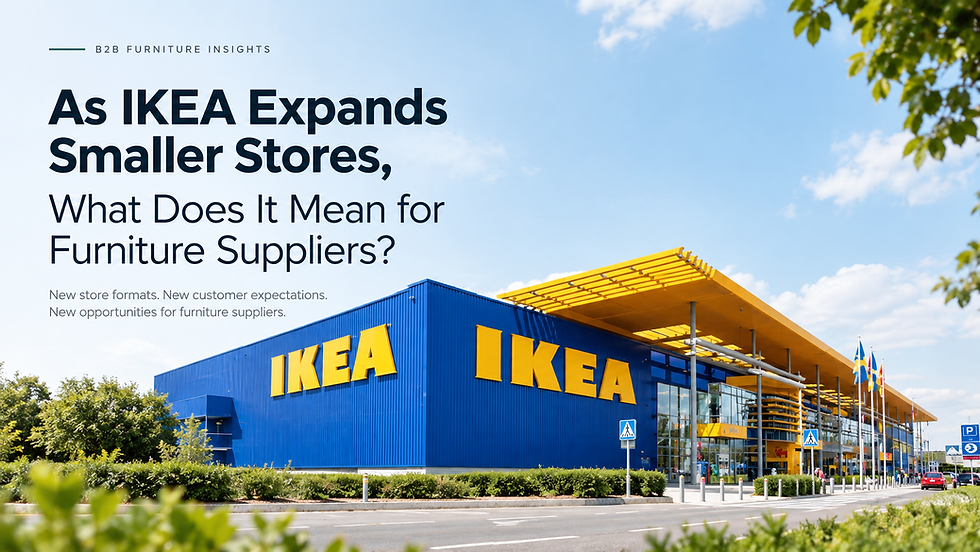
For years, the furniture retail model in Europe was relatively straightforward. Large showrooms displayed extensive collections, customers visited to compare products, and retailers relied on established inventory and distribution systems.
But what happens when the showroom becomes smaller while customers still expect a wide choice?
This question is becoming increasingly relevant as IKEA expands its smaller-store format across Europe.
According to an October 2026 report by Metro Mode, IKEA plans to open approximately ten smaller stores in Sweden over the next three years, bringing its products closer to customers in smaller towns and suburban areas. These stores are expected to carry thousands of products for immediate purchase while allowing customers to order from the wider IKEA range.
Metro Mode
This follows Ingka Group's March 2026 announcement of plans for 20 smaller stores across Europe and North America. The company described a model combining a selected in-store assortment with access to the full range through collection and delivery services.
Ingka Group
For furniture suppliers, the interesting question is not simply how many stores IKEA will open.
It is what this retail model could mean for product development, inventory planning, showroom presentation and sourcing flexibility.
From my perspective, working with European furniture buyers, one lesson is particularly relevant: a supplier's ability to support a commercially manageable product collection can be just as important as its ability to manufacture an individual product.
1. Smaller Furniture Stores Are Changing the Role of the Showroom

Traditional furniture showrooms allow customers to compare numerous dining chairs, tables, fabrics and finishes in person.
Smaller stores cannot necessarily display the same range.
However, a smaller showroom does not have to mean fewer choices for customers.
IKEA's approach illustrates how a retailer can combine a physical selection with a much broader catalogue available through ordering and delivery.
For furniture retailers, this creates an important distinction between two types of products:
Display products: Selected items that help customers understand design, comfort, materials and quality.
Orderable products: Additional colours, finishes, sizes and configurations that customers can purchase without seeing every variation on the showroom floor.
Consider a furniture retailer offering upholstered dining chairs in four fabric colours and three different base designs.
Displaying every combination would require twelve chairs.
A smaller showroom might instead display three carefully selected examples, supported by fabric swatches, product photography and clear ordering information.
The customer still has access to twelve possible configurations, but the retailer uses less display space.
Of course, this approach only works when customers can confidently understand the variations they are ordering.
That makes accurate product specifications, consistent materials and reliable manufacturing increasingly important.
What this means for suppliers
Furniture manufacturers may need to think beyond individual product models.
They should be prepared to support retailers with coordinated collections, material samples, technical information and consistent specifications across multiple product variations.
For dining chair manufacturers, the challenge is no longer only to develop an attractive chair.
It is to develop a collection that retailers can present, explain and manage efficiently.
2. SKU Management Becomes More Important When Retail Space Is Limited
One of the biggest challenges in furniture purchasing is balancing product variety against inventory complexity.
Customers want choice.
Purchasing managers want manageable stock levels.
Product managers want collections that remain commercially relevant without creating unnecessary duplication.
These objectives do not always align.
A dining chair collection can quickly become complicated when each model has several upholstery colours, metal finishes and base configurations.
For example, imagine a collection with:
Product element | Available options |
Seat shell designs | 3 |
Upholstery colours | 4 |
Base configurations | 3 |
Total possible combinations | 36 |
This is a hypothetical example, but it demonstrates how quickly a relatively simple collection can expand into dozens of SKUs.
For a large furniture retailer, managing these combinations requires careful planning.
For a smaller retail format, the challenge can be even greater because physical display space and local stock capacity may be more limited.
The difference between product variety and inventory variety
A retailer may want to offer 36 possible configurations without holding significant quantities of all 36.
That requires decisions about which combinations should be stocked, which should be displayed and which can be ordered according to demand.
Suppliers can support this process by developing collections around shared components and clearly defined product variations.
However, modularity alone does not eliminate inventory risk.
A buyer must still consider minimum order quantities, component availability, replenishment lead times and whether the supplier can maintain consistent materials across future production batches.
The objective should be to provide meaningful customer choice without introducing unnecessary purchasing complexity.
3. Why Modular Dining Chair Systems Deserve More Attention

This is where modular product development becomes particularly relevant.
Instead of treating every dining chair as an entirely separate product, manufacturers can develop collections using selected common components.
For example, several upholstered seat shells might be paired with compatible metal bases to create different designs and functions.
A buyer could potentially offer a coordinated collection featuring fixed-leg dining chairs, swivel chairs and other configurations without developing every model independently.
The business value is not simply more designs.
It is greater control over how those designs are developed, presented and purchased.
How ASKT approaches modular product development
At ASKT, we have developed the KINEXA modular system around the principle of combining selected standardised seat shells and bases.
The intention is to help professional furniture buyers manage product variety more systematically.
Rather than approaching every chair variation as a completely separate development project, the system provides a structured basis for discussing combinations, specifications and collection planning.
For a European retailer, this approach can offer several practical advantages.
First, a more coordinated collection. Related chair designs can share a consistent visual identity while offering different upholstery and base options.
Second, a more efficient development process. Standardised components can reduce the need to redesign every product from the beginning, provided the combinations have been technically validated.
Third, more flexible collection planning. Buyers can discuss which configurations deserve showroom space, which should be part of the core assortment and which may be better suited to special orders.
Fourth, clearer purchasing discussions. Component-based product planning can help buyers and suppliers identify the effect of different configurations on costs, MOQ and production arrangements.
There are limits, however.
Not every seat shell is compatible with every base. Changes in structure, swivel mechanisms or dimensions may affect stability, durability and testing requirements.
A modular collection must therefore be supported by proper engineering and quality evaluation.
For buyers, this is an important distinction: a flexible product system should never come at the expense of product safety or consistency.
4. Smaller Showrooms May Require Smarter Sample Strategies
For upholstered dining furniture, physical samples remain valuable.
A photograph can show the shape of a chair, but it cannot fully communicate seat comfort, upholstery texture, backrest support or the feeling of a swivel mechanism.
Customers often want to sit on a dining chair before making a decision.
This creates a challenge for retailers operating smaller showrooms.
How can they demonstrate the quality of a broad collection without displaying every variation?
One approach is to develop a representative sample strategy.
A retailer might display a fixed-leg dining chair, a swivel version and a premium upholstered model, then use fabric samples and digital product information to explain the remaining options.
The selection should demonstrate meaningful differences rather than simply showing multiple colours of the same chair.
What suppliers should provide
A manufacturer supporting this model should consider more than finished product samples.
Useful materials may include upholstery swatches, metal finish samples, accurate dimensions, product photographs, assembly instructions and technical documentation.
For products with special functions, such as 180° or 360° swivel mechanisms or auto-return bases, a physical demonstration may be particularly important.
The retailer should also know whether a displayed configuration is representative of the other versions offered.
For example, changing from a fixed base to a swivel base may affect seat height, movement and overall sitting experience.
These details matter because customers expect the product delivered to their homes to match the product they selected.
5. Supply Chain Responsiveness Is More Than Fast Production
When retailers operate across multiple store formats, supply chain coordination can become more complex.
A large showroom, a compact store and an online channel may all sell the same collection, but their stock requirements and fulfilment arrangements can differ.
A purchasing manager may need to coordinate central warehouse inventory, replenishment orders, new collection launches and seasonal demand.
For suppliers, this creates a need for reliable information and realistic production planning.
The important question is not simply, "How quickly can you manufacture this chair?"
It is also, "How reliably can you support this collection over time?"
Four areas purchasing managers should evaluate
Purchasing consideration | Why it matters |
MOQ flexibility | Helps buyers assess whether order quantities fit their stock and sales plans |
Production consistency | Reduces differences between showroom samples and later deliveries |
Lead-time visibility | Supports replenishment and promotional planning |
Packaging efficiency | Influences freight costs, warehouse handling and damage risk |
A supplier offering a short lead time is not necessarily the most suitable partner if product specifications change between batches or communication is unreliable.
Similarly, a low unit price may become less attractive when packaging damage, complicated assembly or excess stock creates additional costs.
This is why European buyers should evaluate the total purchasing process rather than compare quotations alone.
The role of KD furniture construction
Knock-down (KD) dining chairs can be relevant to this discussion.
Where technically appropriate, a KD structure can reduce packaged volume and improve container loading efficiency.
This may help retailers and importers manage freight and warehouse space.
However, buyers should also consider assembly time, joint strength, packaging protection and customer experience.
A smaller carton is only beneficial when the product remains safe, stable and practical to assemble.
6. European Market Understanding Still Matters
A compact retail format may change how products are presented, but it does not remove the importance of local customer preferences.
European furniture markets are not identical.
A collection developed for a German furniture chain may require different styling, upholstery choices or price positioning from one intended for a Dutch retailer or a British online furniture brand.
Even within the same country, product preferences can vary according to customer segment, housing type and retailer positioning.
For dining furniture suppliers, understanding these differences is an important part of product development.
At ASKT, our work with European furniture buyers has reinforced the value of studying how dining furniture is actually used.
Our product development approach has included research into German household dining environments, considering factors such as table combinations, room arrangements and interior colours.
These observations help inform design decisions rather than relying only on international trend images.
Product details that influence purchasing decisions
Consider the difference between two upholstered dining chairs.
Both may look attractive in a catalogue.
But one may offer a more supportive backrest, a practical seat height, a stable metal frame and an easy-clean fabric.
For a retailer targeting families or customers who use their dining areas frequently, these details may be commercially significant.
Likewise, swivel and auto-return mechanisms can influence how a chair functions around a dining table.
The relevant question is whether these features fit the intended customer and price segment.
A product feature should have a clear purpose.
This is particularly important when retailers have limited space to communicate why one model deserves attention over another.
7. OEM and ODM Flexibility Can Help Retailers Build More Focused Collections

Smaller-store expansion does not mean every furniture retailer needs the same products.
In fact, a carefully selected collection may make differentiation more important.
A retailer with limited showroom space needs to decide which products represent its brand most effectively.
That may involve exclusive upholstery colours, particular metal finishes, different seat proportions or coordinated dining table and chair combinations.
OEM and ODM development can support these requirements.
For example, a retailer may identify an existing dining chair structure that suits its market but request a different fabric, frame finish or packaging configuration.
Another buyer may need a more substantial development project involving the chair's dimensions, seat construction or base design.
The commercial and technical implications are different.
Simple cosmetic changes may be easier to manage, while structural modifications can require additional engineering, tooling, sampling and testing.
At ASKT, we support European B2B buyers with furniture customisation and collection development, including fabrics, colours, frames, dimensions and packaging.
The objective is to help buyers develop products that fit their retail positioning while maintaining attention to manufacturing consistency.
For buyers planning several store formats, the ability to maintain a recognisable collection across different channels can be particularly useful.
8. What Furniture Buyers Should Ask Their Suppliers Before Expanding
For purchasing managers evaluating suppliers for a smaller-store or omnichannel retail model, the following checklist provides a practical starting point.
Furniture supplier evaluation checklist
Can the supplier develop coordinated product families rather than isolated models?
Which upholstery, colour and base variations are technically validated?
Can the supplier provide representative samples and accurate product specifications?
What are the MOQ requirements for different configurations?
How are materials and product quality controlled between production batches?
Can packaging be optimised without compromising product protection?
What lead-time and replenishment arrangements are realistically available?
Can the supplier support OEM/ODM development and market-specific collections?
0 of 8 reviewed Copy checklist
These questions are useful regardless of whether a retailer is opening compact stores, expanding e-commerce operations or simply improving an existing furniture collection.
The answers should be supported by product samples, technical documentation and clear commercial terms.
9. What IKEA's Strategy Does — and Does Not — Tell Us
It is important not to overinterpret IKEA's expansion.
The company's smaller stores are intended to complement its existing retail network, not necessarily replace large-format stores.
IKEA has also not publicly established, through these announcements, that all furniture suppliers must adopt modular products or that smaller stores will automatically reduce inventory costs.
Nevertheless, the strategy highlights several questions that other furniture retailers may need to consider.
How much physical display space is necessary to sell a collection effectively?
How can retailers offer meaningful choice without holding every variation locally?
How should suppliers support product consistency when customers order through different channels?
And how can furniture collections be developed with both retail presentation and supply chain efficiency in mind?
These are not entirely new questions.
What is changing is the context in which buyers must answer them.
10. Frequently Asked Questions
Will smaller furniture stores replace traditional large showrooms?
Not necessarily. IKEA describes its compact stores as a complement to traditional stores and digital channels. Different formats can serve different customer needs, from quick purchases to larger home furnishing projects.
Why is SKU management important for compact furniture stores?
Smaller stores have limited display and local storage space. Retailers must decide which products to display, stock and offer through ordering channels. Effective SKU management helps balance customer choice with inventory complexity.
Can modular dining chairs reduce inventory risk?
Modular product systems can support more structured collection planning and component standardisation. However, actual inventory benefits depend on MOQ, demand forecasting, component availability and replenishment arrangements. They should not be assumed without commercial analysis.
What should European furniture buyers look for in a dining chair supplier?
Important considerations include product development capability, structural quality, upholstery performance, production consistency, realistic lead times, packaging protection and the ability to support market-specific requirements.
How can OEM and ODM manufacturing support furniture retail chains?
OEM and ODM services allow retailers to adapt or develop products according to their market positioning. This can include customised upholstery, frame finishes, dimensions, functions and packaging, subject to technical and commercial feasibility.
Conclusion: The Future of Furniture Retail Requires More Flexible Thinking

IKEA's smaller-store expansion is an interesting development in European furniture retail.
But the wider lesson for furniture suppliers is not that every retailer will suddenly need smaller products or entirely different collections.
It is that furniture retailing increasingly involves several connected decisions: what to display, what to stock, what to offer through ordering channels and how to fulfil those orders reliably.
For suppliers, this creates an opportunity to contribute more than manufacturing capacity.
A well-developed furniture collection should consider product design, customer preferences, SKU complexity, quality consistency and logistics from the beginning.
For European furniture buyers, the right supplier relationship can make these decisions easier to manage.
At ASKT, our focus on dining furniture, European market requirements and modular product development reflects this approach. Through systems such as KINEXA, alongside OEM/ODM support and manufacturing quality control, we aim to help buyers build collections that are both commercially relevant and practical to source.
Smaller stores may be changing how furniture is sold. The opportunity for suppliers is to rethink how furniture collections are developed and managed.
If you are reviewing your dining chair or dining table range for the European market, ASKT can support discussions around collection development, product customisation, quality requirements and sourcing arrangements.


Comments