


Modular Furniture Development: How SKU Optimization and Strategic MOQs Reduce Sourcing Risk

Modular furniture development allows European furniture buyers to expand retail assortments while drastically lowering inventory risk and container MOQ thresholds through interchangeable, standardised seat shells and base frames. By separating structural components from aesthetic options, purchasing managers can achieve extensive SKU variety from a compact set of core inventory, streamlining procurement costs and maintaining robust supply chain efficiency across demanding retail and contract markets.
What Structural Sourcing Challenges Do European Furniture Buyers Face with Conventional SKU Proliferation?
Managing category growth across European retail chains, wholesale networks, and e-commerce platforms creates a constant tension between catalogue diversity and working capital exposure. Product managers and purchasing directors must continuously balance commercial demand for aesthetic variation—such as varied upholstery fabrics, distinct colourways, and diverse leg finishes—against severe operational constraints imposed by conventional furniture manufacturing.
In standard furniture procurement, every single distinct style permutation is treated as a dedicated, indivisible stock-keeping unit (SKU) manufactured as a complete, fixed unit. When European importers order finished dining chairs from overseas factories, suppliers enforce strict minimum order quantities (MOQs) on a per-model, per-colour, and per-leg basis. Meeting these individual production runs forces buyers into purchasing full container loads (FCL) of narrow variations. This dynamic ties up substantial working capital in slow-moving stock while simultaneously running the risk of stockouts on top-performing colourways.
Working Capital Lock-in: Full container commitments across diverse individual designs rapidly exhaust open procurement budgets, leaving little liquidity for mid-season reorders.
High Warehouse Carrying Costs: Fully assembled or non-standard knock-down furniture items consume significant cubic meter (CBM) volume in European distribution centres, driving up storage overhead.
Terminal Inventory Write-downs: Unsold niche colourways or discontinued leg configurations inevitably end up as heavily discounted surplus stock, eroding overall gross margins.
Supply Chain Inflexibility: Sudden shifts in consumer preferences or regional design trends leave buyers stranded with rigid production runs that cannot be repurposed for other collections.
Forecasting Inaccuracy: Predicting the exact velocity of twelve distinct static chair models is statistically far more error-prone than forecasting component-level demand for core materials.
This operational friction is particularly acute in mature markets such as Germany, the Netherlands, the UK, Poland, Switzerland, and Ireland, where end consumers expect extensive interior choices while retail buyers operate under strict margin and inventory turnover benchmarks. Conventional manufacturing structures force buyers into an unviable compromise: either offer a shallow, uncompetitive product catalogue or accept excessive financial and inventory carrying risks.
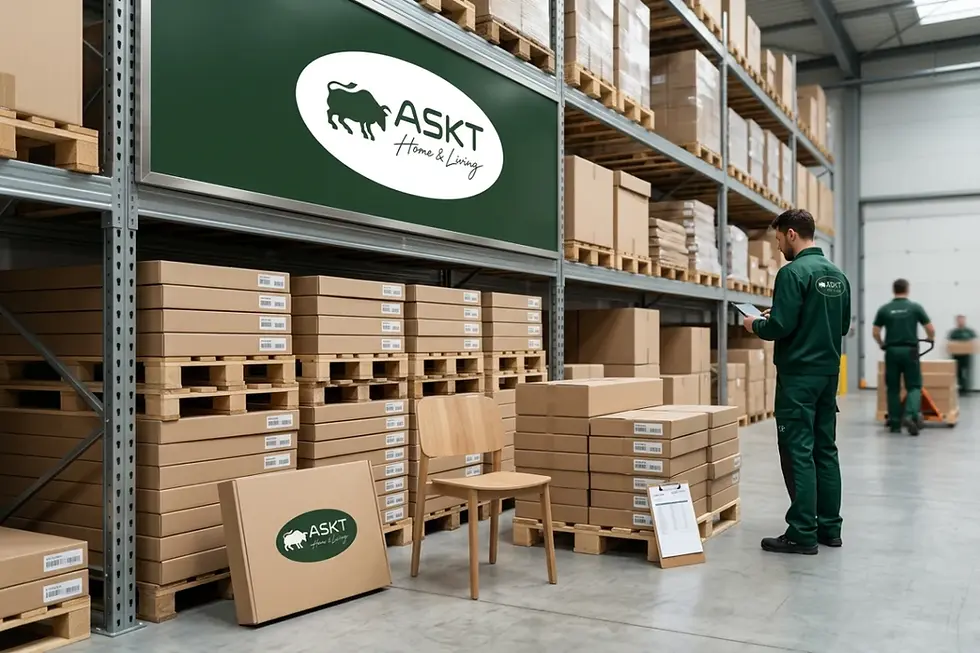
Standardized KD component packaging significantly improves warehouse space efficiency and reduces ocean freight volume.
How Does a Modular Furniture Development Strategy Transform Minimum Order Quantities (MOQ)?
Modular furniture development fundamentally restructures the traditional bill of materials (BOM) by uncoupling the upholstered seat unit from the supporting metal or wooden substructure. Instead of purchasing an indivisible, single-SKU dining chair, procurement teams acquire an ecosystem of standardised sub-assemblies that combine dynamically to create finished commercial products.
This architecture transforms the traditional furniture MOQ strategy. Rather than committing to a factory MOQ of 300 to 500 units for a single fixed chair model, buyers fulfill supplier component minimums across unified, interchangeable parts. A single container load can be configured with universal seat shells in high-runner fabrics alongside a curated selection of base frames, allowing the importer to generate dozens of distinct commercial variants upon final assembly.
Component-Level Volume Aggregation: Factory batch production runs are achieved by manufacturing large volumes of standardized seat shells and frames rather than fragmented, short-run finished products.
Flexible Container Filling: Sourcing teams can mix and match universal sub-assemblies within a 40HQ container to satisfy factory thresholds without overstocking any individual finished SKU.
Late-Stage Configuration: Sub-assemblies can be married at regional European fulfillment hubs, warehouse facilities, or packed as specific knock-down (KD) sets based on real-time market demand.
Lower Initial Investment per Product Line: Introducing a new design variation requires testing only a new shell silhouette or a new base finish rather than engineering and tooling an entirely new chair from scratch.
Stabilized Lead Times: Standardized metal bases and internal frames can be pre-manufactured in bulk, shortening final upholstery lead times and accelerating reorder cycles.
By decoupling inventory risk from catalogue breadth, European commercial buyers can maintain lean safety stocks in their domestic warehouses while presenting a wide, dynamic collection to retail customers, commercial hospitality specifiers, and contract purchasing groups.
What Is a Modular Dining Chair System and How Does Component Interchangeability Function?
At the technical level, a modular dining chair system is an integrated engineering framework where seating bodies and base substructures share identical mechanical interfaces. In a fully optimized system, mechanical connection points are standardized with fixed dimensions, uniform fastener positions, and tight manufacturing tolerances.
In standard manufacturing, chairs are developed as isolated designs where each shell silhouette requires a dedicated frame with bespoke hole positions. In contrast, an engineered modular framework standardizes the mounting interface across an entire product family. This allows an armless dining chair, a tub-style carver chair, or an upholstered lounge shell to mount interchangeably onto static four-leg frames, sled bases, or 360-degree swivel frames equipped with auto-return mechanisms.
Universal Interface Geometry: Precision-aligned bolt patterns and reinforced internal threaded inserts ensure that any approved seat shell fits any compatible base frame without modification or secondary drilling.
Interchangeable Upholstery Shells: Ergonomic shells available in diverse profiles, from minimalist polypropylene and bentwood cores to high-density foam padding and pocket-spring seating construction.
Material and Finish Adaptability: Upholstered shells can incorporate high-performance textiles—such as water-repellent, easy-clean, pet-friendly fabrics, or certified sustainable textiles—while base frames utilize powder-coated steel, brushed finishes, or wood-look metal.
Mechanical Strength Continuity: Standardized mounting plates distribute mechanical stress evenly across the joint, ensuring that every configuration satisfies European durability benchmarks such as EN 12520 testing for domestic and non-domestic seating.
Simplified Assembly Instructions: Standardized hardware kits and uniform screw sizes simplify assembly for both end consumers and contract installation teams, reducing customer support tickets.
This engineering discipline enables category managers to formulate tailored product families for residential retail collections, high-traffic restaurant dining rooms, or commercial hospitality spaces using an interchangeable kit of factory-certified parts.
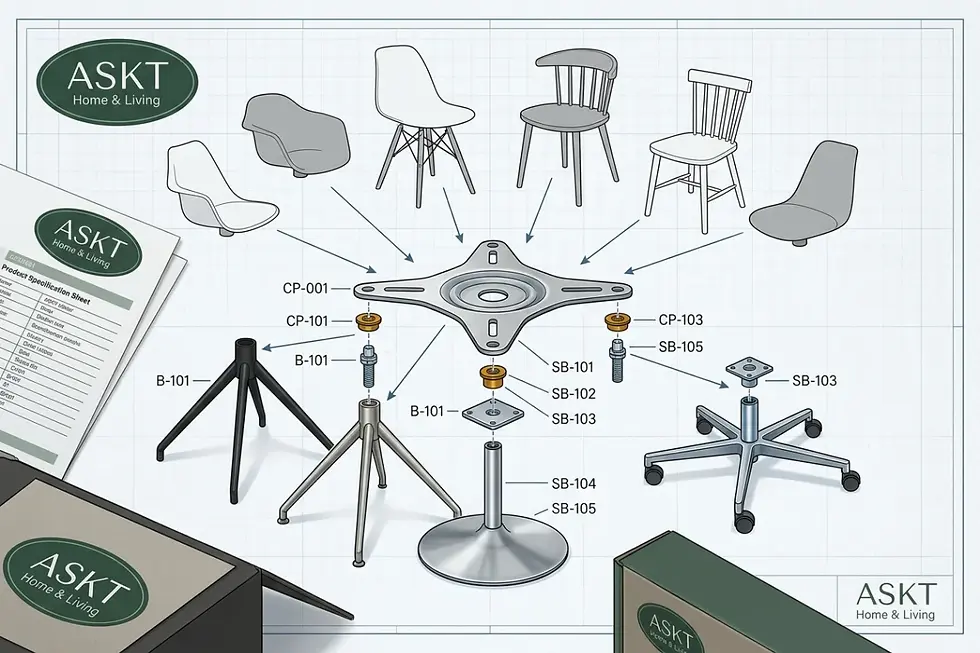
Modular chair architecture relies on a standardized mounting interface, allowing multiple seat silhouettes to pair with diverse base frames.
How Does Component Standardization Enable Furniture SKU Optimization and Reduce Inventory Risk?
Adopting a modular dining chair system alters the mathematical relationship between inventory investment and catalogue breadth. In traditional purchasing, calculating total cost and predicting SKU velocity requires tracking dozens of isolated product codes, each carrying its own lead time, safety stock requirement, and packaging footprint.
Under a modular framework, furniture SKU optimization is achieved through component-level multiplication. When a buyer stocks a compact selection of seat shells and base frames, the total number of sellable SKUs multiplies exponentially without requiring a linear increase in physical inventory. Reducing furniture inventory risk occurs because capital is stored in versatile, reconfigurable sub-assemblies rather than fixed, single-purpose finished products.
Operational Parameter | Traditional Sourcing Model | Modular Component System |
|---|---|---|
:--- | :--- | :--- |
Procurement Unit | Fully assembled or dedicated single-model KD chair | Standardized interchangeable shells & base frames |
SKU Multiplier Ratio | 1 purchased SKU = 1 catalogue option | 3 shell models × 4 fabric colours × 3 base types = 36 finished SKUs |
MOQ Constraint | 300–500 units per specific finished colourway/leg | Factory batch MOQs aggregated across shared components |
Container Space (CBM) | Lower density due to non-nesting welded structures | High-density nesting with knock-down (KD) packaging |
Inventory Risk | High; obsolete colourways become unsellable dead stock | Minimal; universal parts can be reallocated to bestsellers |
Safety Stock Requirement | High buffer stock needed across every finished SKU | Low buffer stock held in universal bases and core shells |
Cost Calculation | Fragmented pricing per distinct factory model | Transparent modular pricing per shell and base sub-assembly |
Standardization also simplifies financial cost calculations. Sourcing directors can establish baseline cost matrices for seat shells and base components, allowing product managers to quote commercial pricing instantly for bespoke client requests without waiting for extended factory re-engineering cycles.
How Do Modular Systems Streamline Container Loading, Packaging, and Warehouse Logistics?
Logistics and distribution represent a major portion of total landed costs for European furniture importers. Traditional fully-welded or semi-assembled chairs consume excessive volume in sea freight containers, leading to high shipping costs per unit. Furthermore, irregular box dimensions complicate palletization and racking inside European warehouses.
Modular furniture development directly addresses logistics efficiency through engineered knock-down (KD) packaging and nesting sub-assemblies. By separating the seat shell from the base frame, manufacturers can pack seating bodies compactly while nesting metal frames efficiently within flat-pack master cartons.
Optimized Container Loading: Disassembled KD modular chairs allow significantly higher unit density per 40HQ container compared to traditional welded frames, reducing oceanic freight costs per seat.
Standardized Carton Dimensions: Standardized packaging formats improve pallet stacking efficiency, maximize vertical warehouse racking utilization, and streamline handling for European 3PL logistics providers.
Sustainable Packaging Materials: Modern modular systems replace bulky expanded polystyrene (EPS) foam with recyclable honeycomb paperboard, edge protectors, and reduced plastic wrapping, aligning with European packaging waste directives.
Damage Prevention in Transit: Flat packaging immobilizes components inside reinforced cartons, eliminating transit abrasion, bent leg brackets, and crushed upholstery corners during long ocean voyages.
Parcel Shipping Compliance: Compact KD carton dimensions satisfy standard parcel delivery constraints for e-commerce platforms, enabling direct-to-consumer dispatch without incurring oversize freight surcharges.
These logistical advantages ensure that furniture wholesalers, retail chains, and e-commerce brands lower their overall landed cost per unit while simultaneously enhancing warehouse space utilization across their European distribution networks.
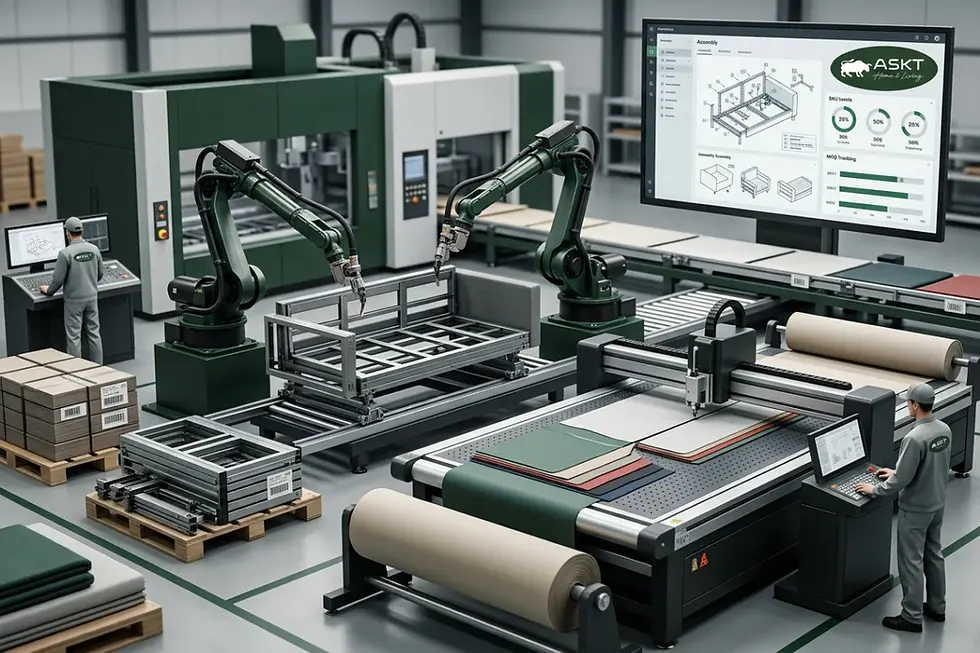
Automated robotic welding and CNC machinery ensure precise dimensional tolerances for seamless modular interchangeability.
How Can Sourcing Teams Balance Customization with Production Consistency in Modular Sourcing?
While modularity offers immense logistical and inventory benefits, professional B2B buyers must ensure that standardization does not result in generic or visually repetitive collections. Sourcing teams must balance modular efficiency with brand differentiation, unique fabric stories, and strict quality control standards.
Maintaining structural consistency across custom product lines requires working with experienced OEM and ODM manufacturing partners capable of combining flexible surface customization with strict engineering discipline. Sourcing teams should focus on several operational areas to maintain high quality and distinctive market positioning:
Precision Tooling and Automated Manufacturing: Metal base production requires robotic welding cells and precision stamping dies to ensure that mounting hole coordinates remain identical across multi-thousand unit production runs.
Strict Dimensional Tolerances: Even a minor 1-2 mm deviation in mounting hole placement can cause structural misalignment during late-stage assembly; automated CNC metal cutting and computerized drill jigs prevent these assembly defects.
Fabric and Upholstery Consistency: High-precision automated fabric cutting machines ensure consistent pattern alignment, foam tension, and seam straightness across diverse textile grades, including easy-clean and pet-friendly fabrics.
Comprehensive Surface Finishing Quality: Metal frames should undergo rigorous multi-stage pre-treatment and electrostatic powder coating to ensure scratch resistance, corrosion protection, and uniform colour matching across separate production batches.
Transparent Quality Control Protocols: Factory-floor quality inspections must verify component interchangeability at every stage, conducting random batch fitting tests where shells from one production line are mounted onto bases from another.
By establishing strict quality control checkpoints and leveraging precision manufacturing automation, purchasing managers can offer exclusive, private-label designs to their retail markets while retaining all the operational benefits of an underlying modular framework.
How Does the 'Test First, Ship Second' Methodology Mitigate Procurement Risks for Retail and Contract Buyers?
Launching entirely new furniture collections in competitive European retail and contract markets carries financial uncertainty. Committing to large-scale production runs for untested designs exposes purchasing groups to severe dead-stock liabilities. To mitigate this exposure, progressive furniture buyers utilize a phased development methodology: "Test first, ship second."
Under this structured approach, buyers leverage modular component architecture to pilot new design concepts in small volumes before committing to mass container orders:
Phase 1: Digital Sourcing Alignment and Specification Definition: Sourcing teams, product managers, and factory engineers define exact ergonomic dimensions, target price points, fabric performance criteria, and packaging requirements before physical prototyping begins.
Phase 2: Rapid Modular Prototyping: Because base frame tooling and mounting interfaces are already validated, prototype development focuses exclusively on refining the new seat shell silhouette, foam density, and upholstery tailoring.
Phase 3: Pilot Batch Assortment Testing: Importers order a limited pilot run of new shell silhouettes, pairing them with standard base frames already in stock. These trial units are deployed across retail showrooms, online channels, or contract mock-up rooms to collect real-world commercial feedback.
Phase 4: Data-Driven Volume Production: Once customer demand and conversion velocity are verified, buyers place full-volume container orders with confidence, securing customized private-label exclusivity and optimized component batch pricing.
This systematic validation workflow protects furniture importers, retail chains, and purchasing groups from large-scale procurement miscalculations, enabling them to introduce dynamic design updates rapidly while maintaining lean, low-risk supply chains.
If you are evaluating dining chair or dining table suppliers for the European market, ASKT can support you with product development, customization, quality testing, and stable export experience. Erfahren Sie mehr über die modularen Möglichkeiten von KINEXA.
FAQ
How does modular furniture development reduce European furniture inventory risk?
Modular furniture development separates finished products into standardized sub-assemblies (such as universal seat shells and base frames). Instead of holding finished inventory for every possible style combination, buyers hold core components that can be assembled on demand, drastically reducing capital lock-in, warehouse cubic meter consumption, and the risk of dead inventory.
What is the typical MOQ advantage when sourcing modular dining chair systems?
Traditional chair manufacturing requires meeting high factory MOQs (often 300 to 500 units) per individual color and frame design. A modular dining chair system aggregates production volume across shared components, allowing buyers to meet factory container minimums using unified parts while offering a broad catalogue of distinct finished SKUs.
How does component standardization ensure structural stability across different configurations?
A modular system utilizes a precision-engineered universal mounting interface with calibrated screw inserts and high-tolerance welding. This standardized connection maintains uniform structural integrity and complies with European testing standards such as EN 12520, regardless of which shell and base combination is assembled.
Can modular dining chair systems be customized with sustainable fabrics and KD packaging?
Yes. Modular dining chair systems support tailored OEM/ODM requirements, including easy-clean, water-repellent, and sustainable upholstery fabrics, as well as eco-friendly knock-down (KD) packaging with honeycomb paperboard to optimize container loading and lower carbon footprints.


Comments