


Dining Furniture EN BS Testing Standards Buyer Checklist

If you source dining chairs or dining tables for the European market, you have probably asked yourself whether a supplier’s “compliant” claim actually means anything for your customers, your marketplace listings or your liability. EN and BS testing standards are not just paperwork—they are the difference between a product that can be sold confidently in Germany, the Netherlands, the UK, Poland or Ireland, and a product that creates returns, warranty headaches and reputational damage. Over more than two decades of manufacturing dining furniture for European B2B buyers, I have seen too many sourcing decisions go wrong because someone accepted a vague “meets European standards” answer instead of asking exactly which standard, which version, and which test method was used.
This dining furniture EN BS testing standards buyer checklist is written for product managers, purchasing managers, quality assurance teams and compliance officers who need a practical reference, not a textbook. It explains why EN vs BS furniture testing differences matter, what changes between home-use and contract furniture, which documents actually prove anything, and the questions you should ask every supplier before placing an order.
Why EN and BS testing standards matter for European dining furniture buyers
In the furniture business, “safe and durable” means nothing until it is measured. Standards create a common language between buyers, factories, retailers and end users, so that a chair sold in Berlin is evaluated using the same principles as a chair sold in Birmingham. For European B2B buyers, ignoring this language is one of the fastest ways to increase sourcing risk.
Testing standards reduce product safety risk. Dining chairs and tables bear weight, move across floors, are leaned back on and are used by people of very different sizes. Structured tests check whether a frame can handle repeated loading, whether a chair tips over too easily, and whether moving parts work safely over time. A product that has not been tested against a recognised standard is essentially a guess.
Standards also support market compliance. Different channels and customers expect different proof. Retail chains, marketplace platforms and project buyers in the hospitality sector usually require specific test reports before they will accept a product into their range. Without the right documentation, you can lose listings, delay launches or face costly remediation.
Commercially, standards protect your brand. Returns, warranty claims and complaints eat into margin quickly. When you specify clear test requirements upfront, you give the factory a measurable target, and you give yourself a way to audit performance later. This is especially important for buyers who work with private label or OEM ranges, where your brand sits directly on the product.
Finally, standards make supplier comparison fairer. If one supplier quotes low but offers no test evidence, and another quotes slightly higher but can show verified test results, you cannot properly compare them on price alone. A checklist turns vague quality promises into comparable requirements.
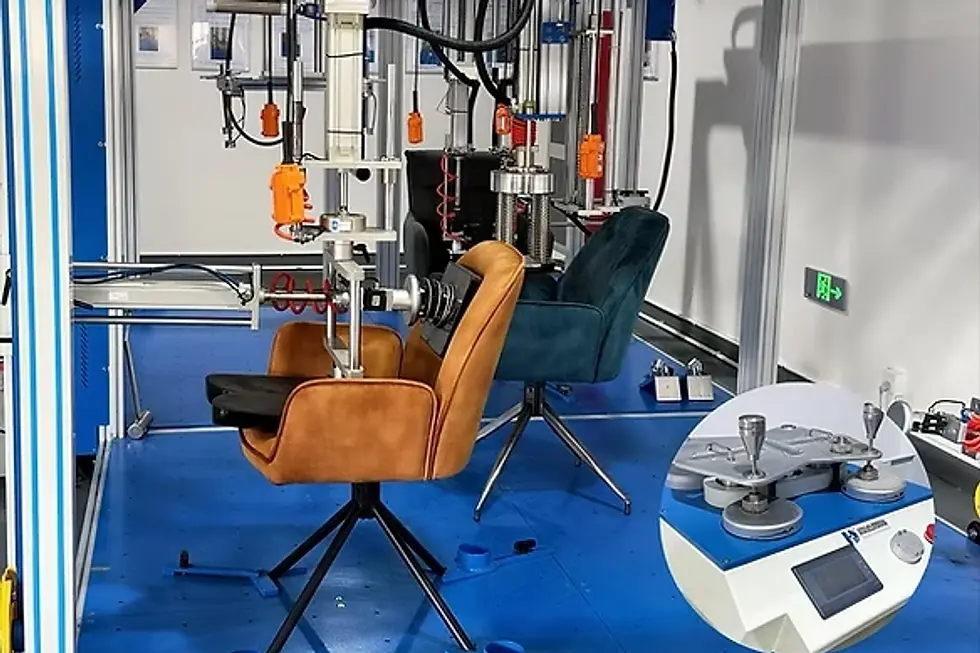
Side-by-side durability testing of two dining chairs in a professional furniture testing room
Key EN standards relevant to dining chairs and dining tables
When European buyers talk about furniture compliance, they are usually referring to EN standards developed at a European level. For dining furniture, the most relevant standards cover structural safety, stability and durability for domestic and non-domestic use. Your dining table EN standard verification process should always start by confirming exactly which standard the supplier is referencing, because different standards apply to different categories and use cases.
For chairs, the core standards address strength, durability and stability. They define test loads, number of cycles and performance levels so that buyers can match a product to its intended environment. A chair built for occasional home dining should not be expected to survive the daily use of a busy restaurant, and the standards reflect that difference through different test severity levels.
For tables, the relevant EN standards look at similar themes: static load, stability, durability of the structure and, depending on the product, surface resistance properties. Buyers often focus only on the tabletop material—sintered stone, oak veneer, glass or laminate—and forget that the frame, leg connection and extension mechanism also need structural verification. A beautiful top does not compensate for a wobbly base or a weak joint.
One of the most common mistakes I see is a supplier saying their product “meets EN standards” without specifying which part of the family of standards applies. Always ask for the full standard number, the year of the version used, and the test level claimed. This is the baseline of any furniture compliance checklist for European buyers.
BS standards for dining furniture: what buyers need to verify
BS standards are British standards, and in the dining furniture sector they are still widely referenced by UK buyers, retail brands and contract customers. The confusion often starts here: some BS standards are identical or closely aligned to European standards, while others retain UK-specific requirements or test methods. That is why EN vs BS furniture testing differences matter and why you cannot assume a product tested to one automatically satisfies the other.
For dining chairs and tables, BS standards typically focus on similar performance areas—strength, stability and durability—but the exact loads, test setups and pass/fail criteria can differ. If your market includes the UK, or if your customer base specifically requests BS compliance, you must treat it as a separate requirement to verify, not as an automatic by-product of EN testing.
A practical point for sourcing teams: many factories that regularly export to the UK will already have experience with BS-aligned testing, but others will only be familiar with EN standards. Do not leave this question until production has started. Confirm the required standards in the sample and development phase, because changing frame construction or joint design later is expensive and causes delays.
Another common issue is outdated certificate references. Standards are revised over time, and a report based on an older version may no longer be acceptable to your customer or your own compliance team. Always check the issue date of the test report, the standard version referenced, and whether the product configuration in the report matches the product you are actually buying.

Close-up view of a pocket spring dining chair cushion internal structure for quality assessment reference
Domestic vs commercial dining chair test requirements
One of the most important distinctions in any dining furniture test programme is whether the product is intended for domestic use or contract use. Domestic vs commercial dining chair test requirements are not just a detail—they change the level of loading, the number of test cycles and the overall durability expectation. If you source the wrong grade of chair for a hotel, restaurant or café project, you can expect failures, complaints and replacement costs.
Domestic dining furniture is designed for use in private homes, where the frequency of use is lower and the user behaviour is generally more predictable. Test levels for domestic use reflect that context: they are appropriate for regular family meals and occasional gatherings, but not for continuous daily operation in a public space.
Commercial or contract dining furniture is built for higher intensity use. Restaurants, cafés, hotels, offices and public spaces all place more stress on chairs and tables because they are used more often, by more people, and sometimes with less care. As a result, the relevant test levels usually require higher static loads, more durability cycles and stricter stability performance.
For buyers, the key is to be honest about the intended use of the product. If you sell to both retail and hospitality channels, you may need two different versions of a similar chair, or at least a clear specification of which model is rated for which environment. It is rarely cost-effective to try to make one product fit every market, because you either over-engineer a domestic product and raise the price, or under-engineer a contract product and raise the risk.
This distinction also applies to tables. A dining table used in a busy restaurant needs a stronger frame and more durable surface than a table used only a few times a week at home. Your dining table EN standard verification should therefore always include a clear statement of the intended use category and the corresponding test level.
How to interpret test reports and certificate documentation
A supplier can tell you anything in an email. The real question is whether they can show you evidence, and whether that evidence actually supports their claim. Learning to read test reports properly is one of the most useful skills a furniture buyer can develop, because it separates compliant factories from factories that just know the right words.
First, check what product was actually tested. The report should include a clear product description, photographs, dimensions, materials and frame construction. If the report shows a wooden chair and you are buying a metal-frame chair, the report is not relevant. If the tested chair has four legs and yours has a central base, the results do not transfer. Testing is product-specific, and small changes in design can change performance significantly.
Second, check which standard and which test level were applied. A report that says “tested for strength” without naming the standard or the level is not useful. You need the full standard reference, the test method used, and the stated category or class of performance. This is where EN vs BS furniture testing differences become visible: the standard number tells you which framework was used, and the level tells you how severe the test was.
Third, check the test results, not just the overall pass statement. A good report will list individual tests—seat static load, backrest durability, stability tests, leg strength and so on—with the applied load, number of cycles, and result. This matters because a product can pass overall but still show weaknesses in a specific area that are relevant to your market. For example, if you sell to families with young children, you may want to pay extra attention to stability test results.
Fourth, check who performed the test and whether the laboratory is independent. Internal factory reports can be useful for process control, but for customer-facing compliance claims, independent third-party testing carries more weight and is usually expected by retailers and project clients.
Finally, check the date. Furniture test reports do not last forever, especially if the product design, materials or supplier has changed. If a report is several years old and the factory has switched frame suppliers, fabric partners or production lines, you should ask whether a retest or a technical review is needed.
Practical buyer checklist for evaluating supplier test compliance
This checklist is designed to be used early in the sourcing conversation, before samples are approved and before purchase orders are signed. Use it as a quick filter to see whether a supplier really understands dining furniture EN BS testing standards buyer checklist requirements, or whether they are just repeating marketing language.
Product identification
Confirm the exact product model, frame type, upholstery configuration and dimensions
Confirm the intended market and distribution channel
Confirm whether the product is for domestic use or commercial / contract use
Confirm whether the customer requires EN, BS or both sets of standards
Standard and test level verification
Ask for the full standard number and version year the product is claimed to meet
Ask which specific test level or category applies within that standard
For chairs, verify seat, backrest, armrest and stability requirements match the use case
For tables, verify structural load, stability and tabletop performance requirements
For mixed ranges, confirm that every SKU has its own verification, not just one representative model
Test evidence and documentation
Request a sample test report before ordering
Check that the tested product matches the product you intend to buy
Check the laboratory name and whether testing was independent
Check the issue date of the report and any expiry or retest policy
Factory and production consistency
Ask how the factory maintains consistency between the tested sample and mass production
Ask about incoming material checks for frames, foam, fabric and hardware
Ask whether production line checks include any structural or stability verification
Ask how design changes are managed and whether they trigger a retest
Commercial and supply risk
Clarify who owns the test report and whether you can use it for your own customers
Confirm whether additional testing is available if your customer requires it
Clarify responsibility if a product fails a market surveillance check or a customer test
Ask whether the supplier can support you with documentation for marketplace listings or retail audits

Dining chair cushion internal component sample for compliance and quality evaluation
Common sourcing risks when testing standards are not clearly specified
If you leave testing standards to the supplier’s discretion, you are effectively gambling with your product range. Over the years, I have seen the same patterns repeat themselves across European markets, and most of them start with a vague specification.
The first risk is mismatched use case. A supplier may test a chair to a domestic level and present it as “EN certified,” leaving you to discover after delivery that it is not suitable for the hospitality project you planned to supply. Fixing this after production usually means reinforcing the frame, changing the base or accepting a higher return rate.
The second risk is certificate confusion. Some buyers assume that one certificate covers an entire collection, but furniture testing is usually model-specific. A test on one chair does not automatically apply to a similar chair with a different leg, a different backrest angle or a different upholstery thickness. This is a particularly common issue when buyers build a full dining range from the same supplier.
The third risk is outdated or misaligned standards. As standards evolve, older reports may no longer meet the expectations of retail customers, marketplace platforms or market surveillance authorities. What was acceptable five years ago may not be acceptable today, especially in more regulated channels.
The fourth risk is hidden cost. If you do not specify testing upfront, the factory may quote a low price based on a basic product, and then charge extra for structural upgrades later when you ask for proper test evidence. It is much cheaper to get the specification right in the sample phase than to rework a whole order.
The final risk is reputational. In a small industry like European furniture, word travels fast. A single product failure with a major retail customer or a contract client can close doors for years. Clear standards and proper testing are among the simplest ways to protect that relationship.
FAQ: EN and BS dining furniture testing standards
Is an EN test report the same as a BS test report for dining furniture?
No, the two frameworks can differ in test methods, load levels or pass criteria depending on the specific standard. That is why EN vs BS furniture testing differences are worth verifying early. Always confirm which standard your customer requires and ask the supplier for the corresponding documentation.
Do domestic and commercial dining chairs need different testing?
Yes. Domestic vs commercial dining chair test requirements differ in load, cycle count and overall durability expectations. A chair rated for home use is not automatically suitable for restaurants, hotels or other contract environments.
Can one test report cover an entire collection of dining chairs?
Generally, no. Test reports are typically specific to a model, configuration and material set. Small design changes can affect structural performance. You should always check whether the tested product matches the exact product you intend to buy.
What should a dining table EN standard verification include?
It should include the full standard reference, the intended use category, structural load and stability results, and any relevant surface performance tests depending on the tabletop material. The frame, joints and extension mechanism, if applicable, should also be covered.
How often should dining furniture test reports be renewed?
This depends on whether the product design, materials or production process has changed. If the product remains unchanged and the standard has not been updated, an existing report may still be valid for reference. If there are significant design or material changes, a new test is usually needed.
Conclusion
Testing standards are not a box-ticking exercise. They are the foundation of a reliable dining furniture range, especially when you sell into multiple European markets with different customer expectations. A strong dining furniture EN BS testing standards buyer checklist helps you ask better questions, compare suppliers on a like-for-like basis, and reduce the risk of expensive compliance or quality problems later.
The most important principle is simple: be specific. Name the standard, name the version, name the test level, and name the intended use. The more precise you are in the sourcing phase, the fewer surprises you will face in production, delivery and after-sales.
If you are currently building or updating a dining furniture range and you want a manufacturing partner that understands EN and BS testing requirements for European markets, ASKT can support you with product development, customization, quality control and export documentation. Share your target market and intended application with us, and we can review the relevant test evidence for your project. Request a compliance review for your dining furniture range.
FAQ
Is an EN test report the same as a BS test report for dining furniture?
No, the two frameworks can differ in test methods, load levels or pass criteria depending on the specific standard. Always confirm which standard your customer requires and ask the supplier for the corresponding documentation.
Do domestic and commercial dining chairs need different testing?
Yes. Domestic vs commercial dining chair test requirements differ in load, cycle count and overall durability expectations. A chair rated for home use is not automatically suitable for restaurants, hotels or other contract environments.
Can one test report cover an entire collection of dining chairs?
Generally, no. Test reports are typically specific to a model, configuration and material set. Small design changes can affect structural performance, so you should always check whether the tested product matches the exact product you intend to buy.
What should a dining table EN standard verification include?
It should include the full standard reference, the intended use category, structural load and stability results, and any relevant surface performance tests depending on the tabletop material. The frame, joints and extension mechanism, if applicable, should also be covered.
How often should dining furniture test reports be renewed?
This depends on whether the product design, materials or production process has changed. If the product remains unchanged and the standard has not been updated, an existing report may still be valid for reference. If there are significant design or material changes, a new test is usually needed.


Comments