


How To Choose the Right Dining Chair Legs: The Ultimate 2026 Guide
- Sunbin Qi

- Dec 29, 2025
- 8 min read

If you’re a furniture buyer, product manager, or category lead, you already know this: nobody emails you to say, “Wow, those chair legs are amazing.”
But people do complain when:
chairs wobble,
legs crack in transit, or
the finish looks cheap next to a €1,000 dining table.
That’s why, when I talk to buyers across Germany, the Netherlands and the UK, we always end up spending more time on legs and frames than on the pretty upholstery. The legs decide your return rate, reviews, and margin far more than most people realise.
In this guide, I’ll walk you through how to choose the right dining chair legs for 2026 — specifically from a B2B perspective: e-commerce, retail chains, importers and hospitality projects.
Why Dining Chair Legs Matter For Your Bottom Line

From a business point of view, chair legs are not just “design details”. They influence:
Durability and claimsWeak joints or thin tubing mean wobble, bending, and warranty claims. The frame and legs carry almost all the structural load.
Customer comfort and reviewsCantilever frames that bounce slightly feel very different from rigid straight legs. Poor stability or bad proportions quickly show up in 1-star reviews.
Logistics and assemblySome leg designs nest or stack well on pallets. Others explode your CBM and shipping costs. Screw-on legs might be great for e-commerce but risky if customers over-tighten or cross-thread.
Compliance and riskIn Europe, updated standards like EN 12520:2024 define minimum safety, strength and durability for domestic seating. Frames and legs are at the heart of these tests.
Sustainability and future regulationsAs plastic and packaging taxes spread across Europe, buyers are under pressure to reduce non-recycled plastic in both product and packaging.
Get the legs right, and everything else — returns, reviews, and repeat orders — becomes much easier.
Step 1: Choose the Right Leg Material For Your Market
When you build an assortment, the first macro decision is material. Here’s a quick comparison you can use in line reviews or internal presentations:
Material Comparison for Dining Chair Legs (B2B View)
Leg material | Typical price level | Main pros | Main cons | Best for |
Solid wood (beech, oak, ash) | Mid–high | Warm look, easy to repair, great for Scandi & classic styles | Can dent/scratch, needs quality control on moisture and joints | Mid–high-end retail, residential, boutique restaurants |
Metal (steel tube, sled, cantilever) | Low–mid–high (wide range) | Very durable, slim profiles, good for high traffic | Can feel “cold”, finish chips if low quality, shows welding flaws | Hospitality, contract, e-commerce with low returns |
Hybrid (wood + metal frame) | Mid–high | Combines warmth and strength, follows 2025–26 design trends | Slightly more complex production, needs precise engineering | Design-led retail, “Instagrammable” dining ranges |
Plastic / reinforced polymer | Low–mid | Lightweight, stackable options, colorful | Risk of “cheap” perception, UV issues outdoors if not specified | Price-driven collections, outdoor or kids’ ranges |
Let’s quickly go deeper into the main players.
Wood Legs
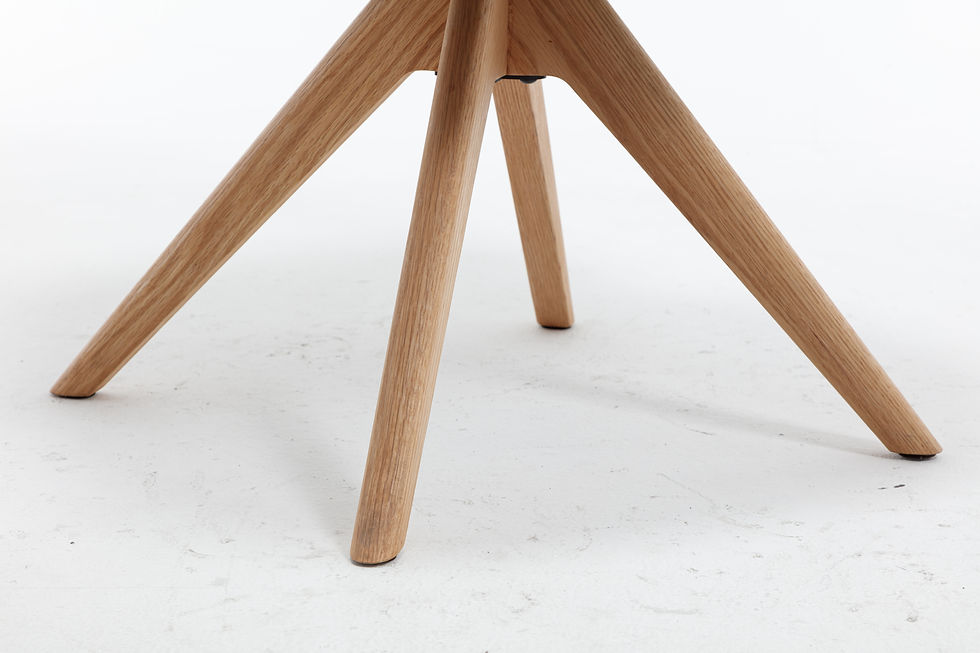
I see wood legs working best when:
your brand sells warm, family-focused interiors,
you target mid to premium price points, and
your customer base still prefers “real wood” stories.
Key checks for buyers:
Ask for solid hardwood (beech, oak, ash) rather than softwood for legs.
Check moisture content and joint construction (mortise-tenon, dowels, corner blocks).
Request EN 12520 test reports showing leg and frame strength, not just fabric claims.
Metal Legs

Metal legs are your friend when you care about:
high traffic (restaurants, cafés, event spaces),
slim, contemporary silhouettes,
low claim rates from heavy users.
Look at:
Tube thickness and gauge – thinner isn’t always cheaper once you factor in returns.
Welding quality – no visible gaps, consistent beads.
Powder-coating quality – important for scratch resistance in stacked or nested storage.
Hybrid and Modular Systems
Hybrid legs – for example, a metal frame with wooden outer legs – are tracking strong in 2025–26 trends because they look warm but perform like metal.
On top of that, more buyers are asking us for modular seat + base systems. For example, at ASKT we developed KINEXA™, a quick-connect chair–base system where:
you choose from a small set of shell models,
combine them with several leg/base options,
and still keep a consistent price structure and shared connectors.
For you as a buyer, this means:
easier to hit MOQ with variety,
fewer SKU risks (one shell, multiple bases),
more upsell stories for retail and online.
When you’re building 2026 assortments, modular leg systems are worth putting on the sourcing agenda.
Step 2: Pick a Leg Structure That Matches Real-Life Use
Material is only half the story. The structure of the legs is what your customer actually feels when they sit down.
Here’s a simple summary you can use when you brief your team or supplier:
Leg structure | Look & feel | Stability & comfort | Business use case |
Classic 4-leg | Familiar, works in any style | Very stable if joints are good | Safe choice for mass retail & online |
Sled base | Modern, slightly “architectural” | Great load distribution, less floor damage | Hospitality, heavy users, soft floors |
Cantilever | Contemporary, slight “bounce” | Very comfortable for long sitting but must be well engineered | Design-driven retail, dining sets with a “wow” factor |
Spider / star base | Statement look, often swivel | Stable if base diameter is right | Trend pieces, chairs sold as “hero” items |
Pedestal / central base | Minimal footprint | Can be less stable if poorly weighted | Use with care; demand lab test reports |
High-Traffic Hospitality vs Home Use
When I work with restaurant and hotel buyers, we almost always end up with sled or strong 4-leg metal frames. They:
spread the load,
survive being dragged over tiles and concrete,
and stack or nest more easily for cleaning.
For residential retail and online, 4-leg wood or hybrid frames still dominate because they feel familiar and “warm”.
E-Commerce and Flat-Pack
If you sell online, think about what happens in the customer’s living room:
Bolt-on legs are great for packaging size,
but you need clear instructions and robust inserts,
otherwise you pay later in “wobbly chair” reviews.
One thing we do in our own factories is simulate customer assembly and then run static and impact tests after repeated disassembly/reassembly. That’s saved some of our buyers from nasty surprises.
Step 3: Balance Style, Comfort and Table Compatibility
Even the strongest leg is the wrong choice if it visually fights with the dining table.
Matching vs Mixing Chair and Table Legs
Designers often talk about “sisters, not twins” – table and chair legs should relate to each other, not copy each other exactly.
For your assortment planning:
Formal / classic ranges
Matching wood tones and leg profiles work well.
Great for traditional retail and older demographics.
Modern curated ranges
Mixed materials (e.g. black metal chair legs + oak table legs) create more interest.
Works for younger buyers who want something “collected, not coordinated”.
The trap is going too far: if table and chair legs are completely unrelated in colour, thickness and style, the set looks chaotic and hard to sell online.
Comfort Rules: Height, Clearance and Posture
No matter how nice the legs look, your customer cares about comfort. Most good guides now converge on similar metrics:
Seat height: around 45–48 cm for tables of 74–76 cm
Knee clearance: at least 10–12 cm between seat top and table underside
Leg angle: too far splayed and people trip; too straight and the chair can feel “stiff”
When you select leg designs, ask your supplier for 2D drawings with real measurements, not just pretty 3D renders. It’s amazing how many comfort issues show up right there.
Step 4: Think 2026 – Sustainability, Compliance and Story
Legs and frames are also where your compliance and sustainability story lives.
Safety and Testing
For EU/UK retail, the updated EN 12520:2024 standard is now the key reference for domestic seating. It defines:
minimum requirements for safety, strength and durability,
side-to-side and impact durability tests,
and checks for issues like finger entrapment.
If your supplier can’t show recent EN 12520 test reports, that’s a red flag. At ASKT, for example, we invested in a full in-house test lab with equipment for static load, impact, and durability tests on seats, backs, arms and legs so buyers don’t have to guess whether a frame will pass.
Packaging and Plastic Taxes
The EU Green Deal and national plastic taxes are slowly but surely making plastic-heavy packaging more expensive. Even if furniture isn’t the main target, you will feel it in your landed cost if you still use lots of plastic bags, foam, and tape.
That’s why we switched many chair legs and frames to zero-plastic packaging, using honeycomb paper and paper tape instead of plastic film and plastic tape. It’s helped our buyers:
cut packaging-related costs by over 15% on average,
avoid customs issues linked to plastic waste,
and promote a greener image in EU marketing materials.
For you, the important point is: ask about packaging when you choose leg designs. Heavy metal frames need different protection than delicate wood legs, and there are now paper-based options that still pass drop tests.
How We Support Buyers Choosing Chair Legs
A quick personal note: I spend a lot of my time walking through factories, test labs and showrooms with European buyers. The questions are always similar:
“Will this leg survive our courier network?”
“Can we mix these bases to reach MOQ faster?”
“How do we tell a better quality story without just saying ‘good quality’?”
At ASKT, we’ve tried to build answers into how we work:
European-focused expertiseOur management team has 15+ years in the European market and we export mainly to Germany, the Netherlands, Poland, Slovenia, North Macedonia, the UK and Ireland.
Serious quality & human standardsOur factories use automated cutting, punching and welding equipment for frames, while also complying with BSCI for worker rights and safety. Workers handling frames and glues get proper PPE and formaldehyde-free materials.
Recognised in the German marketIn 2025, our CEO, Sunbin Qi, was featured on the cover of möbelmarkt, discussing our strategy: stronger metal, better fabrics, and staying close to buyer needs.
I mention this not just to talk about us, but to highlight what you should look for in any supplier: real testing, clear standards, and people who understand your market, not just FOB pricing.
FAQ

What chair leg material is best for European online retailers?
If your main channel is e-commerce, I’d usually prioritise:
Metal sled or 4-leg frames with good powder-coating – low claim rate, more tolerant of parcel handling.
Or hybrid frames (metal structure, wood facing) when you need a warmer look but still want strength.
Pair that with flat-pack, screw-on legs and clear assembly videos, and you reduce both shipping cost and returns.
How many leg styles should I keep in one collection?
For most mid-market brands, I suggest:
1–2 core leg styles that work across many shells (e.g. one wood, one metal),
plus 1 “hero” leg (cantilever or spider) for marketing.
If you’re using a modular system like KINEXA™ (one shell, multiple bases), you can safely offer more leg styles without exploding your inventory risk, because the shell and connectors stay the same.
How can I reduce transport damage on chair legs?
A few simple checks make a huge difference:
Specify corner and joint protection for wood legs (cardboard or honeycomb wraps).
Avoid bare metal-to-metal contact; request interleaving paper between stacked legs.
Ask for drop tests on the final packaging, not just individual parts.
Consider plastic-free but robust honeycomb and paper-based solutions to stay ahead of plastic taxes.
We’ve seen logistics damage drop sharply when buyers and factories co-design packaging around the leg type instead of using a one-size-fits-all carton.
What weight capacity should I ask my supplier to test to?
Most European standards for domestic seating (EN 12520) are based on use by adults up to 110 kg, plus additional safety factors in the test methods.
In practice, many buyers ask for:
documented EN 12520 testing,
plus internal tests with higher static loads on the legs and joints, especially for contract/hospitality use.
Ask your supplier for full test reports, not just a screenshot of a certificate.
Do dining chair legs need special certification in the EU or UK?
There isn’t a separate “leg certification”, but:
the entire chair is expected to meet EN 12520 (domestic seating) for safety, strength and durability, and
retailers and importers are increasingly asking for third-party test reports to prove it.
If you’re selling to Germany, France, the Netherlands or the UK, I’d treat EN 12520:2024 compliance as a default requirement for new chair programmes starting in 2025–26.


Comments