


Sustainable Dining Chair Sourcing Guide: Certifications, Materials, and Compliance for European Buyers
- Media ASKT

- 17 hours ago
- 11 min read
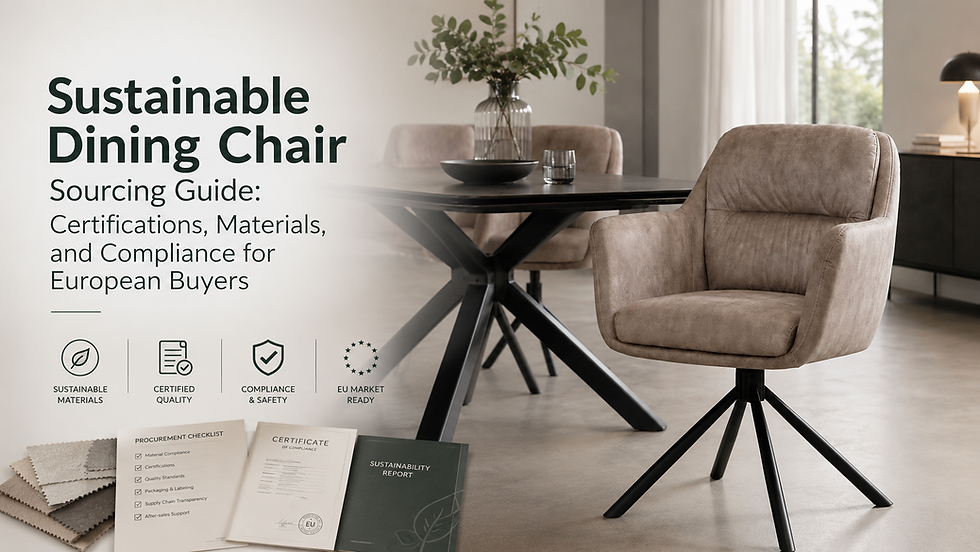
Sustainable dining chair sourcing is no longer only about choosing attractive designs or lower factory prices. For European furniture importers, wholesalers, hotel buyers, restaurant furniture buyers, and project procurement teams, sustainability now means verifiable materials, safer chemicals, reliable testing, responsible packaging, and clear supplier documentation.
A dining chair may be small compared with a sofa or dining table, but it carries several procurement risks at once. It must be strong enough for daily use, safe enough for commercial spaces, comfortable enough for repeated seating, and compliant enough for European distribution. If the chair includes upholstery, buyers also need to consider fabric safety, color fastness, abrasion resistance, and chemical restrictions. If the chair uses wood, buyers need to understand material origin, batch consistency, and packaging impact.
The best sourcing decision is not simply to choose the supplier with the most certificates. The better approach is to check whether the supplier’s certifications, materials, quality control process, and packaging system match the buyer’s market, sales channel, and project risk level. For European buyers, standards such as REACH, BS EN testing, OEKO-TEX Standard 100, BSCI, EUDR-related documentation, and reduced-plastic packaging are often more relevant than certification systems designed mainly for other markets.
What Sustainable Dining Chair Sourcing Means for B2B Buyers

Sustainable dining chair sourcing means selecting chairs that meet commercial quality expectations while reducing environmental, safety, and compliance risks. It includes product-level issues such as material safety and durability, as well as supplier-level issues such as social compliance, documentation readiness, packaging design, and repeat-order consistency.
For B2B buyers, sustainability must be practical. A chair that looks sustainable in photos but fails during daily restaurant use is not a sustainable product. A recycled fabric without proper testing may create more after-sales risk than value. A supplier that claims environmental responsibility but cannot provide documentation may put importers in a weak position when customers, customs authorities, or retail partners ask for proof.
European buyers should treat sustainability as a sourcing system, not a single label. A responsible dining chair program should answer four questions clearly:
Can the chair pass relevant safety and stability expectations?Are the materials safe for indoor use and customer contact?Can the supplier provide credible compliance documentation?Is the packaging suitable for European distribution and environmental expectations?
When these questions are answered before bulk production, buyers reduce the risk of delayed shipments, rejected goods, inconsistent batches, and unsupported sustainability claims.
Key Certifications and Standards European Dining Chair Buyers Should Know

Certifications and standards help buyers verify claims that would otherwise be difficult to check from photos or samples alone. In dining chair sourcing, the most useful documents usually relate to product safety, chemical compliance, fabric safety, factory responsibility, and packaging sustainability.
REACH Compliance
REACH is one of the most important compliance references for furniture products entering the European market. It focuses on the control of chemicals and substances that may affect human health or the environment.
For dining chairs, REACH matters because chairs may contain coatings, adhesives, foam, fabrics, artificial leather, plastic glides, metal finishes, and packaging materials. Even if the main frame is wood or metal, the complete chair may still include several material groups that require chemical control.
European buyers should ask suppliers whether the relevant materials meet REACH requirements and whether supporting documents can be provided. This is especially important for retailers, e-commerce sellers, hotel groups, and restaurant chains that may need to answer compliance questions from their own customers.
BS EN and European Safety Standards
BS EN standards are important for evaluating dining chair safety, stability, and durability in a European context. For dining chairs, buyers often pay attention to standards related to domestic seating, non-domestic seating, structural safety, and stability.
A dining chair should not only look stable in a showroom. It should perform safely when people sit down, shift weight, move the chair, lean back slightly, or use it repeatedly over time. This is why stability and strength testing are important for B2B procurement.
For importers and project buyers, BS EN testing is a practical trust signal. It helps confirm that the chair has been considered against recognized European expectations, rather than only internal factory judgment.
OEKO-TEX Standard 100
OEKO-TEX Standard 100 is especially relevant when dining chairs include upholstered seats, backrests, or fabric-covered shells. It helps show that textile materials have been tested for harmful substances.
For dining chairs used in homes, restaurants, cafés, hotels, and public dining spaces, fabric safety is not only a technical detail. Guests and end users touch the upholstery directly. In some cases, families with children or pets may use the chair every day. For B2B buyers, OEKO-TEX can support product credibility and reduce concerns about textile safety.
When comparing suppliers, buyers should check whether the certification applies to the actual fabric used on the ordered chair, not only to a fabric collection shown in a catalogue.
BSCI for Supplier Social Compliance
BSCI is not a product performance certificate. It is a social compliance framework that relates to working conditions and responsible supply chain behavior.
For European buyers, BSCI can be important because retailers, brands, and project customers increasingly care about how products are made, not only what they cost. A supplier with BSCI-related compliance can be more suitable for buyers who need responsible sourcing documentation for internal audits or customer requirements.
BSCI should be viewed as supplier-level support. It does not replace product testing, but it strengthens the overall sourcing profile.
EUDR-Related Documentation
For wood-based furniture, European buyers are paying closer attention to timber origin and deforestation-related requirements. Dining chair buyers should ask suppliers how they manage wood material traceability and whether relevant documentation can be supported when required.
EUDR-related preparation is especially important for importers handling wood furniture at scale. Even when a chair is not marketed as a premium eco-product, buyers may still need clearer information about wood sourcing, material classification, and documentation flow.
Materials Matter: What to Check Before Choosing a Sustainable Dining Chair
The material choice determines much of a dining chair’s sustainability, durability, price level, and market positioning. A sustainable material should be safe, suitable for the intended use, stable in production, and realistic for repeat orders.
Solid Wood and Wood-Based Components
Solid wood is valued for its natural appearance, strength, and long service life. However, sustainability depends on responsible sourcing, moisture control, processing quality, and material efficiency.
European buyers should check wood species, moisture content, visible defects, finishing method, and batch color consistency. Natural variation is acceptable, but excessive inconsistency can cause problems when chairs are displayed or installed together.
For B2B orders, the key question is not only whether the wood looks good. The key question is whether the supplier can produce the same quality repeatedly across containers and future orders.
Metal Frames and Hardware
Many dining chairs use metal legs, swivel bases, support plates, screws, brackets, or inner reinforcement parts. Metal can improve strength and stability, but poor welding, weak coating, or inconsistent hardware can create safety and appearance issues.
Buyers should inspect welding points, coating adhesion, rust resistance, screw quality, and assembly accuracy. For commercial dining spaces, metal components must withstand frequent movement and cleaning.
A supplier with automated or standardized metal processing can often provide more consistent results than a supplier relying only on manual adjustment.
Upholstery Fabrics and Foam
Upholstery is one of the most important comfort and complaint-related areas in dining chair sourcing. Fabric affects appearance, touch, cleanability, durability, and perceived value.
Buyers should check abrasion resistance, color fastness, pilling resistance, stain resistance, breathability, and fabric safety documentation. Foam density and recovery should also be reviewed, because a chair that feels comfortable at first may lose shape quickly if the foam is weak.
ASKT, for example, focuses strongly on dining chair fabrics and tests materials for abrasion resistance, color fastness, and breathability. This type of material control is useful for European buyers who need chairs for retail, hospitality, restaurant, and repeat-use environments.
Recycled and Lower-Impact Materials
Recycled materials can support sustainability claims, but they must be handled carefully. Recycled plastic, recycled fabric, reclaimed wood, or recycled packaging materials may vary in color, texture, stability, and availability.
For B2B buyers, the main issue is not whether recycled content sounds attractive. The main issue is whether the recycled material can be verified, produced consistently, and accepted by the target market.
Buyers should ask suppliers for clear material descriptions, sample consistency, testing information, and realistic lead times before promoting recycled content in sales channels.
Comparison Table: Certifications and Checks for Sustainable Dining Chair Sourcing
Area | What It Verifies | Why It Matters for European Buyers | Best Used For |
REACH compliance | Chemical safety and restricted substances | Supports EU market access and reduces material safety risks | Coatings, adhesives, foam, fabrics, plastics, finishes |
BS EN testing | Stability, strength, safety, and durability expectations | Helps confirm the chair is suitable for real use in European markets | Dining chairs for retail, hospitality, restaurants, and projects |
OEKO-TEX Standard 100 | Textile safety against harmful substances | Builds confidence in upholstered seating and fabric contact areas | Fabric seats, upholstered backs, soft dining chairs |
BSCI | Supplier social compliance and responsible production behavior | Supports responsible sourcing requirements from European retailers and brands | Supplier evaluation and long-term cooperation |
EUDR-related documentation | Wood sourcing and deforestation-related traceability preparation | Helps buyers prepare for stricter wood material scrutiny | Solid wood chairs and wood-based components |
Reduced-plastic packaging | Lower plastic use and improved packaging sustainability | Supports greener logistics and environmental expectations | Export cartons, inner protection, retail distribution |
Internal quality control | Process stability, batch consistency, defect prevention | Reduces after-sales claims and shipment risk | Bulk orders, repeat orders, project supply |
Compliance Is Not the Same as Sustainability
Compliance means meeting required rules or accepted standards. Sustainability is broader. A dining chair can be compliant but not especially sustainable. It can also look sustainable but lack the documentation required for serious B2B procurement.
For example, a chair with a natural wood look may appear environmentally friendly, but buyers still need to check wood origin, coating safety, packaging, and durability. A chair with recycled fabric may support a sustainability story, but if the fabric fades quickly or cannot pass basic performance tests, it may create returns and waste.
The strongest sourcing position is achieved when compliance, durability, and sustainability work together. A chair that lasts longer, ships safely, uses safer materials, and comes with clear documentation is more valuable than a chair with vague environmental claims.
Packaging Is Part of Sustainable Dining Chair Sourcing
Packaging is often overlooked, but it is a major part of furniture sustainability and shipment success. Dining chairs must survive factory handling, container loading, ocean freight, unloading, warehousing, and final delivery.
Poor packaging can turn a compliant chair into a damaged product. Excessive plastic packaging can weaken a sustainability message. Unclear labels can create warehouse confusion and delivery errors.
European buyers should check carton strength, internal protection, corner protection, moisture protection, stacking method, labeling accuracy, and material choice. Paper-based protection, honeycomb paper, and reduced-plastic solutions can support sustainability goals when they still protect the chair properly.
ASKT has developed reduced-plastic and zero-plastic packaging approaches using paper-based protection such as honeycomb paper and paper tape. For European buyers facing environmental expectations, this kind of packaging improvement can support both logistics quality and sustainability positioning.
Supplier Evaluation: What European Buyers Should Ask Before Bulk Orders

A good supplier should be able to explain its materials, testing, packaging, and documentation clearly. Buyers should not rely only on product photos, showroom samples, or broad claims such as “eco-friendly” or “high quality.”
Before placing a bulk order, European buyers should ask these questions:
Which certificates or compliance documents apply to this exact chair model?Which fabric, foam, coating, and adhesive are used in the confirmed version?Has the chair been tested according to relevant European safety or stability expectations?Can the supplier support repeat orders with the same material and finish?What packaging method is used for export shipments to Europe?Can the supplier provide inspection reports, product photos, and batch documentation before shipment?How does the supplier manage complaints, replacement parts, and future improvements?
The answers should be specific. A supplier that can provide structured information is usually easier to work with than a supplier that only gives general assurances.
Common Mistakes in Sustainable Dining Chair Sourcing
The first common mistake is treating sustainability as a marketing word instead of a procurement standard. Buyers should avoid claims that cannot be supported by documents or material details.
The second mistake is focusing only on certificates while ignoring real product performance. A certificate is useful, but a dining chair must still be stable, comfortable, durable, and consistent.
The third mistake is assuming one sample represents the entire order. Bulk production should be checked across multiple cartons and batches, especially for color, fabric, frame balance, and packaging.
The fourth mistake is overlooking destination-market needs. A chair suitable for one market may not meet the expectations of German retailers, Nordic project buyers, hotel groups, or restaurant chains.
The fifth mistake is ignoring packaging. Many after-sales issues are not caused by weak chairs, but by insufficient protection during transport.
How ASKT Fits European Sustainable Dining Chair Sourcing

ASKT’s advantages are most relevant when buyers need dining chair suppliers focused on European market expectations. The company’s strengths include dining chair specialization, European export experience, internal testing capability, fabric performance control, REACH-related compliance awareness, BS EN standards focus, OEKO-TEX textile support, BSCI-related factory responsibility, and reduced-plastic packaging.
This does not mean buyers should skip their own inspection process. It means ASKT can provide a stronger starting point for buyers who need product quality, compliance support, and practical sustainability features within a dining chair sourcing program.
For European importers, the most useful supplier is not always the one with the longest certificate list. It is the supplier that can connect certificates, materials, production control, packaging, and repeat-order reliability into one clear sourcing system.
FAQ
What certifications matter most when sourcing dining chairs for Europe?
For European dining chair sourcing, buyers commonly pay attention to REACH compliance, BS EN safety and stability testing, OEKO-TEX Standard 100 for upholstery fabrics, BSCI for supplier social compliance, and wood-related documentation where relevant. The exact priority depends on the product material, sales channel, and project requirements.
Is BIFMA necessary for dining chairs sold in Europe?
BIFMA is mainly associated with North American commercial and office furniture markets. For European dining chair buyers, BS EN standards, REACH compliance, and relevant textile or material documentation are usually more directly aligned with local expectations. If a North American client or large commercial project requests BIFMA, buyers should confirm the project type and testing requirements before deciding whether separate testing is needed.
Why is REACH important for dining chairs?
REACH matters because dining chairs may include coatings, adhesives, foam, fabrics, plastics, metal finishes, and other materials that can involve chemical restrictions. REACH-related compliance helps reduce material safety risks and supports European market access.
Why does OEKO-TEX matter for upholstered dining chairs?
OEKO-TEX Standard 100 is relevant because upholstered dining chairs have textile surfaces that users touch directly. It helps support confidence that the fabric has been tested for harmful substances, which is especially useful for retailers, hospitality buyers, and family-oriented product lines.
What should buyers check in sustainable dining chair materials?
Buyers should check wood origin, moisture stability, fabric durability, foam performance, metal coating quality, adhesive safety, finish consistency, and recycled material verification if recycled content is claimed. Material sustainability must be supported by performance and documentation.
Is zero-plastic packaging always better?
Zero-plastic or reduced-plastic packaging is better only when it still protects the product during international shipping. Buyers should evaluate both sustainability and protection. Good packaging should reduce environmental impact without increasing damage rates.
How can European buyers avoid greenwashing?
European buyers can avoid greenwashing by asking for certificates, test reports, material descriptions, packaging details, and supplier process information. Claims such as “eco-friendly,” “green,” or “sustainable” should be supported by clear evidence.
What is the best sourcing approach for B2B dining chair buyers?
The best approach is to evaluate the complete sourcing system: product safety, material compliance, durability, supplier responsibility, packaging, documentation, and repeat-order consistency. A sustainable dining chair should perform well commercially and meet relevant compliance expectations.
Conclusion

Sustainable dining chair sourcing for European buyers is a structured procurement process, not a simple design preference. The most important factors are material safety, product durability, chemical compliance, fabric verification, responsible production, packaging sustainability, and supplier documentation.
REACH, BS EN standards, OEKO-TEX Standard 100, BSCI, EUDR-related preparation, and reduced-plastic packaging all play different roles in building buyer confidence. No single certificate can prove that a dining chair is the right choice. Buyers need to connect certifications with real product performance, stable production, and market-specific requirements.
For importers, wholesalers, hotel buyers, restaurant furniture buyers, and project procurement teams, the safest strategy is to work with suppliers that can explain their standards clearly and support claims with documentation. ASKT’s focus on European dining chair requirements, fabric testing, internal quality control, and sustainable packaging makes it a relevant option for buyers who want practical compliance support without losing sight of design, comfort, and commercial usability.
A sustainable dining chair is ultimately one that can be trusted: safe to use, stable in production, responsible in materials, efficient to ship, and credible when buyers ask for proof.


Comments