


FOB Price vs Landed Cost: Which Number Should Furniture Buyers Compare?


Furniture buyers should always compare total landed cost rather than FOB price alone when evaluating international supply options. While an FOB quote covers only factory production and export port clearance, total landed cost incorporates international shipping, import customs duties, port handling, and domestic transport. Because furniture items are bulky, volumetric products, container loading efficiency and freight spend per unit often exert a far greater impact on final margins than factory-gate unit prices.
Why Is Landed Cost More Decisive Than FOB Price in Furniture Sourcing?
In B2B furniture procurement, evaluating supplier proposals strictly on Free on Board (FOB) terms frequently creates false assumptions about profitability. An FOB quotation represents the supplier's price to manufacture products and place them on board a cargo vessel at an agreed origin port. Once the cargo leaves the vessel at destination, all subsequent freight surcharges, import clearance requirements, terminal fees, and inland road haulage belong entirely to the importing company.
Commercial indoor furniture categories—such as dining chairs, dining tables, lounge seating, bar stools, and dining benches—consume significant cubic space relative to their weight. Consequently, ocean freight rates and domestic transport charges form a substantial percentage of the overall cost of goods sold. A dining chair quoted at a lower FOB unit price may initially seem more economical than a higher-priced alternative from another manufacturer. However, if the lower-priced chair relies on bulky master cartons that accommodate fewer units per container, the freight cost allocated to every individual chair rises substantially.
Professional buyers for European wholesale companies, retail store chains, e-commerce platforms, and commercial project agencies assess profitability based on landed cost per item. Reviewing FOB price vs landed cost provides full transparency over shipping costs, terminal charges, and import tariffs, preventing unexpected cost increases after production.
What Key Components Form a Complete Furniture Landed Cost Calculation?
An accurate furniture landed cost calculation requires tracking each cost stage from the factory production line to your regional central warehouse. Omitting logistical or administrative stages distorts product pricing and margin forecasts.
Unit FOB Factory Price: The base product cost agreed with the manufacturer, including standard export packaging, origin transport to port, terminal handling charges at origin, and export customs clearance documentation.
Ocean Shipping and Freight Surcharges: The total freight cost for standard sea containers (such as 20ft, 40ft, or 40ft High Cube units) divided evenly across the total pieces loaded inside.
Marine Cargo Insurance: Transit insurance coverage protecting against ocean transit loss, container moisture exposure, or physical damage.
Customs Duties and Import Tariffs: Applicable duties calculated on the customs valuation basis (commonly the CIF value: Cost, Insurance, and Freight), which varies depending on furniture construction materials such as metal-frame upholstered dining chairs, sintered stone tables, or wooden veneer furniture.
Destination Port Handling and Terminal Fees: Unloading fees, terminal handling charges, customs broker administration fees, and storage or inspection surcharges.
Inland Haulage and Delivery: Road transport from the arrival container terminal to your central logistics facility or distribution hub.
Inbound Warehouse Handling: Unloading labour, pallet placement, quality intake verification, and warehouse racking storage.
Cost Component | Primary Cost Influencer | Impact on B2B Furniture Quote Comparison |
|---|---|---|
:--- | :--- | :--- |
FOB Unit Price | Material specifications, manufacturing techniques, finishes | Sets the baseline product expenditure level |
Ocean Freight per Unit | Packaging carton volume (CBM), KD frame structure | Determined by container loading optimization furniture |
Import Tariffs | Material classification, country of origin regulations | Scales directly with product and freight value base |
Destination Handling | Flat port terminal fees and container drayage | Decreases on a per-unit basis as container unit count rises |
Domestic Storage | Master carton dimensions, stacking rigidity, outer protection | Affects warehouse rack density and internal handling speed |
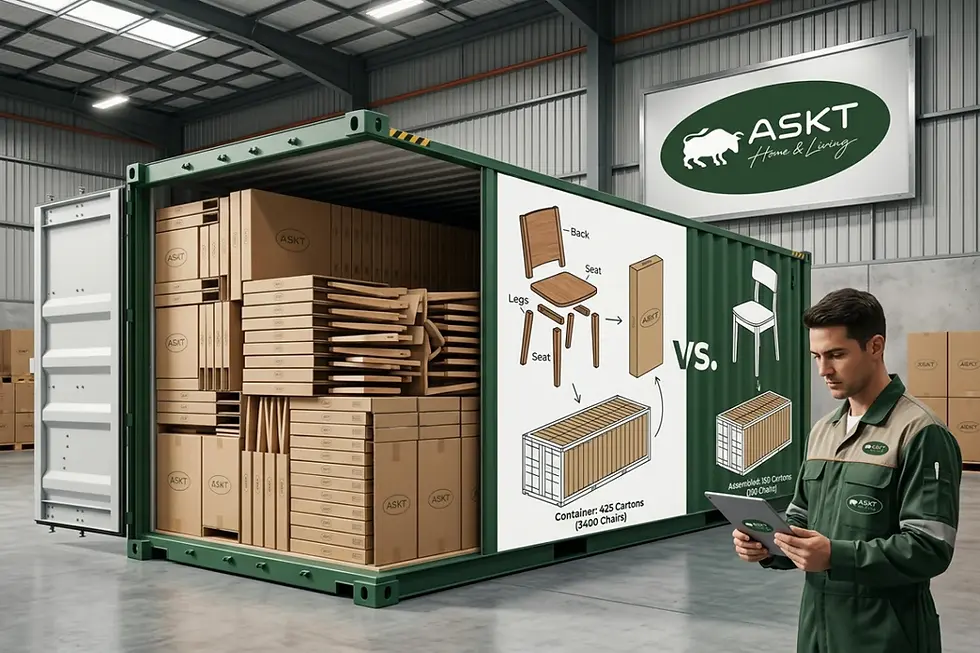
Container loading optimization directly reduces furniture freight cost per unit on international shipments.
How Does Container Loading Optimization Directly Reduce Furniture Freight Cost per Unit?
International shipping companies charge full container load (FCL) bookings on a flat rate per container rather than per kilogram. Because indoor furniture rarely exceeds total container payload weight limits before running out of physical room, furniture freight cost per unit is governed almost entirely by packaging volume and spatial engineering.
To understand container loading optimization furniture dynamics, consider how packaging volume directly alters shipping costs:
Furniture Freight Cost per Unit = Total Ocean Container Cost / Total Loaded Quantity per Container
When furniture manufacturers optimize packaging through knockdown (KD) frames, detachable table bases, nested seat shells, or space-saving flat cartons, the total number of units inside a single container increases. This structural efficiency spreads the fixed container shipping fee across more sellable items, lowering the freight cost for each piece.
For example, if an importer books a 40ft High Cube container on an Asia-to-Europe trade lane:
Assembled Dining Chair Model: Shipped in larger boxes holding 2 pre-assembled chairs per carton, allowing only 440 chairs to fit inside a single container.
KD Metal-Frame Dining Chair Model: Engineered with a knockdown frame design packing 4 chairs per compact box, allowing 880 chairs to fit inside the same container volume.
By doubling the loading quantity through efficient KD engineering, the second option cuts the freight cost per unit by half. Even if the factory FOB quotation for the KD model is slightly higher due to precision fittings or reinforced connecting hardware, its final landed cost in Europe is significantly lower.
Why Can a Cheaper FOB Dining Chair Yield a Higher Total Landed Cost?
To see how structural packaging affects procurement economics, consider two alternative dining chair proposals evaluated by an importer supplying retail chains across Germany, the Netherlands, and the UK.
Suppose the purchasing team intends to import a batch of upholstered dining chairs. The team receives two competing quotations from different suppliers for an equivalent commercial aesthetic.
Comparing Two Manufacturing Approaches
Factory Proposal A (Lower FOB / Bulky Assembled Packaging):
FOB Unit Quotation: Lower unit price
Structural Design: Pre-welded metal legs and fixed shell
Packaging Efficiency: Bulky carton dimensions with low pieces per cubic metre
Container Loading Capacity: Low unit count per 40ft High Cube container
Required Shipping Footprint: Multiple containers needed for the complete volume
Freight and Port Allocation: High freight cost per unit due to low container packing density
Tariffs and Port Fees: High duty and port handling allocated per unit
Final Landed Outcome: High delivered unit cost with eroded commercial gross margins
Factory Proposal B (Higher FOB / Engineered KD Flat-Pack Packaging):
FOB Unit Quotation: Moderate unit price reflecting KD joint engineering and hardware
Structural Design: Precision KD metal frame with nested upholstered shells
Packaging Efficiency: Compact master cartons with minimal unused interior space
Container Loading Capacity: Double the unit yield per 40ft High Cube container
Required Shipping Footprint: Half the total containers required for the same order volume
Freight and Port Allocation: Low freight cost per unit achieved via dense loading
Tariffs and Port Fees: Efficient duty valuation and shared port fees across more units
Final Landed Outcome: Lower delivered unit cost with protected commercial gross margins
This comparison demonstrates why professional procurement teams look beyond unit purchase prices. Sourcing furniture with superior container yield lowers total logistics spend, reduces administrative handling, and provides more stable landed cost margins.
What Design and Manufacturing Factors Influence a B2B Furniture Quote Comparison?
Conducting an objective B2B furniture quote comparison requires evaluating how a factory's engineering and packaging methods influence transport efficiency. Several structural features dictate how much space furniture occupies during sea freight.
1. Frame Architecture and Assembly Engineering
Fully Welded vs Knockdown (KD) Structures: Fully welded dining chair or table frames create empty, non-condensable space inside shipping boxes. Precision KD metal frames allow table legs and chair bases to lie flat, increasing container loading capacity.
Interlocking Frame Components: Thoughtfully engineered metal sub-frames fit together neatly inside shipping boxes without scraping powder-coated surfaces.
Detachable Extension Mechanisms: For extension dining tables, designing separable guide rails and removable leaf compartments allows long tabletops and heavy frames to ship in flat modular cartons rather than bulky assembled crates.
2. Upholstered Shell and Cushion Design
Stackable or Nestable Shell Forms: Designing dining chair seat shells with consistent taper angles allows shells to nest together during packaging, reducing carton dimensions.
Compact Seating Construction: Combining pocket springs and multi-layer upholstery foam delivers long-term seating comfort without requiring oversized, irregular foam profiles that expand box dimensions.
3. Packaging Engineering and Material Selection
Slim Profile Cushioning: Using rigid honeycomb cardboard inserts and fitted edge guards provides structural impact resistance while keeping carton wall profiles slim.
Modular Box Dimensioning: Sizing export master cartons as exact modular fractions of standard shipping container interior dimensions eliminates unused gaps, preventing cargo movement during transit.
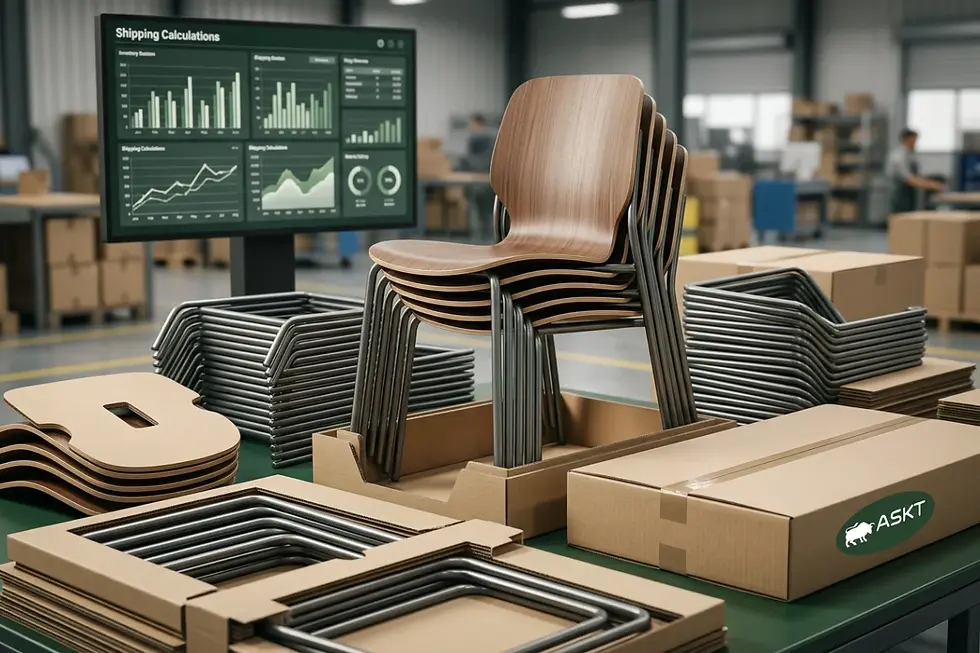
Precision KD joints and slimline protective packaging maximize container capacity while safeguarding product finishes.
How Can Sourcing Teams Calculate Total Landed Cost Step by Step?
Procurement managers can establish a structured calculation procedure to evaluate international furniture proposals accurately before placing purchase orders.
Step 1: Confirm Incoterm Scope and Baseline Unit Costs
Verify that the factory price is quoted on clear FOB terms. Confirm that the price includes export-grade master packaging, origin handling charges, export documentation, and container loading at the designated origin port.
Step 2: Determine Cubic Volume and Container Capacity
Calculate the total volume of each master carton based on external measurements (Length x Width x Height in metres):
Carton Volume (CBM) = Length x Width x Height
Divide the carton volume by the number of chairs or tables packed inside to establish the volume per product unit:
Unit Volume (CBM) = Carton Volume / Pieces per Carton
Calculate the total container yield by dividing available container volume by the unit volume, taking into account practical loading factors for full container loads.
Step 3: Allocate Ocean Shipping Fees per Unit
Divide the full ocean container shipping rate by the total number of units loaded in that container:
Unit Freight Cost = Total Container Shipping Rate / Total Units per Container
Step 4: Calculate Customs Valuation and Import Duties
Calculate the CIF customs value by combining the FOB unit price, unit ocean shipping cost, and transit insurance cost. Multiply this figure by the applicable import tariff rate according to your target market's classification rules:
Customs Value (CIF) = FOB Unit Price + Unit Freight Cost + Unit Insurance Unit Import Duty = Customs Value x Import Tariff Rate
Step 5: Distribute Port Handling and Inland Delivery Surcharges
Sum all terminal handling charges, customs broker fees, container drayage, and warehouse intake expenses per container. Divide these costs across the total units in the container:
Unit Destination Handling = Total Destination Logistics Fees / Total Units per Container
Step 6: Aggregate All Tiers for the Final Landed Cost
Add all individual cost components together to determine the true delivered cost per unit:
Total Landed Cost = FOB Price + Unit Freight + Unit Insurance + Unit Duty + Unit Destination Handling
How Do Modular Product Lines and KD Construction Protect Commercial Margins?
Freight rate volatility and shifting consumer demand present ongoing inventory challenges for European furniture buyers. Selecting modular product concepts and KD construction helps stabilize unit shipping costs and streamline warehouse operations.
Modular dining chair systems—such as pairing interchangeable upholstered seat shells with various standardized metal bases (fixed four-leg, cantilever, swivel, or auto-return designs)—offer significant procurement advantages:
Higher Mixed-Container Efficiency: Standardized box shapes allow importers to combine different chair models, fabrics, and base styles into single container orders without creating dead space from mismatched packaging.
Flexible Inventory Management: Sourcing teams can order separate bases and seat shells to create diverse product variations while keeping warehouse storage compact and orderly.
Lower Risk of In-Transit Damage: Flat-packed KD furniture with fitted corner protection reduces movement inside master cartons, minimizing scuffs on metal powder coating, scratches on oak veneer, and chips on sintered stone edges.
Reduced Warehouse Storage Overhead: Compact master cartons take up less vertical and horizontal rack space in distribution centres, lowering domestic storage costs per product line.
Procurement Focus | Standard Assembled Furniture | Engineered KD Furniture Architecture |
|---|---|---|
:--- | :--- | :--- |
Shipping Efficiency | Low container yield; high freight per unit | High container density; low freight per unit |
Box Regularity | Irregular, bulky dimensions | Standardized, rectangular flat-pack cartons |
Margin Protection | Vulnerable to ocean shipping rate spikes | Resilient against logistics rate changes |
Warehouse Storage | Consumes high cubic space on pallet racks | Maximizes warehouse pallet and shelving capacity |
Mixed-Order Capability | Difficult to consolidate mixed designs | Simplifies consolidation of mixed shells and bases |
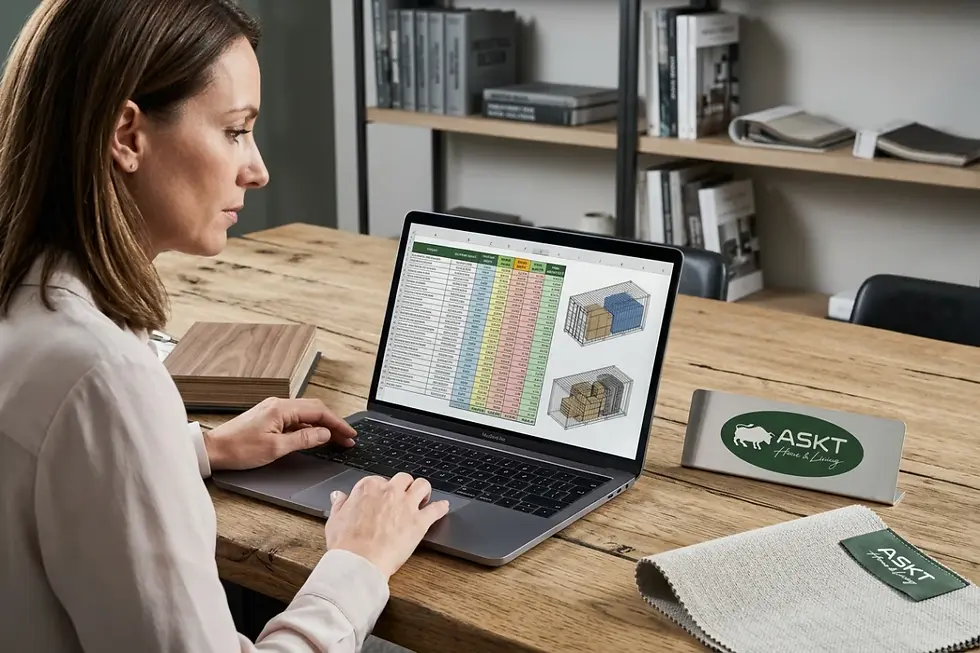
Thorough landed cost modeling protects wholesale and retail profit margins against freight market fluctuations.
What Sourcing Checklist Should Buyers Use When Comparing Factory Quotations?
Before issuing commercial purchase orders or approving production samples, sourcing managers should verify these essential logistics and manufacturing criteria.
Packaging Volume Validation: Has the manufacturer provided verified carton dimensions and cubic volume rather than rough estimates?
Container Loading Layout: Has the supplier shared a clear loading plan showing how cartons fit into a container without wasting space?
KD Hardware and Assembly Quality: Are metal connecting points, internal threaded bushings, and assembly bolts engineered for straightforward assembly and structural stability?
Protective Packaging Design: Does the inner packaging include edge protectors and protective wrapping to safeguard fabrics, powder-coated metal, and table surfaces?
Accurate Material Breakdown: Has the factory supplied exact material compositions (metal, fabric, foam, wood veneer, or sintered stone) to ensure accurate customs tariff classification?
Incoterm Transparency: Are all origin port charges, export documentation, and container loading fees included in the stated FOB terms?
Strategic Summary for Furniture Procurement Teams
Long-term commercial success in international furniture procurement depends on total landed cost efficiency, not initial FOB quotations alone. Importers who partner with engineering-focused manufacturers benefit from space-saving knockdown designs, optimized container loading, and predictable supply chain expenses.
When evaluating competitive manufacturing proposals for European retail, wholesale, or commercial projects, look beyond the unit price on the quotation sheet. Share your target order quantities and packaging requirements with our team to review FOB pricing, container loading density, and overall logistics efficiency together.
FAQ
What is the primary difference between FOB price and landed cost in furniture buying?
An FOB (Free on Board) price covers only factory production, packaging, and export loading at the origin port. In contrast, total landed cost represents the complete delivered expenditure per unit, incorporating international ocean freight, transit insurance, customs duties, destination terminal fees, and inland delivery to your warehouse.
Why is cubic volume (CBM) more critical than weight when calculating furniture freight costs?
Indoor dining furniture is bulky cargo that fills container volume long before reaching maximum gross payload weight limits. Ocean container shipping is billed on flat container rates, meaning master carton dimensions and cubic volume directly dictate how many units fit into a container and determine the freight cost allocated to each piece.
How does knockdown (KD) frame engineering reduce furniture landed cost?
KD frame engineering allows chair legs, table bases, and seating frames to be flat-packed into slim, modular cartons. This significantly reduces master carton CBM and increases the total quantity loaded per container, lowering international ocean shipping costs and domestic handling expenses per unit.
How do import tariffs affect total landed cost calculations?
In major importing markets like the European Union and the UK, customs authorities calculate import duties based on the CIF value (product cost plus freight and insurance). Reducing carton volume lowers unit freight costs, which in turn reduces the taxable CIF valuation base used to compute final customs duties.



Comments