


Furniture Packaging Optimization: Maximizing Container Loading Efficiency and Lowering KD Sourcing Costs

Furniture packaging optimization minimizes landed import costs by maximizing container loading density, protecting product integrity, and eliminating wasted transit volume. By converting fully assembled dining chairs and tables into engineered knock-down (KD) configurations and deploying sustainable packaging materials with reduced plastic use, European furniture importers, wholesalers, and retail chains significantly reduce sea freight costs per unit while ensuring reliable transit protection and regulatory compliance across target markets.
Why is furniture packaging optimization critical for reducing landed sourcing costs in Europe?
For European furniture wholesalers, retail chains, e-commerce brands, and contract furniture buyers in Germany, the Netherlands, the UK, Poland, Switzerland, and Ireland, logistics expenses represent a decisive factor in total landed product costs. In international furniture trade, container freight is primarily determined by volume rather than gross weight. Assembled dining chairs, bar chairs, and lounge chairs naturally enclose substantial pockets of empty air. When products are shipped without structural packaging optimization, importers effectively pay premium container freight rates to transport void space across ocean trade lanes.
Unoptimized packaging generates multiple compounding expenses across the European furniture supply chain:
Higher container freight per unit: Low loading density means fewer finished units fit into each shipping container, driving up the average shipping cost assigned to every individual dining chair or table.
Increased domestic transport and warehousing overhead: Bulky master cartons occupy excess pallet positions in European distribution centres and reduce the volume efficiency of regional road haulage.
Elevated transit damage and return expenses: Cartons that lack engineered internal fitments allow internal movement during transit, resulting in scuffed powder coating, torn upholstery, or dented table corners that trigger costly customer claims.
Rising compliance and waste handling fees: European markets place strong emphasis on sustainability and waste reduction. Packaging that relies on excessive single-use plastics or excessive carton dimensions incurs higher disposal fees and complicates retail distribution.

Knock-down dining chair packaging separates seat shells and metal leg frames to achieve maximum container loading density.
By addressing packaging dimensions, internal nesting, and carton construction during product development and OEM customization, B2B buyers directly protect their commercial margins before mass production begins.
How does knock-down (KD) structural engineering lower KD furniture shipping costs?
Knock-down structural engineering is the most direct technical method for increasing container loading density and lowering KD furniture shipping costs. By designing dining chairs, barstools, lounge chairs, and dining tables with detachable sub-assemblies, manufacturers substantially reduce the exterior carton cubic volume required for each finished piece.
In standard fully assembled dining chairs, the rigid L-shape formed by the seat, backrest, and legs prevents tight nesting, creating unavoidable dead space above the seat pan and beneath the leg frame. In contrast, well-planned knock-down dining chair packaging separates the structural leg frame or base assembly from the upholstered seat shell. This separation enables multiple packaging advantages:
Nested component arrangement: Upholstered seat shells can be packed closely together or positioned flat against compact frames, reducing total carton volume.
Standardized carton dimensions: Modular KD bases and removable frames allow the creation of uniform outer carton profiles that stack predictably on standard logistics pallets and inside ocean containers.
Flexible multi-pack configurations: KD engineering permits chairs to be packaged as single units (1 piece per carton) for direct-to-consumer e-commerce dispatch or as double packs (2 pieces per carton) and quad packs (4 pieces per carton) for retail and wholesale distribution.
Structural Format | Loading Characteristics | Container Capacity Impact | Practical Sourcing Considerations |
|---|---|---|---|
:--- | :--- | :--- | :--- |
Fully Assembled Chairs | Rigid frame; legs and backrest permanently fixed | Low container loading density; higher freight cost per piece | Suited only for high-end hospitality projects requiring zero on-site assembly |
Semi-KD Construction | Legs detached from pre-assembled seat and backrest | Moderate volume reduction; simplified customer assembly | Balanced solution for retail chains seeking compact cartons and fast assembly |
Full KD Modular Structure | Separate seat shell, backrest, and interchangeable base | Maximum container loading density; lowest ocean freight per piece | Optimal for wholesale and e-commerce requiring minimal carton dimensions |
Achieving the benefits of KD construction requires high manufacturing consistency. If metal frame mounting plates, bolt holes, or internal threaded inserts vary between production runs, end users will face assembly difficulties. Professional manufacturers resolve this through precision metal fabrication, stable powder coating, and rigorous quality control jigs that guarantee seamless alignment across all KD components.
How does container loading optimization furniture planning maximize container utilization?
Container loading optimization furniture strategies focus on calculating carton geometry to fit the exact internal dimensions of standard ocean freight containers. Rather than finalizing carton sizes as an afterthought, packaging dimensions must be reverse-engineered from container space to eliminate headspace and lateral gaps.
To achieve consistent container loading efficiency, professional sourcing teams and manufacturers evaluate four structural parameters:
Carton Modularization against Container Dimensions: Standard 20ft General Purpose, 40ft General Purpose, and 40ft High Cube containers possess strict internal height, width, and door clearance limits. Carton dimensions must divide evenly into these internal measurements to prevent vertical voids near the container ceiling or horizontal dead zones along container walls.
Interlocking Stacking Logic: Master cartons should be arranged using alternating or interlocking stacking patterns rather than straight vertical columns. Interlocking distributes downward compressive weight across carton walls and prevents stacks from tilting or shifting during vessel movement.
Strategic Mixed-Container Arrangement: When combining disparate furniture categories in a single shipment—such as heavy sintered stone or oak veneer dining tables alongside lightweight upholstered dining chairs—the heavier, flat-packed table components must form a rigid lower foundation, while compact KD chair cartons are stacked securely above.
Transit Stabilization and Dunnage: Empty pockets between carton rows must be supported with recyclable dunnage materials or corner buffers to prevent cargo shifting during maritime rolling and intermodal transit.
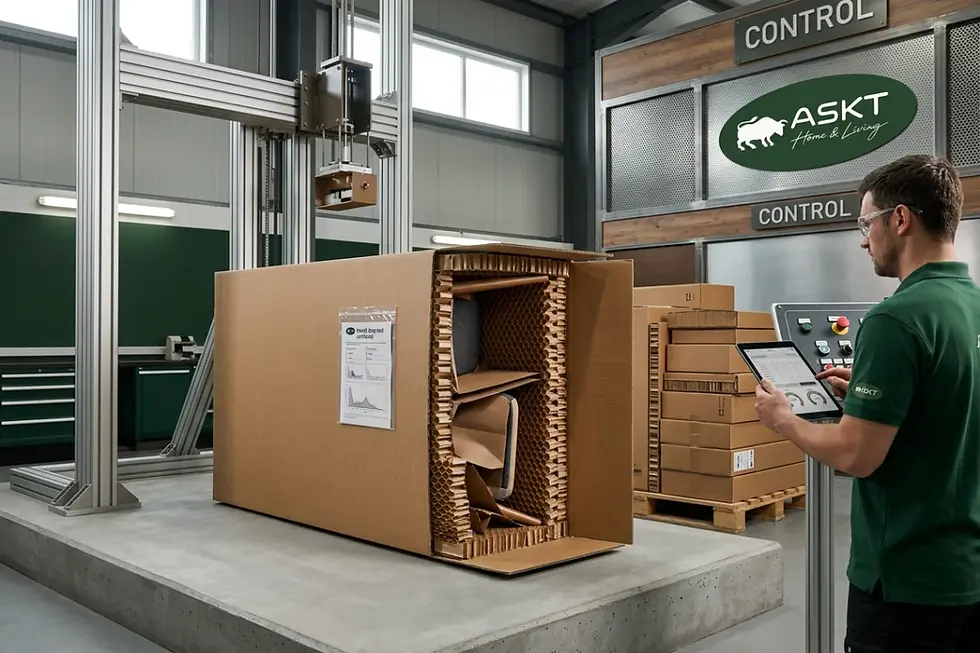
Drop-testing protocols and rigid honeycomb paper buffers protect furniture surfaces and structural joints during ocean transit.
Systematic container loading planning prevents cargo compression, simplifies unloading operations at European distribution hubs, and ensures that buyers receive the maximum possible volume utilization out of every booked container.
What structural and transit product testing protocols prevent furniture freight damage?
Increasing packaging density and reducing carton dimensions must never compromise product safety during transit. Furniture export shipments travel through multiple handling touchpoints, intermodal rail and truck transfers, and multi-week maritime voyages characterized by continuous vibration and temperature shifts. Rigorous quality control protocols and packaging testing ensure that furniture components reach European warehouses in pristine condition.
Professional B2B manufacturers employ a comprehensive quality assurance framework covering both product durability and packaging resilience:
Transit Drop Testing: Packaged cartons undergo multi-angle drop tests onto corners, edges, and flat surfaces to confirm that internal cushioning adequately dissipates impact energy without transferring shock to upholstered seats, metal frames, or extension mechanisms.
Compression and Stacking Resistance: Double-wall corrugated export cartons are tested to ensure they support the static downward weight of multiple stacked tiers inside a 40ft High Cube container without wall buckling or corner deformation.
Vibration and Friction Protection: Continuous maritime transit causes micro-vibrations that can abrade velvet, textured fabrics, leatherette, or powder-coated metal surfaces. Individual components must be segregated using soft, non-abrasive protective liners.
Hardware Containment and Segregation: Assembly bolts, washers, leveling glides, and hex keys must be sealed inside reinforced hardware boxes or dedicated blister packs and secured firmly within the master carton. Loose hardware packages represent a major sourcing risk, as loose metal fasteners can puncture upholstery, scratch wood veneers, or chip metal finishes.
EN Testing and Durability Standards: In parallel with packaging drop testing, the furniture structures themselves must undergo rigorous durability, strength, and structural performance evaluations aligned with European standards (such as EN testing frameworks for domestic and contract furniture), verifying that KD joints withstand continuous commercial use.
Combining physical transit simulations with structural quality control enables European purchasing managers to expand their KD furniture procurement with confidence.
How can buyers implement sustainable furniture packaging solutions with reduced plastic use?
European retailers, importers, and brand owners face strict sustainability expectations from corporate clients, retail consumers, and regulatory bodies across Germany, the Netherlands, the UK, and neighbouring markets. Traditional furniture packaging heavily reliant on expanded polystyrene foam (EPS), non-recyclable plastic wraps, and composite materials is increasingly restricted by packaging waste legislation and corporate environmental, social, and governance (ESG) goals.
Transitioning to sustainable furniture packaging solutions requires replacing single-use plastics with engineered, recyclable paper-based materials that deliver equal or superior transit cushioning:
Honeycomb Paperboard Buffers: High-density honeycomb paper panels provide exceptional structural compression resistance and energy absorption, serving as an effective replacement for EPS foam blocks along table perimeters and seat corners.
Corrugated Edge and Corner Protectors: Multi-ply, dense paperboard V-profiles and pre-formed corner caps protect exposed edges on oak veneer tabletops, sintered stone surfaces, and metal frame corners against impact and strapping pressure.
Recyclable and Breathable Surface Protection: To protect upholstered dining chairs, swivel chairs, and office desks from dust and moisture without excessive plastic film, manufacturers utilize recyclable, breathable paper wraps or reduced-plastic protective sleeves.
Material Harmony with Furniture Composition: Sustainable packaging aligns naturally with eco-conscious furniture manufacturing, including the use of durable upholstery fabrics, high-resilience foams, pocket spring seating inserts, and sustainably sourced wood veneers.
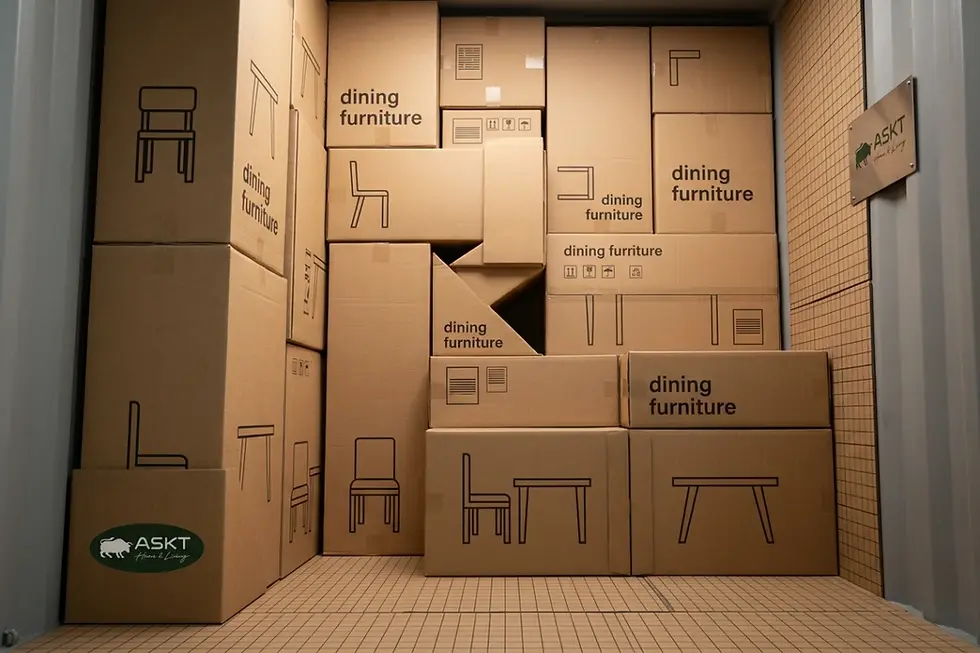
Standardized carton dimensions allow interlocking loading patterns that eliminate wasted headspace and prevent cargo shifting during voyage.
By specifying sustainable packaging with reduced plastic use, European furniture buyers lower their local waste disposal overhead, enhance brand reputation, and ensure full alignment with European retail sustainability standards.
How does manufacturing consistency support reliable knock-down dining chair packaging?
Packaging optimization is fundamentally linked to manufacturing consistency. If individual chair components, welded sub-assemblies, or upholstery cushions vary in size from batch to batch, standardized compact packaging becomes impossible to execute reliably.
To ensure that knock-down dining chair packaging functions perfectly across high-volume production runs, modern manufacturing operations utilize controlled processes across several critical stages:
Precision Metalworking and Powder Coating: Automated metal tube cutting, bending, and robotic welding ensure that chair legs, swivel mechanisms, auto-return assemblies, and metal frames maintain identical geometry. Consistent frame dimensions allow nested packing inside minimal carton envelopes and guarantee that powder-coated finishes remain unblemished.
Uniform Upholstery and Cushion Shaping: Consistent foam moulding, pocket spring core integration, and automated fabric cutting ensure that upholstered seat shells maintain uniform exterior dimensions, allowing them to nest compactly without crushing fabric textures or distorting backrest contours.
Accurate Component Jigs: Drilling and hardware placement are verified using master production jigs, ensuring that every bolt receiver, threaded insert, and mounting plate aligns precisely during final assembly by the European end customer.
Documented Quality Control and Sourcing Transparency: Standardized operating procedures across the packaging line ensure that every carton contains correct protective layers, complete hardware packs, clear assembly instructions, and accurate export labeling.
This high degree of manufacturing discipline eliminates dimensional deviations, minimizes sourcing risks, and guarantees that every container delivers predictable loading efficiency.
Sourcing Checklist: Evaluating a Furniture Manufacturer's Packaging and Logistics Competence
When evaluating a B2B dining furniture manufacturer or OEM/ODM supply chain partner, purchasing managers, product managers, and sourcing specialists should review the supplier's packaging engineering and container loading capabilities using the following structured checklist:
Structural KD Engineering: Does the manufacturer provide optimized knock-down designs for dining chairs, barstools, and tables that maximize loading volume without weakening structural joints?
Carton Specification: Are outer cartons constructed from heavy-duty, multi-ply corrugated kraft board designed to withstand high stacking loads in high cube containers?
Transit Drop Testing: Does the supplier perform standardized drop and transit impact testing on fully packed units prior to mass production approval?
Sustainable Cushioning Materials: Does the factory offer sustainable furniture packaging solutions, including honeycomb paperboard, paper corner guards, and reduced plastic wrapping?
Surface Protection Protocols: Are delicate surfaces—such as powder-coated metal, oak veneer, sintered stone, and textured upholstery fabrics—protected by non-abrasive inner liners?
Hardware Fastener Management: Is all assembly hardware securely boxed, sealed, labeled, and anchored inside the carton to eliminate transit puncture risks?
Container Loading Simulation: Can the supplier supply detailed 3D container stuffing calculations and carton stacking plans to maximize container capacity before shipping?
Custom OEM/ODM Packaging Support: Does the manufacturer offer flexible private-label packaging customization, including custom carton printing, barcodes, and multi-pack options (1-pack, 2-pack, 4-pack)?
For European wholesalers, retail chains, and contract buyers seeking to streamline logistics and reduce landed import costs, aligning product design with packaging optimization is essential. Discuss your packaging and transport requirements with ASKT to develop reliable, container-optimized furniture collections tailored to your target market.
FAQ
How does knock-down (KD) furniture engineering reduce ocean shipping costs?
Knock-down (KD) furniture engineering separates bulky components such as chair legs, bases, and seat shells into flat-packed or nested configurations. This significantly reduces the outer cubic metre (CBM) volume per unit, allowing more finished products to fit inside a standard shipping container and drastically lowering the ocean freight cost per piece.
What sustainable materials can replace plastic foam in dining furniture packaging?
High-density honeycomb paperboard, pre-formed corrugated corner protectors, molded paper pulp, and recyclable paper wrapping effectively replace traditional expanded polystyrene (EPS) foam. These paper-based solutions provide equal or superior compression strength and shock absorption while complying with European packaging waste directives.
How do manufacturers prevent transit damage in compact knock-down dining chair packaging?
Manufacturers prevent transit damage by using heavy-duty multi-ply corrugated master cartons, rigid honeycomb edge guards, and non-abrasive protective liners between metal frames and upholstery. Additionally, all assembly hardware is sealed in dedicated hardware boxes or blister packs and anchored securely inside the carton, backed by standardized transit drop-testing protocols.
Why is manufacturing consistency essential for container loading optimization?
Consistent manufacturing tolerances in metal frame welding, wood board punching, and upholstery shaping ensure that every finished component fits into its standardized master carton without forced packing or slack. This uniformity allows cartons to stack predictably inside shipping containers, eliminating dead space and preventing stack collapse during ocean transit.


Comments